12.11 Excelsior Class Space Control Ship
EXCELSIOR CLASS SPACE CONTROL SHIP SERVICE ENTRY DATE (OLD CALENDAR): 2288 It was called “the Great Experiment.” It was meant to be the hera
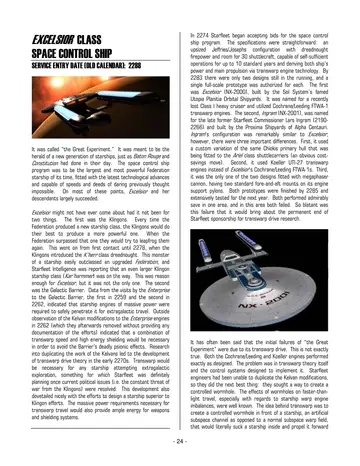
EXCELSIOR CLASS SPACE CONTROL SHIP SERVICE ENTRY DATE (OLD CALENDAR): 2288
It was called “the Great Experiment.” It was meant to be the herald of a new generation of starships, just as Baton Rouge and Constitution had done in their day. The space control ship program was to be the largest and most powerful Federation starship of its time, fitted with the latest technological advances and capable of speeds and deeds of daring previously thought impossible. On most of these points, Excelsior and her descendants largely succeeded.
Excelsior might not have ever come about had it not been for two things. The first was the Klingons. Every time the Federation produced a new starship class, the Klingons would do their best to produce a more powerful one. When the Federation surpassed that one they would try to leapfrog them again. This went on from first contact until 2278, when the Klingons introduced the K’herr class dreadnought. This monster of a starship easily outclassed an upgraded Federation, and Starfleet Intelligence was reporting that an even larger Klingon starship class (Kar’harmmer) was on the way. This was reason enough for Excelsior, but it was not the only one. The second was the Galactic Barrier. Data from the visits by the Enterprise to the Galactic Barrier, the first in 2259 and the second in 2262, indicated that starship engines of massive power were required to safely penetrate it for extragalactic travel. Outside observation of the Kelvan modifications to the Enterprise engines in 2262 (which they afterwards removed without providing any documentation of the efforts) indicated that a combination of transwarp speed and high energy shielding would be necessary in order to avoid the Barrier’s deadly psionic effects. Research into duplicating the work of the Kelvans led to the development of transwarp drive theory in the early 2270s. Transwarp would be necessary for any starship attempting extragalactic exploration, something for which Starfleet was definitely planning once current political issues (i.e. the constant threat of war from the Klingons) were resolved. This development also dovetailed nicely with the efforts to design a starship superior to Klingon efforts. The massive power requirements necessary for transwarp travel would also provide ample energy for weapons and shielding systems. In 2274 Starfleet began accepting bids for the space control ship program. The specifications were straightforward: an upsized Jeffries/Josephs configuration with dreadnought firepower and room for 30 shuttlecraft, capable of self-sufficient operations for up to 10 standard years and deriving both ship’s power and main propulsion via transwarp engine technology. By 2283 there were only two designs still in the running, and a single full-scale prototype was authorized for each. The first was Excelsior (NX-2000), built by the Sol System’s famed Utopia Planitia Orbital Shipyards. It was named for a recently lost Class I heavy cruiser and utilized Cochrane/Leeding FTWA-1 transwarp engines. The second, Ingram (NX-2001), was named for the late former Starfleet Commissioner Lars Ingram (2190- 2266) and built by the Proxima Shipyards of Alpha Centauri. Ingram’s configuration was remarkably similar to Excelsior; however, there were three important differences. First, it used a custom variation of the same Chiokis primary hull that was being fitted to the Ariel class shuttlecarriers (an obvious costsavings move). Second, it used Koeller UTI-27 transwarp engines instead of Excelsior’s Cochrane/Leeding FTWA-1s. Third, it was the only one of the two designs fitted with megaphaser cannon, having two standard fore-and-aft mounts on its engine support pylons. Both prototypes were finished by 2285 and extensively tested for the next year. Both performed admirably save in one area, and in this area both failed. So blatant was this failure that it would bring about the permanent end of Starfleet sponsorship for transwarp drive research.
It has often been said that the initial failures of “the Great Experiment” were due to its transwarp drive. This is not exactly true. Both the Cochrane/Leeding and Koeller engines performed exactly as designed. The problem was in transwarp theory itself and the control systems designed to implement it. Starfleet engineers had been unable to duplicate the Kelvan modifications, so they did the next best thing: they sought a way to create a controlled wormhole. The effects of wormholes on faster-thanlight travel, especially with regards to starship warp engine imbalances, were well known. The idea behind transwarp was to create a controlled wormhole in front of a starship, an artificial subspace channel as opposed to a normal subspace warp field, that would literally suck a starship inside and propel it forward
- 24 -
at sustained speeds in excess of warp 20. Crossing the Great Barrier would pose no problem to a transwarp starship because it would literally punch its way through, flying though a controlled wormhole so fast that there wouldn’t be time for the Barrier’s psionic variances to begin affecting its crew. That was the theory, anyway. What happened in practice was that transwarp control systems proved virtually incapable of managing the wormhole once it was generated. Both Excelsior and Ingram repeatedly went out of control during transwarp tests, and both had to resort to the old-fashioned method of shutting down their warp drives in order to stop their wormholes. The most dramatic of these failures occurred on 9 July 2287. Excelsior, having had its transwarp drive and control systems rebuilt for the third time, simply disappeared on its fourth and what would prove to be its final transwarp test flight. A frantic search by every Starfleet and civilian vessel in and around the Local Group yielded nothing. Two weeks later, the Excelsior suddenly reappeared just outside the Sol System in the exact same spot where she had disappeared, completely drained of all power and running off of emergency batteries. The reconfigured transwarp control system combined with the power of Excelsior’s engines had done more than create a wormhole. It had apparently created a breach in the local space-time continuum through which the ship had fallen through. Excelsior had become trapped in the limbo between universes until Captain Raymond Styles and his crew had regenerated enough ship’s power to affect a safe return. None of them, including Captian Styles, expressed a desire to stay on a starship that the more existential among them were now beginning to call cursed, and they were soon transferred to other duty stations.
It was at that point that Starfleet Command stepped in and terminated the transwarp program for good. Both Excelsior and Ingram were quickly stripped of their transwarp control systems, and ones used for standard linear warp drive were adapted for use with their unique warp engines. There was method behind Starfleet Command’s apparent madness. The Excelsior program had already been chosen by the Military Staff Committee as the winning design for the space control ship despite the transwarp issue, and the keels for two additional Excelsio class vessels (Columbia and Galacta) were already r being laid. Political and military realities had forced the rapid acceptance of the space control ship program, problems or no. Transwarp technology was not necessary in dealing with the growing threat of war with the Klingon Empire. Starfleet needed the Excelsior and needed it now, before the Klingons started using their new K’herr class dreadnoughts for more than just showing off. Ingram would remain as the lone example of its type. It would also be the only Starfleet space control ship (as of this date) ever to see service fitted with megaphaser cannon.
The overall excellence of the modified Excelsior design has quickly proven itself in any task upon which it is called. So successful has it become, in spite of its early pre-service failures, that many are already calling it “the new Constitution” of the fleet. Starfleet Command also sees the Excelsior in this light, playing the role of a new and larger heavy cruiser in a new fleet of starships that are already being dubbed “the Excelsior generation.” A number of spin-off designs have already appeared, inspired by exiting Class I Program vessels, and some have even won tentative approval for construction. It appears that Excelsior may very well join join Baton Rouge and Constitution as the defining starship design of its era.
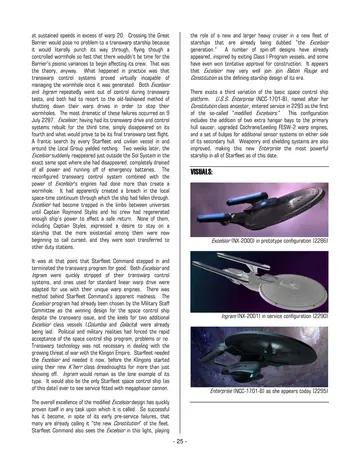
There exists a third variation of the basic space control ship t platform. U.S.S. En erprise (NCC-1701-B), named after her Constitution class ancestor, entered service in 2293 as the first r of the so-called “modified Excelsio s.” This configuration includes the addition of two extra hangar bays to the primary hull saucer, upgraded Cochrane/Leeding FESW-2 warp engines, and a set of bulges for additional sensor systems on either side of its secondary hull. Weaponry and shielding systems are also improved, making this new Enterprise the most powerful starship in all of Starfleet as of this date.
VISUALS:
Excelsior (NX-2000) in prototype configuration (2286)
Ingram (NX-2001) in service configuration (2290)
Enterprise (NCC-1701-B) as she appears today (2295)
- 25 -
SPECIFICATIONS (EXCELSIOR ):
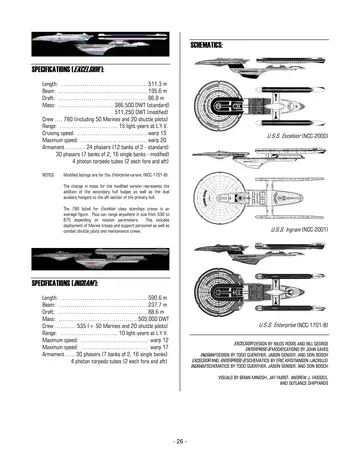
Length: …………………………………….. 511.3 m Beam: ……………………………………… 195.6 m Draft: …………………….………………… 86.8 m Mass: ………………………. 386,500 DWT (standard) 511,250 DWT (modified) Crew .… 780 (including 50 Marines and 20 shuttle pilots) Range: ………………………... 15 light-years at L.Y.V. Cruising speed: ………………….………….. warp 15 Maximum speed: ………………….………… warp 20 Armament …….… 24 phasers (12 banks of 2 - standard) 30 phasers (7 banks of 2, 16 single banks - modified) 4 photon torpedo tubes (2 each fore and aft)
NOTES: Modified listings are for the Enterprise variant (NCC-1701-B).
The change in mass for the modified version represents the addition of the secondary hull bulges as well as the dual auxiliary hangars to the aft section of the primary hull.
The 780 listed for Excelsior class starships crews is an average figure. Thus can range anywhere in size from 530 to 875 depending on mission parameters. This includes deployment of Marine troops and support personnel as well as combat shuttle pilots and maintenance crews.
SPECIFICATIONS (INGRAM ):
Length: …………………………………….. 590.6 m Beam: ……………………………………… 237.7 m Draft: …………………….………………… 88.6 m Mass: …………………………………. 505,000 DWT Crew ……..… 535 (+ 50 Marines and 20 shuttle pilots) Range: ………………………... 10 light-years at L.Y.V. Maximum speed: ………………….………… warp 12 Maximum speed: ………………….………… warp 17 Armament ….. 30 phasers (7 banks of 2, 16 single banks) 4 photon torpedo tubes (2 each fore and aft) SCHEMATICS:
U.S.S. Excelsior (NCC-2000)
U.S.S. Ingram (NCC-2001)
U.S.S. Enterprise (NCC-1701-B)
EXCELSIOR DESIGN BY NILOS RODIS AND BILL GEORGE ENTERPRISE-B MODIFICATIONS BY JOHN EAVES INGRAM DESIGN BY TODD GUENTHER, JASON GENSER, AND DON BOSCH EXCELSIOR AND ENTERPRISE-B SCHEMATICS BY ERIC KRISTIANSEN (JACKILLS) INGRAM SCHEMATICS BY TODD GUENTHER, JASON GENSER, AND DON BOSCH
VISUALS BY BRIAN MINOSH, JAY HURST, ANDREW J. HODGES, AND OUTLANCE SHIPYARDS
- 26 -