1.10 Historical Articles
A collection of archival articles, speeches, and transcripts documenting key 20th-century spaceflight milestones, from the Bumper V-2 and Sputnik through Kennedy's and Reagan's speeches to the shuttle phaseout, Project Daedalus, Khan's escape, and Luna's independence.
V-2 Becomes First Space Rocket
White Sands Missile Base Historical Archive (selected).
Prior to July 1946, Major General H.N. Toftoy, then a colonel and chief of the Research and Development Division, Office of the Chief of Ordinance, suggested the possibility of combining the V-2 rocket and the WAC Corporal. This would provide a two-stage rocket capable of reaching heretofore unattainable altitudes and would greatly increase the possibilities of upper atmosphere research.
On June 20, 1947, the Bumper Program was inaugurated. This was a co-operative program established among the agencies responsible for the various phases of the basic programs. The purpose of this program was to investigate launching techniques for a two-stage missile and separation of the two stages at high velocity, to conduct limited investigation of high-speed, high-altitude phenomena, and to attain velocities and altitudes higher than ever reached.
In the design finally decided upon, the powder rocket booster normally used to launch the WAC Corporal was dispensed with in order to limit the size of the combination missile and allow the smaller rocket to fit as deeply as possible into the V-2, yet retain enough space in the instrument compartment of the V-2 for housing the indispensable components of its guidance equipment. Also fitted within the instrument section were the guide rails and expulsion cylinders used as a launcher for the WAC Corporal. These cylinders were activated by means of a compressed-air bottle through a pressure reducer and a solenoid valve. This valve was activated by the final cut-off signal of the V-2, causing the fins of the WAC Corporal to slide out of the three slots in the upper part of the warhead launcher.
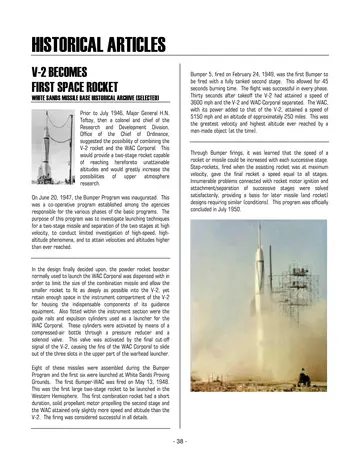
Eight of these missiles were assembled during the Bumper Program and the first six were launched at White Sands Proving Grounds. The first Bumper-WAC was fired on May 13, 1948. This was the first large two-stage rocket to be launched in the Western Hemisphere. This first combination rocket had a short duration, solid propellant motor propelling the second stage and the WAC attained only slightly more speed and altitude than the V-2. The firing was considered successful in all details. Bumper 5, fired on February 24, 1949, was the first Bumper to be fired with a fully tanked second stage. This allowed for 45 seconds burning time. The flight was successful in every phase. Thirty seconds after takeoff the V-2 had attained a speed of 3600 mph and the V-2 and WAC Corporal separated. The WAC, with its power added to that of the V-2, attained a speed of 5150 mph and an altitude of approximately 250 miles. This was the greatest velocity and highest altitude ever reached by a man-made object [at the time].
Through Bumper firings, it was learned that the speed of a rocket or missile could be increased with each successive stage. Step-rockets, fired when the assisting rocket was at maximum velocity, gave the final rocket a speed equal to all stages. Innumerable problems connected with rocket motor ignition and attachment/separation of successive stages were solved satisfactorily, providing a basis for later missile [and rocket] designs requiring similar [conditions]. This program was officially concluded in July 1950.
Soviet Union Launches Earth Orbiting Satellite
From Sputnik: The Shock of the Century by Paul Dickson.
On a fall Friday afternoon in 1957, five bells rang ominously on noisy teletype machines in newsrooms across Washington, DC as a newswire brought word of Sputnik's launch.
LONDON, OCT. 4 (AP) – MOSCOW RADIO SAID TONIGHT THAT THE SOVIET UNION HAS LAUNCHED AN EARTH SATELLITE.
The news flash displaced several stories in the works: the tense racial situation at Central High School in Little Rock, Arkansas; the Milwaukee Braves & New York Yankees World Series [baseball game]; and a widespread flu epidemic. Jimmy Hoffa had been elected head of the Teamsters earlier in the day by a vote of 1208 to 453. Yom Kippur was beginning at sundown, and the television series Leave It To Beaver would premiere later in the evening on the CBS television network.
Details about the satellite were slow in coming, while information on the launch vehicle, or booster, that put Sputnik in orbit would not be known in the West for years. What was known in the first hours was that the Soviet Union had launched the first artificial satellite to orbit the Earth. It was approximately the size of a basketball, weighed only 184 pounds, and took approximately 96 minutes to orbit the Earth on an elliptical path.
The scientists and engineers assembled at the [Soviet] embassy party were thrilled. Cheers rang out. Within minutes, one of the most impenetrable buildings in Washington was putting out the welcome mat to reporters. The Washington Daily News later called it “a veritable open house.” Vodka flowed as more news was given out about the satellite. The Americans offered their congratulations, and [American physicist Lloyd V.] Berkner proposed a toast, while the Soviet scientists doled out proud quotes. Joseph Kaplan, chairman of the U.S. program for the IGY, called it “fantastic.”
Someone brought out a shortwave radio, and soon a beeping noise filled the room. A Russian scientist, Anatoly Blagonravov, confirmed it was Sputnik. “That is the voice,” he said dramatically, “I recognize it.” John Townsend, Jr., one of the scientists at the party, recalled watching Blagonravov. “I knew him quite well, and I could tell he was a little surprised and quite proud. My reaction was, ‘Damn!’”
Explorer 1
From the About:Space Historical Archive.
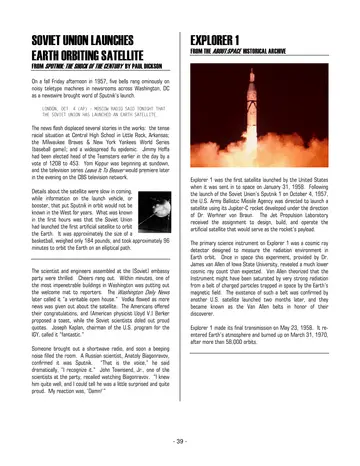
Explorer 1 was the first satellite launched by the United States when it was sent into space on January 31, 1958. Following the launch of the Soviet Union's Sputnik 1 on October 4, 1957, the U.S. Army Ballistic Missile Agency was directed to launch a satellite using its Jupiter-C rocket developed under the direction of Dr. Werhner von Braun. The Jet Propulsion Laboratory received the assignment to design, build, and operate the artificial satellite that would serve as the rocket's payload.
The primary science instrument on Explorer 1 was a cosmic ray detector designed to measure the radiation environment in Earth orbit. Once in space this experiment, provided by Dr. James van Allen of Iowa State University, revealed a much lower cosmic ray count than expected. Van Allen theorized that the instrument might have been saturated by very strong radiation from a belt of charged particles trapped in space by the Earth's magnetic field. The existence of such a belt was confirmed by another U.S. satellite launched two months later, and they became known as the Van Allen belts in honor of their discoverer.
Explorer 1 made its final transmission on May 23, 1958. It re-entered Earth's atmosphere and burned up on March 31, 1970, after more than 58,000 orbits.
President John F. Kennedy: Rice Stadium Moon Speech
Selected excerpts – 12 September 1962.
No man can fully grasp how far and how fast we have come; but condense, if you will, the 50,000 years of man's recorded history in a time span of but half a century. Stated in these terms, we know very little about the first 40 years, except at the end of them advanced man had learned to use the skins of animals to cover him. Then about 10 years ago, under this standard, man emerged from his caves to construct other kinds of shelter. Only five years ago man learned to write and use a cart with wheels. Christianity began less than two years ago. The printing press came this year, and less than two months ago, during this whole 50-year span of human history, the steam engine provided a new source of power. Newton explored the meaning of gravity. Last month electric lights and telephones and automobiles and airplanes became available. Only last week did we develop penicillin and television and nuclear power; and now, if America's new spacecraft succeeds in reaching Venus, we will have literally reached the stars before midnight tonight.
If this capsule history of our progress teaches us anything, it is that man, in his quest for knowledge and progress, is determined and cannot be deterred. The exploration of space will go ahead, whether we join it or not. It is one of the great adventures of the time, and no nation which expects to be the leader of other nations can expect to stay behind in the race for space.
We set sail on this new sea because there is new knowledge to be gained and new rights to be won, and they must be won and used for the progress of all people. For space science, like nuclear science and technology, has no conscience of its own. Whether it will become a force for good or ill depends on man, and only if the United States occupies a position of pre-eminence can we help decide whether this new ocean will be a sea of peace or a new terrifying theater of war. I do not say that we should or will go unprotected against the hostile misuse of space any more than we go unprotected against the hostile use of land or sea, but I do say that space can be explored and mastered without feeding the fires of war, without repeating the mistakes that man has made in extending his writ around this globe of ours.
There is no strife, no prejudice, no national conflict in outer space as yet. Its hazards are hostile to us all. Its conquest deserves the best of all mankind, and its opportunity for peaceful cooperation may never come again. But why, some say, the moon? Why choose this as our goal? And they may well ask why climb the highest mountain. Why, 35 years ago, fly the Atlantic? Why does Rice play Texas?
We choose to go to the moon. We choose to go to the moon in this decade and do the other things, not because they are easy, but because they are hard; because that goal will serve to organize and measure the best of our energies and skills, because that challenge is one we are willing to accept, one we are unwilling to postpone, and one which we intend to win, and the others, too.
We have had our failures, but so have others, even if they do not admit them and they may be less public. To be sure, we are behind, and will be behind for some time in manned flight. But we do not intend to stay behind, and in this decade, we shall make up and move ahead. The growth of our science and education will be enriched by new knowledge of our universe and environment, by new techniques of learning and mapping and observation, by new tools and computers for industry, medicine, the home as well as school.
To be sure, all this costs us all a great deal of money. This year's space budget is three times what it was in January 1961, and it is greater than the space budget for the previous eight years combined. I realize that this is in some measure an act of faith and vision, for we do not now know what benefits await us. But if I were to say, my fellow citizens, that we shall send to the moon, 240,000 miles away from the control station in Houston, a giant rocket more than 300 feet tall, the length of this football field, made of new metal alloys, some of which have not yet been invented, capable of standing heat and stresses several times more than have ever been experienced, fitted together with a precision better than the finest watch, carrying all the equipment needed for propulsion, guidance, control, communications, food and survival, on an untried mission, to an unknown celestial body, and then return it safely to Earth, re-entering the atmosphere at speeds of over 25,000 miles an hour, causing heat about half that of the temperature of the sun – almost as hot as it is here today – and do all this, and do it right, and do it first before this decade is out, then we must be bold.
It will be done … and it will be done before the end of this decade.
Many years ago the great British explorer George Mallory, who was to die on Mount Everest, was asked why did he want to climb it. He said, “Because it is there.” Well, space is there, and we're going to climb it, and the moon and the planets are there, and new hopes for knowledge and peace are there. And therefore, as we set sail we ask God's blessing on the most hazardous, dangerous, and greatest adventure on which man has ever embarked.
First Man in Space
From “These We Honor,” San Diego Aerospace Museum, Terra, 1984.
Colonel Yuri Alexeyevich Gagarin was born of a peasant family in the village of Klushino, Smolensk region in Russia. His education was primarily in the vocations until he entered pilot training at Orenburg in 1957. He graduated with honors from the Zhukovsky Air Force Engineering Academy in 1967.
Cosmonaut Yuri Gagarin was called “the Columbus of the cosmos,” an apt and well-deserved title. His epic 108-minute Earth orbital flight on April 12, 1961 was far more than just a successful operational mission. It was man's first encounter with the nether regions of space and the beginning of man's journey to the stars. As pilot of the spaceship Vostok I he proved that man could endure the rigors of lift-off, re-entry, and weightlessness, and yet still perform the manual operations essential to spacecraft flight.
Gagarin was superbly prepared for his encounter with history, both physically and technologically. On the night before his flight while others paced and worried “Cosmonaut One” slumbered. When asked how he could sleep so peacefully on the eve of launching Yuri answered, “Would it be right to take off if I were not rested? It was my duty to sleep, so I slept.” This is discipline and dedication at its best.
At the conclusion of his flight he was subjected to the most intensive debriefing and scientific examination. It was found in spite of the difficult and strange weightless environment his great skill permitted him to work and to record important data which his fellow astronauts and scientific collaborators would find vital in future space flights.
His impressions of space flight are filled with words of poetry. Joy – beauty – black sky – black stars – these are the universal words of the pilot who knows and loves the firmament. The light of the bright star of Yuri Gagarin was extinguished on March 27, 1968 in a plane crash near Moscow.
Yuri Gagarin was invested in 1970 into the International Aerospace Hall of Fame.
First Outer Space Treaty
United Nations General Assembly Resolution 2222 – 1967.
The [Outer Space] Treaty was opened for signature by the three depository Governments (the Russian Federation, the United Kingdom, and the United States) in January 1967, and it entered into force in October 1967. The Outer Space Treaty provides the basic framework on international space law, including the following principles:
- the exploration and use of outer space shall be carried out for the benefit and in the interests of all countries and shall be the province of all mankind;
- outer space shall be free for exploration and use by all states;
- outer space is not subject to national appropriation by claim of sovereignty, by means of use or occupation, or by any other means;
- states shall not place nuclear weapons or other weapons of mass destruction in orbit or on celestial bodies or station them in outer space in any other manner;
- the Moon and other celestial bodies shall be used exclusively for peaceful purposes;
- astronauts shall be regarded as the envoys of mankind;
- states shall be responsible for national space activities whether carried out by governmental or non-governmental activities;
- states shall be liable for damage caused by their space objects; and
- states shall avoid harmful contamination of space and celestial bodies.
First Man on the Moon
Touchdown transcript – 16 July 1969.
(The following transcript extract is taken from NASA archives of the day. It records the actual conversation between NASA's Houston Space Center Apollo Mission Control and the Apollo 11 crew members. Eagle was the name given to the Lunar Excursion Module [LEM] that actually performed the landing. Columbia is the name for the Apollo craft in orbit around Luna that ferried the LEM there for its landing.)
EAGLE: Houston, Tranquility Base here. The Eagle has landed.
HOUSTON: Roger, Tranquility, we copy you on the ground. You've got a bunch of guys about to turn blue. We're breathing again. Thanks a lot.
EAGLE: Thank you.
HOUSTON: You're looking good here.
EAGLE: A very smooth touchdown.
COLUMBIA: How do you read me?
HOUSTON: Columbia, he has landed Tranquility Base. Eagle is at Tranquility.
COLUMBIA: Yeah, I heard the whole thing.
HOUSTON: Well, it's a good show.
COLUMBIA: Fantastic.
EAGLE: I'll second that.
Six and one-half hours later United States astronaut Neil Armstrong, commander of the Apollo 11 mission, was the first human to set foot on a non-Terran surface. As he did so he said simply, “That's one small step for a man, one giant leap for mankind.”
The Apollo 11 landing site, along with all of the other Terran manned and unmanned craft landing sites, are still preserved today as part of the Federation Air and Space Museum's Luna surface tour.
Goddard Moonbase Operational
AP Press Wire – 14 September 1998.
Representatives from the nine major spacefaring nations in the United Nations gathered today a half-million kilometers from their homes to formally dedicate the opening of Goddard Moonbase, man's first permanent outpost on a world other than our own. Encased in three double-hulled geodesic domes, Goddard provides reasonable accommodations for up to 70 people who will live and work at the base along with a limited number of visitors. The base is completely self-contained and self-supporting: using natural water on the moon, generating its own electricity through solar power, and recycling its own air and waste.
Although primarily a research outpost, Goddard marks the first phase of bringing man to the moon in strength. Already extensive commercial mining efforts are being planned and the researchers at Goddard will play a key role in this effort. The high cost of new construction and bringing in new people and materials is expected to be offset by enormous profits gained from low-gravity construction contracts. Plans are already on the board for two significant expansions to Goddard as it grows and becomes more capable of fulfilling the future for which it has been designed.
Goddard, like Apollo-Soyuz before and StarLab to come, is a truly international effort. Both Russia and the United States have used their considerable space expertise in designing and building its first phase. The European, Japanese, and Indian space agencies have also contributed with manpower, tools and technology. All in all Goddard represents the best the world has to offer, as well as the future that it hopes will come.
StarLab Operational
Donald Butler, Associated Press – 16 October 1982.
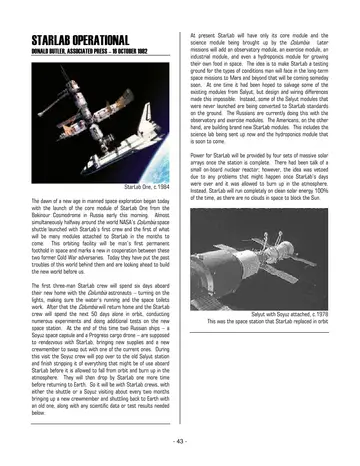
The dawn of a new age in manned space exploration began today with the launch of the core module of StarLab One from the Baikonur Cosmodrome in Russia early this morning. Almost simultaneously halfway around the world NASA's Columbia space shuttle launched with StarLab's first crew and the first of what will be many modules attached to StarLab in the months to come. This orbiting facility will be man's first permanent foothold in space and marks a new era in cooperation between these two former Cold War adversaries. Today they have put the past troubles of this world behind them and are looking ahead to build the new world before us.
The first three-man StarLab crew will spend six days aboard their new home with the Columbia astronauts – turning on the lights, making sure the water's running and the space toilets work. After that the Columbia will return home and the StarLab crew will spend the next 50 days alone in orbit, conducting numerous experiments and doing additional tests on the new space station. At the end of this time two Russian ships – a Soyuz space capsule and a Progress cargo drone – are supposed to rendezvous with StarLab, bringing new supplies and a new crewmember to swap out with one of the current ones. During this visit the Soyuz crew will pop over to the old Salyut station and finish stripping it of everything that might be of use aboard StarLab before it is allowed to fall from orbit and burn up in the atmosphere. They will then drop by StarLab one more time before returning to Earth. So it will be with StarLab crews, with either the shuttle or a Soyuz visiting about every two months bringing up a new crewmember and shuttling back to Earth with an old one, along with any scientific data or test results needed below. At present StarLab will have only its core module and the science module being brought up by the Columbia. Later missions will add an observatory module, an exercise module, an industrial module, and even a hydroponics module for growing their own food in space. The idea is to make StarLab a testing ground for the types of conditions man will face in the long-term space missions to Mars and beyond that will be coming someday soon. At one time it had been hoped to salvage some of the existing modules from Salyut, but design and wiring differences made this impossible. Instead, some of the Salyut modules that were never launched are being converted to StarLab standards on the ground. The Russians are currently doing this with the observatory and exercise modules. The Americans, on the other hand, are building brand new StarLab modules. This includes the science lab being sent up now and the hydroponics module that is soon to come.
Power for StarLab will be provided by four sets of massive solar arrays once the station is complete. There had been talk of a small on-board nuclear reactor; however, the idea was vetoed due to any problems that might happen once StarLab's days were over and it was allowed to burn up in the atmosphere. Instead, StarLab will run completely on clean solar energy 100% of the time, as there are no clouds in space to block the Sun.
President Ronald Reagan: Remembering the Challenger
National televised address, 28 January 1986.
Ladies and gentlemen, I had planned to speak to you tonight on the state of the union, but the events of today have led me to change those plans. Today is a day for mourning and remembering. Nancy and I are pained to the core by the tragedy of the shuttle Challenger. We know we share this pain with all of the people of our country. This is truly a national loss.
Nineteen years ago, almost to the day, we lost three astronauts in a terrible accident on the ground. But we've never lost an astronaut in flight; we've never had a tragedy like this. And perhaps we've forgotten the courage it took for the crew of the shuttle; but they, the Challenger Seven, were aware of the dangers, but overcame them and did their jobs brilliantly. We mourn seven heroes: Michael Smith, Dick Scobee, Judith Resnik, Ronald McNair, Ellison Onizuka, Gregory Jarvis, and Christa McAuliffe. We mourn their loss as a nation together.
For the families of the seven, we cannot bear, as do you, the full impact of this tragedy. But we feel the loss, and we're thinking about you so very much. Your loved ones were daring and brave, and they had a special grace, that special spirit that says, “Give me a challenge and I'll meet it with joy.” They had a hunger to explore the universe and discover its truths. They wished to serve, and they did. They served all of us.
We've grown used to wonders in this century. It's hard to dazzle us. But for 25 years the United States space program has been doing just that. We've grown used to the idea of space, and perhaps we forget that we've only just begun. We're still pioneers. They, the members of the Challenger crew, were pioneers.
And I want to say something to the school children of America who were watching the live coverage of the shuttle's takeoff. I know it is hard to understand, but sometimes painful things like this happen. It's all a part of the process of exploration and discovery. It's all part of taking a chance and expanding man's horizons. The future doesn't belong to the fainthearted; it belongs to the brave. The Challenger crew was pulling us into the future, and we'll continue to follow them. I've always had great faith in and respect for our space program, and what happened today does nothing to diminish it. We don't hide our space program. We don't keep secrets and cover things up. We do it all up front and in public. That's the way freedom is, and we wouldn't change it for a minute. We'll continue our quest in space. There will be more shuttle flights and more shuttle crews and yes, more volunteers, more civilians, more teachers in space. Nothing ends here; our hopes and journeys continue.
I want to add that I wish I could talk to every man and woman who works for NASA or who worked on this mission and tell them: “Your dedication and professionalism have moved and impressed us for decades. We know of your anguish and we share it.”
There's a coincidence today. On this day 390 years ago, the great explorer Sir Francis Drake died aboard ship off the coast of Panama. In his lifetime the great frontiers were the oceans, and a historian later said, “He lived by the sea, died on it, and was buried in it.” Well, today we can say of the Challenger crew: their dedication was, like Drake's, complete.
The crew of the space shuttle Challenger honored us by the manner in which they lived their lives. We will never forget them, nor the last time we saw them: this morning … as they prepared for their journey and waved goodbye … and slipped the surly bonds of Earth to touch the hand of God.
Space Shuttles to Be Phased Out of Service
Official 1992 UESPA press release, 11 March 1992 (selected excerpts).
Today marks a historic occasion in the history of man in space. Today marks the end of the space shuttle program, bringing to an end one of the most important chapters in human history.
When NASA first launched the space shuttle Columbia some 553 missions ago it planned for its new craft to become the backbone of a new generation of space vehicles. That dream has proven successful beyond NASA's wildest expectations. While the early shuttle flights were oriented more towards science, later missions proved the commercial viability of our very first “space truck.” It is only fair to say that this “truck” has done more for mankind in twelve short years than any other space program to date. SpaceLab, the launch of the Space Telescope and countless planetary and interplanetary satellites, early industrial manufacturing under weightless conditions, resupply of StarLab and Space Station Freedom, in-service repairs of orbiting space stations and satellites, the launch of the first Orbital Solar Power Satellites – these are but a few of the space shuttle's many accomplishments.
Success has its downside, though. The largest problem with a successful system is that it often renders itself obsolete. So it is with the space shuttle. Both the Columbia and Buran class orbiters have worked so well in helping mankind achieve the dream of space that they have inspired their own successor. The next generation that the space shuttle concept hoped to inspire has finally arrived and it is now ready to go into service. With the successful test launch of the first Space Ferry just a short time ago the true successor to the shuttle is at hand. Be that as it may, however, mankind will always hold a special place in its heart and collective memory for this pioneering craft. It made us believe in space. More than that, it made it an everyday reality for us.
Project Daedalus Becomes Reality
Official Dyson-Yoyodyne 1988 press release.
In the mid 1970s the British Interplanetary Society conducted a study that is today considered a classic in space science. They set out to design the first ever practical interstellar spacecraft using the technology of the day. They named their spacecraft Daedalus after the great craftsman of the Greek myths: the man who made wings so he could fly.
Today, Dyson-Yoyodyne is proud to announce that the dream is now real. The United Earth Space Probe Agency has approved funding for our design for Project Daedalus, man's first-ever ship designed to travel the length of our Solar System and beyond. This is a historic occasion that will go down as one of the great moments of our time. The ship that will come of this effort, the Dyson-Yoyodyne series 100, will also go down as one of the great spaceships of our time.
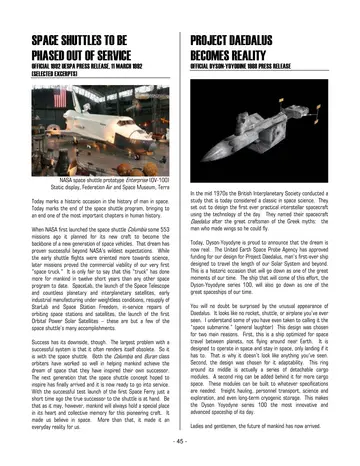
You will no doubt be surprised by the unusual appearance of Daedalus. It looks like no rocket, shuttle, or airplane you've ever seen. I understand some of you have even taken to calling it the “space submarine.” (general laughter) This design was chosen for two main reasons. First, this is a ship optimized for space travel between planets, not flying around near Earth. It is designed to operate in space and stay in space, only landing if it has to. That is why it doesn't look like anything you've seen. Second, the design was chosen for its adaptability. This ring around its middle is actually a series of detachable cargo modules. A second ring can be added behind it for more cargo space. These modules can be built to whatever specifications are needed: freight hauling, personnel transport, science and exploration, and even long-term cryogenic storage. This makes the Dyson-Yoyodyne series 100 the most innovative and advanced spaceship of its day.
Ladies and gentlemen, the future of mankind has now arrived.
Khan Escapes into Space
UNS press release – 22 September 1996.
At 4:02 pm this evening on the outskirts of Khanton, former capital of the empire of genetic superman dictator Khan Noonien Singh, UN coalition forces closing on the city were startled by the sight and sound of a massive rocket lifting off into space. The visual profile matched that of the stolen UESPA space vessel Botany Bay, which Khan had seized from its Australian berth as it neared completion during his rapid rise to power. The Botany Bay rapidly ascended into space despite the best efforts of UN forces in the area to shoot it down. Unfortunately no UESPA craft or UNPF space patrols were within range to intercept it before it achieved escape velocity and raced out of our Solar System. Its telemetry track indicates that its probable destination is the star Tau Ceti, where at least one habitable planet is known to exist. After the departure of the Botany Bay UN forces met with only token resistance and were able to take control of Khanton by the following day. Khan, along with 96 of his closest staff and aides, apparently escaped aboard the Botany Bay.
UESPA experts were unwilling to comment on Khan's chances of survival in his desperate escape bid. AP space expert Marcus Riley notes that the visual of the Botany Bay taken by UN cameras seem to indicate a long range explorer configuration for the ship. Where and how Khan got the necessary materials to reconfigure the Botany Bay in this manner is still a mystery. This would almost certainly mean that Khan and his followers have placed themselves in suspended animation for the duration of the voyage. No human under normal conditions would live long enough for the trip Khan has apparently planned for himself and his people.
Possible UN plans to pursue the Botany Bay remain in doubt due to the extended head start Khan's ship has on any that would follow it. Most civilian space experts are of the opinion that Khan is left well enough alone and that the resources required would be better spent on recovering from the aftermath of the Eugenics Wars. Initial estimates place the final death toll at some 33 million. Hundreds of thousands of homeless and shellshocked survivors live in squalid refugee camps throughout Africa, Southeast Asia, and Australia, where many basic services no longer exist due to years of constant warfare. These portions of the world may be facing a new Dark Age for years to come without massive UN assistance.
Moon Declares Independence
UNS press release – 01 January 2000.
Today in special session and with the narrowest of votes the United Nations Security Council approved the request of Goddard Moonbase to be granted independent status as a UN protectorate, the first such off-planet. The vote was evenly split among Council members, with both the United States and Russian representatives abstaining due to their sponsorship of the initial construction of Goddard. It was Japanese representative Norikio Takashima who cast the swing vote in Goddard's favor, making it in effect the first “nation” in space.
Goddard's path to nationhood was a quick one. Founded in 1984 through a joint American-Russian effort, Goddard quickly grew into a major complex that dominated much of the Copernicus crater on the moon. The European Space Agency was largely responsible for Goddard's first major expansion as the ranks of its scientists swelled and new facilities had to be built to accommodate them. Just two years ago two more domes and a swarm of additional outbuildings began construction, making Goddard just large enough to be spotted from Earth with the aid of a telescope or binoculars. As more scientists and researchers from other parts of the world joined its staff, such as China, Japan, India, Pakistan, Argentina, and Spain, it soon became apparent that Goddard's original administrative system couldn't handle its rapidly growing population. What was needed was a real government, free of Terran national ties and able to deal with the unique problems faced by Goddard due to its location on the moon. Goddard personnel debated among themselves for two months before making their request to be a UN protectorate, and then only after informing their respective sponsor governments.
It is uncertain how today's vote will affect the future of Goddard Moonbase. What is certain is that the pattern of non-Terran independence will likely be repeated again and again with each successful off-world colony man founds in the stars.
to be continued …