2.3 Bussard Ramjet Colonization Ship
Accounts of the privately built Bussard ramjet colonization ships of the 2010s and the failed DY-300 class prototype, which introduced the first AI ship's computer.
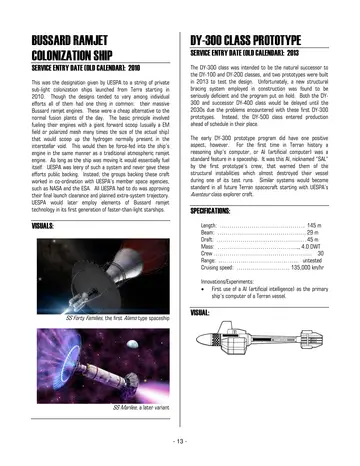
Bussard Ramjet Colonization Ship
Service entry date (old calendar): 2010
This was the designation given by UESPA to a string of private sub-light colonization ships launched from Terra starting in 2010. Though the designs tended to vary among individual efforts all of them had one thing in common: their massive Bussard ramjet engines. These were a cheap alternative to the normal fusion plants of the day. The basic principle involved fueling their engines with a giant forward scoop (usually a EM field or polarized mesh many times the size of the actual ship) that would scoop up the hydrogen normally present in the interstellar void. This would then be force-fed into the ship’s engine in the same manner as a traditional atmospheric ramjet engine. As long as the ship was moving it would essentially fuel itself. UESPA was leery of such a system and never gave these efforts public backing. Instead, the groups backing these craft worked in co-ordination with UESPA’s member space agencies, such as NASA and the ESA. All UESPA had to do was approving their final launch clearance and planned extra-system trajectory. UESPA would later employ elements of Bussard ramjet technology in its first generation of faster-than-light starships.
DY-300 Class Prototype
Service entry date (old calendar): 2013
The DY-300 class was intended to be the natural successor to the DY-100 and DY-200 classes, and two prototypes were built in 2013 to test the design. Unfortunately, a new structural bracing system employed in construction was found to be seriously deficient and the program put on hold. Both the DY-300 and successor DY-400 class would be delayed until the 2030s due the problems encountered with these first DY-300 prototypes. Instead, the DY-500 class entered production ahead of schedule in their place.
The early DY-300 prototype program did have one positive aspect, however. For the first time in Terran history a reasoning ship’s computer, or AI (artificial intelligence) was a standard feature in a spaceship. It was this AI, nicknamed “SAL” by the first prototype’s crew, that warned them of the structural instabilities which almost destroyed their vessel during one of its test runs. Similar systems would become standard in all future Terran spacecraft starting with UESPA’s Aventeur class explorer craft.
Specifications:
- Length: 145 m
- Beam: 29 m
- Draft: 45 m
- Mass: 4.0 DWT
- Crew: 30
- Range: untested
- Cruising speed: 135,000 km/hr
Innovations/Experiments:
- First use of a AI (artificial intelligence) as the primary ship’s computer of a Terran vessel.