1.2 The Space Age (1901-2000): Overview
A narrative overview of 20th-century Terran spaceflight, from the Wright Brothers and the rocket pioneers through the U.S.-Russian space race, reusable spacecraft, commercial ventures, secret alien contact, and the dawn of a new Golden Age.
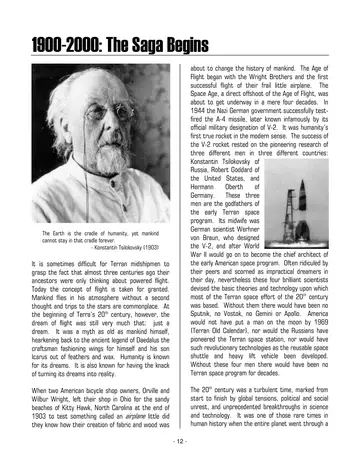
The Earth is the cradle of humanity, yet mankind cannot stay in that cradle forever. — Konstantin Tsiolkovsky (1903)
It is sometimes difficult for Terran midshipmen to grasp the fact that almost three centuries ago their ancestors were only thinking about powered flight. Today the concept of flight is taken for granted. Mankind flies in his atmosphere without a second thought and trips to the stars are commonplace. At the beginning of Terra's 20th century, however, the dream of flight was still very much that: just a dream. It was a myth as old as mankind himself, hearkening back to the ancient legend of Daedalus the craftsman fashioning wings for himself and his son Icarus out of feathers and wax. Humanity is known for its dreams. It is also known for having the knack of turning its dreams into reality.
When two American bicycle shop owners, Orville and Wilbur Wright, left their shop in Ohio for the sandy beaches of Kitty Hawk, North Carolina at the end of 1903 to test something called an airplane little did they know how their creation of fabric and wood was about to change the history of mankind. The Age of Flight began with the Wright Brothers and the first successful flight of their frail little airplane. The Space Age, a direct offshoot of the Age of Flight, was about to get underway in a mere four decades. In 1944 the Nazi German government successfully test-fired the A-4 missile, later known infamously by its official military designation of V-2. It was humanity's first true rocket in the modern sense. The success of the V-2 rocket rested on the pioneering research of three different men in three different countries: Konstantin Tsiolkovsky of Russia, Robert Goddard of the United States, and Hermann Oberth of Germany. These three men are the godfathers of the early Terran space program. Its midwife was German scientist Werhner von Braun, who designed the V-2, and after World War II would go on to become the chief architect of the early American space program. Often ridiculed by their peers and scorned as impractical dreamers in their day, nevertheless these four brilliant scientists devised the basic theories and technology upon which most of the Terran space effort of the 20th century was based. Without them there would have been no Sputnik, no Vostok, no Gemini or Apollo. America would not have put a man on the moon by 1969 (Terran Old Calendar), nor would the Russians have pioneered the Terran space station, nor would have such revolutionary technologies as the reusable space shuttle and heavy lift vehicle been developed. Without these four men there would have been no Terran space program for decades.
The 20th century was a turbulent time, marked from start to finish by global tensions, political and social unrest, and unprecedented breakthroughs in science and technology. It was one of those rare times in human history when the entire planet went through a paradigm shift in both lifestyle and philosophy. Two world wars and dozens of smaller ones had a lot to do with that, forcing mankind to up his level of technology again and again in rapid succession. Things that were thought impossible at the beginning of the 20th century, such as computers, became an inexpensive commodity by its end. So it was with the Terran space effort. The visions of the early pioneers in the 1920s and 30s were surpassed beyond their wildest imaginations before the century reached its end.
As with any planetary culture's space program rocket technology paved the way for the rest that would follow. The early efforts of the Germans, which arrived too late near the end of World War II to make their side any difference in the outcome, were captured and eagerly studied by the victorious Americans and Russians. The Russians were on the scene first and got most of the technology and notes. The Americans got the real prize, however. They got Werhner von Braun and his associates. So the official story goes. Whatever else they got, or was possibly spirited away before they could seize it (such as the long-rumored Vrill Program) has never been officially disclosed.
The Russians were first in overcoming almost every major hurdle at the start of the Terran Space Age. They put the first artificial satellite in orbit (Sputnik I), they put the first man in space (Yuri Gagarin), the first woman in space (Valentina Tereshkova), launched the first multi-occupant spacecraft (Voskhod), and built Terra's first operational space station (Salyut). It was around this point, however, that the Russian space program failed them. At the risk of oversimplifying a complex issue their program had simply become too complicated for its own good. A string of calamities and launch failures over a decade finally resulted in the spectacular catastrophe that was the N-1 manned moon rocket launch test. The resulting explosion not only destroyed the rocket but took out its service gantry and most of the launch complex as well. Successive attempts resulted in equally spectacular explosions. It was at this point that the Russian government finally stepped in and put a temporary halt to the ambitions of Russian space scientists. Not that it mattered by this point anyway, they told their disheartened comrades. The Americans had already beaten them to the moon the year before.
The Americans had started late and a full year behind the Russians insofar as space technology was concerned. Nevertheless they plowed into the fray with all of the gusto and bravado for which their country was known. American President John F. Kennedy, a charismatic politician and a skilled leader to boot (a rare combination), had challenged his people to help their country build a space program that would “put a man on the moon by the end of the decade.” His words still carry weight even today: “We do this thing not because it is easy, but because it is hard.” He knew that the Americans had the skill, ingenuity, and resources to catch and pass the Russians in the great race to space. Kennedy would not live to see his dream, being slain by an assassin's bullet in 1963; however, the space agency that he founded would make sure his dream became reality. That was NASA, the National Aeronautics and Space Administration and the direct ancestor of UESPA. By the mid 1960s they had successfully duplicated almost every one of the Russian space triumphs. In 1968 they beat the Russians to the moon with the Apollo program. The first man to set foot on Luna, the Terran moon, was NASA astronaut Neil Armstrong. Six more missions would follow in the years to come. It was only the beginning of humanity's leap into space.
The biggest problem in getting mankind to the stars was the cost. It was expensive sending up large, one-way rockets that could never be used again. A reusable spacecraft would lessen the costs considerably. Other fanciful dreams such as orbital elevators and tethered satellites were batted around for years. In the end the reusable spacecraft would prove to be the most practical and cost effective approach as far as humanity was concerned. The Americans led in this effort this time around with their OV-100 Enterprise class space shuttles, with the Russians playing a close second with their own Buran program. They left the rockets to the Europeans and forged ahead with more advanced technologies. The Russians had pioneered space station technology and were the acknowledged leaders in the field; so naturally they were in charge of the StarLab program. It was the first space station to be built by a joint effort of spacegoing nations, and the first of many such programs on Terra.
It should come as no surprise that with all of the government activity in space commercial industry and private sector efforts wanted their slice of the pie as well. The privately financed Conestoga One rocket program was the first such successful effort, followed shortly thereafter by the Allen-Rutan effort Spaceship One. The latter was the first privately built reusable spacecraft, on a smaller scale than but in the same vein as the more expensive NASA space shuttle. These ventures were small, however, compared with commercial ventures. It was largely the backing of private corporations that helped fund the construction of NASA's Goddard Moonbase. Their involvement was purely selfish: zero-gee manufacturing techniques could produce a highly profitable return back on Earth. The same was true for the various planetary satellite networks that provided communications and cheap power on a global scale. Finally, their funding of efforts to explore the inner asteroid belt of the Sol System would bring them financial windfalls the likes of which had not been seen since the petroleum boom days of the turn of the century.
There was also another reason for man to make the move into space. He was not alone in the universe. The fact that other intelligent species existed on other worlds was perhaps the best-kept secret of the governments of Terra in the 20th century. They consistently refused to divulge this information, despite the efforts of such leading scientists as Dr. Hogan Richman, simply for the fear of the impact that such knowledge would have on humanity. The Brookings Report, commissioned by the American government during the Cold War era, had determined that humanity's most probable reaction to a real alien encounter would be worldwide culture shock. Similar studies by the Russian KGB and Britain's U.N.I.T. had come to the same conclusion. Each national government set up one or more secret agencies to collect and collate data on possible and potential alien contacts. Oftentimes even the political leaders of these nations were kept in the dark as to the true nature and extent of such agencies. Their overall plan was to slowly disseminate the knowledge that mankind was not alone in the universe as one might slowly cook a good meal. Too much knowledge too soon and mankind might go into a cultural tailspin from which it might never recover. Too little too late and mankind would not be ready for the day when First Contact would inevitably happen … and it already had; at least in officially classified form. Terran leaders desperately wanted their world to be a spacefaring one by the time true First Contact was established. At least then they would be in a better position to bargain and establish something approaching normal relations with their new neighbors in the universe.
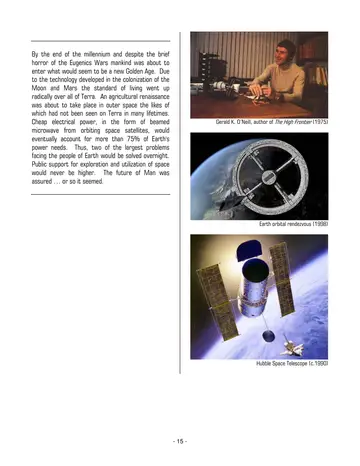
By the end of the millennium and despite the brief horror of the Eugenics Wars mankind was about to enter what would seem to be a new Golden Age. Due to the technology developed in the colonization of the Moon and Mars the standard of living went up radically over all of Terra. An agricultural renaissance was about to take place in outer space the likes of which had not been seen on Terra in many lifetimes. Cheap electrical power, in the form of beamed microwave from orbiting space satellites, would eventually account for more than 75% of Earth's power needs. Thus, two of the largest problems facing the people of Earth would be solved overnight. Public support for exploration and utilization of space would never be higher. The future of Man was assured … or so it seemed.