2.8 Historical Articles
A collection of period documents and news reports, including the United Space Initiative and Space Homestead Act, the first lunar birth and death, the first space city and Mars colonies, and the discoveries of antimatter, subspace, the spinner drive and the loss of the Courageous.
The United Space Initiative
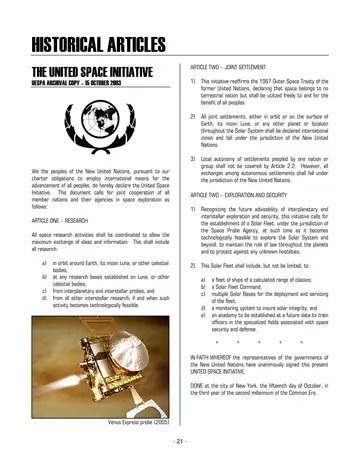
UESPA archival copy – 15 October 2003
We the peoples of the New United Nations, pursuant to our charter obligations to employ international means for the advancement of all peoples, do hereby declare the United Space Initiative. This document calls for joint cooperation of all member nations and their agencies in space exploration as follows:
Article One – Research
All space research activities shall be coordinated to allow the maximum exchange of ideas and information. This shall include all research:
- a) in orbit around Earth, its moon Luna, or other celestial bodies,
- b) at any research bases established on Luna, or other celestial bodies,
- c) from interplanetary and interstellar probes, and
- d) from all other interstellar research, if and when such activity becomes technologically feasible.
Article Two – Joint Settlement
- 1) This initiative reaffirms the 1967 Outer Space Treaty of the former United Nations, declaring that space belongs to no terrestrial nation but shall be utilized freely to and for the benefit of all peoples.
- 2) All joint settlements, either in orbit or on the surface of Earth, its moon Luna, or any other planet or location throughout the Solar System shall be declared international zones and fall under the jurisdiction of the New United Nations.
- 3) Local autonomy of settlements peopled by one nation or group shall not be covered by Article 2.2. However, all exchanges among autonomous settlements shall fall under the jurisdiction of the New United Nations.
Article Two – Exploration and Security
- 1) Recognizing the future advisability of interplanetary and interstellar exploration and security, this initiative calls for the establishment of a Solar Fleet, under the jurisdiction of the Space Probe Agency, at such time as it becomes technologically feasible to explore the Solar System and beyond, to maintain the rule of law throughout the planets and to protect against any unknown hostilities.
- 2) This Solar Fleet shall include, but not be limited, to:
- a) a fleet of ships of a calculated range of classes;
- b) a Solar Fleet Command,
- c) multiple Solar Bases for the deployment and servicing of the fleet,
- d) a monitoring system to insure solar integrity, and
- e) an academy to be established at a future date to train officers in the specialized fields associated with space security and defense.
In faith whereof the representatives of the governments of the New United Nations have unanimously signed this present United Space Initiative,
Done at the city of New York, the fifteenth day of October, in the third year of the second millennium of the Common Era.
The First Space Child
United News Service wire – 11 June 2005
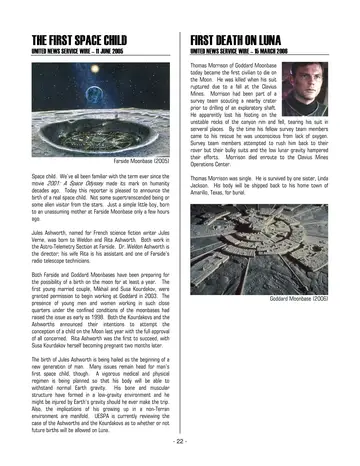
Space child. We’ve all been familiar with the term ever since the movie 2001: A Space Odyssey made its mark on humanity decades ago. Today this reporter is pleased to announce the birth of a real space child. Not some super-transcended being or some alien visitor from the stars. Just a simple little boy, born to an unassuming mother at Farside Moonbase only a few hours ago.
Jules Ashworth, named for French science fiction writer Jules Verne, was born to Weldon and Rita Ashworth. Both work in the Astro-Telemetry Section at Farside. Dr. Weldon Ashworth is the director; his wife Rita is his assistant and one of Farside’s radio telescope technicians.
Both Farside and Goddard Moonbases have been preparing for the possibility of a birth on the moon for at least a year. The first young married couple, Mikhail and Susa Kourdakov, were granted permission to begin working at Goddard in 2003. The presence of young men and women working in such close quarters under the confined conditions of the moonbases had raised the issue as early as 1998. Both the Kourdakovs and the Ashworths announced their intentions to attempt the conception of a child on the Moon last year with the full approval of all concerned. Rita Ashworth was the first to succeed, with Susa Kourdakov herself becoming pregnant two months later.
The birth of Jules Ashworth is being hailed as the beginning of a new generation of man. Many issues remain head for man’s first space child, though. A vigorous medical and physical regimen is being planned so that his body will be able to withstand normal Earth gravity. His bone and muscular structure have formed in a low-gravity environment and he might be injured by Earth’s gravity should he ever make the trip. Also, the implications of his growing up in a non-Terran environment are manifold. UESPA is currently reviewing the case of the Ashworths and the Kourdakovs as to whether or not future births will be allowed on Luna.
First Death on Luna
United News Service wire – 15 March 2006
Thomas Morrison of Goddard Moonbase today became the first civilian to die on the Moon. He was killed when his suit ruptured due to a fall at the Clavius Mines. Morrison had been part of a survey team scouting a nearby crater prior to drilling of an exploratory shaft. He apparently lost his footing on the unstable rocks of the canyon rim and fell, tearing his suit in serveral places. By the time his fellow survey team members came to his rescue he was unconscious from lack of oxygen. Survey team members attempted to rush him back to their rover but their bulky suits and the low lunar gravity hampered their efforts. Morrison died enroute to the Clavius Mines Operations Center.
Thomas Morrison was single. He is survived by one sister, Linda Jackson. His body will be shipped back to his home town of Amarillo, Texas, for burial.
First City in Space
CNN Headline News – 15 March 2006
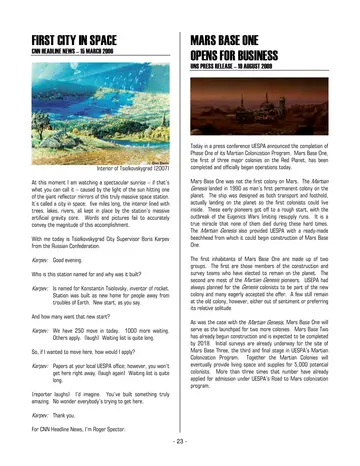
At this moment I am watching a spectacular sunrise – if that’s what you can call it – caused by the light of the sun hitting one of the giant reflector mirrors of this truly massive space station. It’s called a city in space: five miles long, the interior lined with trees, lakes, rivers, all kept in place by the station’s massive artificial gravity core. Words and pictures fail to accurately convey the magnitude of this accomplishment.
With me today is Tsiolkovskygrad City Supervisor Boris Karpev from the Russian Confederation.
Karpev: Good evening.
Who is this station named for and why was it built?
Karpev: Is named for Konstantin Tsiolovsky, inventor of rocket. Station was built as new home for people away from troubles of Earth. New start, as you say.
And how many want that new start?
Karpev: We have 250 move in today. 1000 more waiting. Others apply. (laugh) Waiting list is quite long.
So, if I wanted to move here, how would I apply?
Karpev: Papers at your local UESPA office; however, you won’t get here right away. (laugh again) Waiting list is quite long.
(reporter laughs) I’d imagine. You’ve built something truly amazing. No wonder everybody’s trying to get here.
Karpev: Thank you.
For CNN Headline News, I’m Roger Spector.
Mars Base One Opens for Business
UNS press release – 19 August 2009
Today in a press conference UESPA announced the completion of Phase One of its Martian Colonization Program. Mars Base One, the first of three major colonies on the Red Planet, has been completed and officially began operations today.
Mars Base One was not the first colony on Mars. The Martian Genesis landed in 1990 as man’s first permanent colony on the planet. The ship was designed as both transport and foothold, actually landing on the planet so the first colonists could live inside. These early pioneers got off to a rough start, with the outbreak of the Eugenics Wars limiting resupply runs. It is a true miracle that none of them died during these hard times. The Martian Genesis also provided UESPA with a ready-made beachhead from which it could begin construction of Mars Base One.
The first inhabitants of Mars Base One are made up of two groups. The first are those members of the construction and survey teams who have elected to remain on the planet. The second are most of the Martian Genesis pioneers. USEPA had always planned for the Genesis colonists to be part of the new colony and many eagerly accepted the offer. A few still remain at the old colony, however, either out of sentiment or preferring its relative solitude.
As was the case with the Martian Genesis, Mars Base One will serve as the launchpad for two more colonies. Mars Base Two has already begun construction and is expected to be completed by 2018. Initial surveys are already underway for the site of Mars Base Three, the third and final stage in UESPA’s Martian Colonization Program. Together the Martian Colonies will eventually provide living space and supplies for 5,000 potential colonists. More than three times that number have already applied for admission under UESPA’s Road to Mars colonization program.
Epidemic Ravages Mars
UNS press release – 17 May 2011
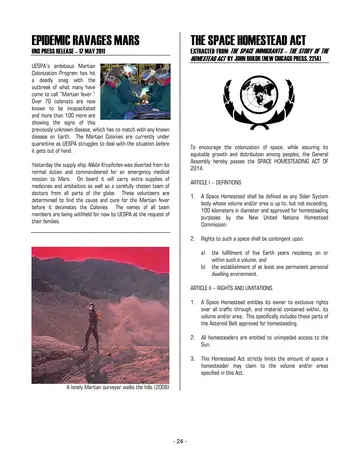
UESPA’s ambitious Martian Colonization Program has hit a deadly snag with the outbreak of what many have come to call “Martian fever.” Over 70 colonists are now known to be incapacitated and more than 100 more are showing the signs of this previously unknown disease, which has no match with any known disease on Earth. The Martian Colonies are currently under quarantine as UESPA struggles to deal with the situation before it gets out of hand.
Yesterday the supply ship Nikita Krushchev was diverted from its normal duties and commandeered for an emergency medical mission to Mars. On board it will carry extra supplies of medicines and antibiotics as well as a carefully chosen team of doctors from all parts of the globe. These volunteers are determimed to find the cause and cure for the Martian fever before it decimates the Colonies. The names of all team members are being withheld for now by UESPA at the request of their families.
The Space Homestead Act
Extracted from The Space Immigrants – The Story of the Homestead Act by John Bukor (New Chicago Press, 2214)
To encourage the colonization of space, while assuring its equitable growth and distribution among peoples, the General Assembly hereby passes the Space Homesteading Act of 2014.
Article I – Definitions
- 1. A Space Homestead shall be defined as any Solar System body whose volume and/or area is up to, but not exceeding, 100 kilometers in diameter and approved for homesteading purposes by the New United Nations Homestead Commission.
- 2. Rights to such a space shall be contingent upon:
- a) the fulfillment of five Earth years residency on or within such a volume, and
- b) the establishment of at least one permanent personal dwelling environment.
Article II – Rights and Limitations
- 1. A Space Homestead entitles its owner to exclusive rights over all traffic through, and material contained within, its volume and/or area. This specifically includes those parts of the Asteroid Belt approved for homesteading.
- 2. All homesteaders are entitled to unimpeded access to the Sun.
- 3. This Homestead Act strictly limits the amount of space a homesteader may claim to the volume and/or areas specified in this Act.
Article III – Homesteading Incentives
- 1. Transportation to any sector approved for homesteading purposes shall be provided by the United Earth Solar Fleet, its auxiliaries, or a comparable civilian agency for the homestead and his or her immediate family.
- 2. A low-interest loan, at rates determined by the Homestead Commission, shall be made available to the homesteader, if desired, to finance his or her homesteading effort. The purpose for such a loan may include but is not limited to purchase of passage, purchase of appropriate spacecraft, purchase of homesteading goods, and purchase of supplies.
- 3. Persons directly involved with the establishment of or work on a Homestead shall be exempt from Terran taxes and other Terran duties on their person for the duration of the time they spend off planet. This Act does not excuse them, however, from any taxes or other duties that may be levied by governments off-planet, such as those on Luna and the Martian Colonies.
- 4. Any business that contributes to the furtherance of this Act shall receive an appropriate tax incentive as described in Appendix C of this document.
Natural Antimatter Discovered
UNS press release – 26 February 2017
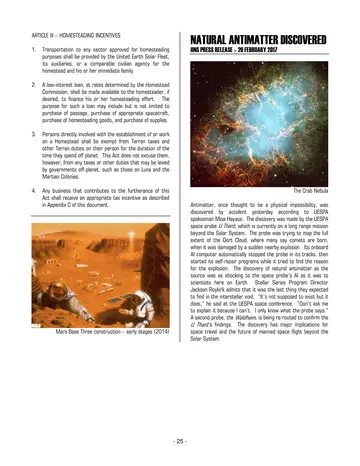
Antimatter, once thought to be a physical impossibility, was discovered by accident yesterday according to UESPA spokesman Misa Hayase. The discovery was made by the UESPA space probe U Thant, which is currently on a long range mission beyond the Solar System. The probe was trying to map the full extent of the Oort Cloud, where many say comets are born, when it was damaged by a sudden nearby explosion. Its onboard AI computer automatically stopped the probe in its tracks, then started its self-repair programs while it tried to find the reason for the explosion. The discovery of natural antimatter as the source was as shocking to the space probe’s AI as it was to scientists here on Earth. Stellar Series Program Director Jackson Roykirk admits that it was the last thing they expected to find in the interstellar void. “It’s not supposed to exist but it does,” he said at the UESPA space conference. “Don’t ask me to explain it because I can’t. I only know what the probe says.” A second probe, the Waldheim, is being re-routed to confirm the U Thant’s findings. The discovery has major implications for space travel and the future of manned space flight beyond the Solar System.
Elinor M Flies Again
CNN Headline News – 31 May 2018
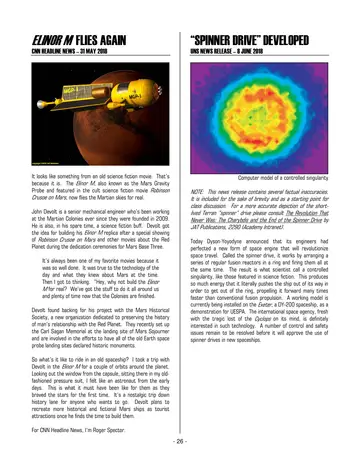
It looks like something from an old science fiction movie. That’s because it is. The Elinor M, also known as the Mars Gravity Probe and featured in the cult science fiction movie Robinson Crusoe on Mars, now flies the Martian skies for real.
John Devolt is a senior mechanical engineer who’s been working at the Martian Colonies ever since they were founded in 2009. He is also, in his spare time, a science fiction buff. Devolt got the idea for building his Elinor M replica after a special showing of Robinson Crusoe on Mars and other movies about the Red Planet during the dedication ceremonies for Mars Base Three.
It’s always been one of my favorite movies because it was so well done. It was true to the technology of the day and what they knew about Mars at the time. Then I got to thinking. “Hey, why not build the Elinor M for real? We’ve got the stuff to do it all around us and plenty of time now that the Colonies are finished.”
Devolt found backing for his project with the Mars Historical Society, a new organization dedicated to preserving the history of man’s relationship with the Red Planet. They recently set up the Carl Sagan Memorial at the landing site of Mars Sojourner and are involved in the efforts to have all of the old Earth space probe landing sites declared historic monuments.
So what’s it like to ride in an old spaceship? I took a trip with Devolt in the Elinor M for a couple of orbits around the planet. Looking out the window from the capsule, sitting there in my old-fashioned pressure suit, I felt like an astronaut from the early days. This is what it must have been like for them as they braved the stars for the first time. It’s a nostalgic trip down history lane for anyone who wants to go. Devolt plans to recreate more historical and fictional Mars ships as tourist attractions once he finds the time to build them.
For CNN Headline News, I’m Roger Spector.
“Spinner Drive” Developed
UNS news release – 8 June 2018
NOTE: This news release contains several factual inaccuracies. It is included for the sake of brevity and as a starting point for class discussion. For a more accurate depiction of the short-lived Terran “spinner” drive please consult The Revolution That Never Was: The Charybdis and the End of the Spinner Drive by JAT Publications, 2290 (Academy Intranet).
Today Dyson-Yoyodyne announced that its engineers had perfected a new form of space engine that will revolutionize space travel. Called the spinner drive, it works by arranging a series of regular fusion reactors in a ring and firing them all at the same time. The result is what scientist call a controlled singularity, like those featured in science fiction. This produces so much energy that it literally pushes the ship out of its way in order to get out of the ring, propelling it forward many times faster than conventional fusion propulsion. A working model is currently being installed on the Exeter, a DY-200 spaceship, as a demonstration for UESPA. The international space agency, fresh with the tragic lost of the Cyclops on its mind, is definitely interested in such technology. A number of control and safety issues remain to be resolved before it will approve the use of spinner drives in new spaceships.
Not Space, But Subspace
Excerpted from a Time Magazine special space issue, July 2022
The possible existence of other dimensions has long been the fancy of physicists and science fiction writers. Such theories have been given a boost in recent years with the development of the subspace theory. As proposed by physicist Gerald Borkin of the University of Cambridge, subspace is a dimension that is quite different than our own. Most common notions about other dimensions is that they are either parallel to each other or nested one inside the other like a set of Russian nesting dolls. Borkin’s theory is that subspace exists perpendicular to our own, not parallel to or inside or around. As such it would have physical properties completely different from those we know.
Borkin’s theory has been gaining a lot of ground among space researchers because of what it has to say about the speed of light. In subspace, according to Borkin’s mathematical model, the speed of light is not absolute but achievable. All that would be required to push an object faster than the speed of light would be only the energy necessary to put it into subspace. A similar expenditure would in theory allow it to return to normal space. By lowering the total energy cost required, a “starship” could go faster than light simply by enveloping it within a subspace field. The starship itself would not be interacting with our universe, where the speed of light is absolute. Rather, its energy signature would remain while the ship itself would be immersed in subspace like a submarine in the ocean. This is in theory possible because it is a known fact that certain forms of energy, such as Cherenkov radiation and Soliton waves, can travel at faster than light speeds in our universe. The existence of the subspace domain, if confirmed, opens for the first time the possibility for the achievement of theorist Miguel Alcubierre’s “warp drive” within the century.
UES Courageous Lost
CNN Headline News – 2022
“They’re not coming home.” That was the tragic message delivered to family and friends of the crew of the spaceship Courageous earlier today.
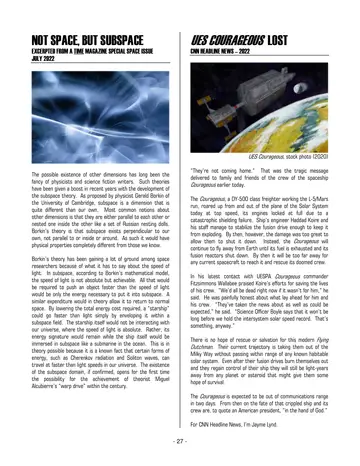
The Courageous, a DY-500 class freighter working the L-5/Mars run, roared up from and out of the plane of the Solar System today at top speed, its engines locked at full due to a catastrophic shielding failure. Ship’s engineer Haddad Koire and his staff manage to stabilize the fusion drive enough to keep it from exploding. By then, however, the damage was too great to allow them to shut it down. Instead, the Courageous will continue to fly away from Earth until its fuel is exhausted and its fusion reactors shut down. By then it will be too far away for any current spacecraft to reach it and rescue its doomed crew.
In his latest contact with UESPA Courageous commander Fitzsimmons Wallabee praised Koire’s efforts for saving the lives of his crew. “We’d all be dead right now if it wasn’t for him,” he said. He was painfully honest about what lay ahead for him and his crew. “They’ve taken the news about as well as could be expected,” he said. “Science Officer Boyle says that it won’t be long before we hold the intersystem solar speed record. That’s something, anyway.”
There is no hope of rescue or salvation for this modern Flying Dutchman. Their current trajectory is taking them out of the Milky Way without passing within range of any known habitable solar system. Even after their fusion drives burn themselves out and they regain control of their ship they will still be light-years away from any planet or asteroid that might give them some hope of survival.
The Courageous is expected to be out of communications range in two days. From then on the fate of that crippled ship and its crew are, to quote an American president, “in the hand of God.”
For CNN Headline News, I’m Jayme Lynd.
Venus Transformed?
UNS science wire – 11 November 2024
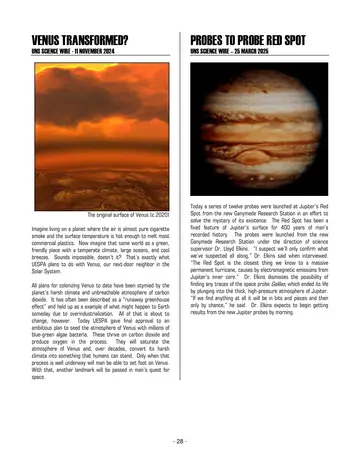
Imagine living on a planet where the air is almost pure cigarette smoke and the surface temperature is hot enough to melt most commercial plastics. Now imagine that same world as a green, friendly place with a temperate climate, large oceans, and cool breezes. Sounds impossible, doesn’t it? That’s exactly what UESPA plans to do with Venus, our next-door neighbor in the Solar System.
All plans for colonizing Venus to date have been stymied by the planet’s harsh climate and unbreathable atmosphere of carbon dioxide. It has often been described as a “runaway greenhouse effect” and held up as a example of what might happen to Earth someday due to overindustrialization. All of that is about to change, however. Today UESPA gave final approval to an ambitious plan to seed the atmosphere of Venus with millions of blue-green algae bacteria. These thrive on carbon dioxide and produce oxygen in the process. They will saturate the atmosphere of Venus and, over decades, convert its harsh climate into something that humans can stand. Only when that process is well underway will man be able to set foot on Venus. With that, another landmark will be passed in man’s quest for space.
Probes to Probe Red Spot
UNS science wire – 25 March 2025
Today a series of twelve probes were launched at Jupiter’s Red Spot from the new Ganymede Research Station in an effort to solve the mystery of its existence. The Red Spot has been a fixed feature of Jupiter’s surface for 400 years of man’s recorded history. The probes were launched from the new Ganymede Research Station under the direction of science supervisor Dr. Lloyd Elkins. “I suspect we’ll only confirm what we’ve suspected all along,” Dr. Elkins said when interviewed. “The Red Spot is the closest thing we know to a massive permanent hurricane, causes by electromagnetic emissions from Jupiter’s inner core.” Dr. Elkins dismisses the possibility of finding any traces of the space probe Galileo, which ended its life by plunging into the thick, high-pressure atmosphere of Jupiter. “If we find anything at all it will be in bits and pieces and then only by chance,” he said. Dr. Elkins expects to begin getting results from the new Jupiter probes by morning.