9.3 Civilian Starships
Entries cover the civilian vessels of the Baton Rouge era, including the Provider class tug associated with the great warp superconvoys, the Hunter class corvette, the Masters class tug, the Cabot class trawler, and the Hercules class transport, followed by the complete list of authorized, reallocated, and unbuilt Baton Rouge generation starship classes.
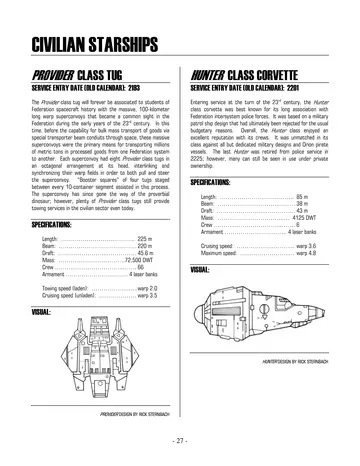
Provider Class Tug
Service entry date (old calendar): 2193
The Provider class tug will forever be associated to students of Federation spacecraft history with the massive, 100-kilometer long warp superconvoys that became a common sight in the Federation during the early years of the 23rd century. In this time, before the capability for bulk mass transport of goods via special transporter beam conduits through space, these massive superconvoys were the primary means for transporting millions of metric tons in processed goods from one Federation system to another. Each superconvoy had eight Provider class tugs in an octagonal arrangement at its head, interlinking and synchronizing their warp fields in order to both pull and steer the superconvoy. "Booster squares" of four tugs staged between every 10-container segment assisted in this process. The proverbial superconvoy has since gone the way of the dinosaur; however, plenty of Provider class tugs still provide towing services in the civilian sector even today.
Specifications:
- Length: 225 m
- Beam: 220 m
- Draft: 45.6 m
- Mass: 72,500 DWT
- Crew: 66
- Armament: 4 laser banks
- Towing speed (laden): warp 2.0
- Cruising speed (unladen): warp 3.5
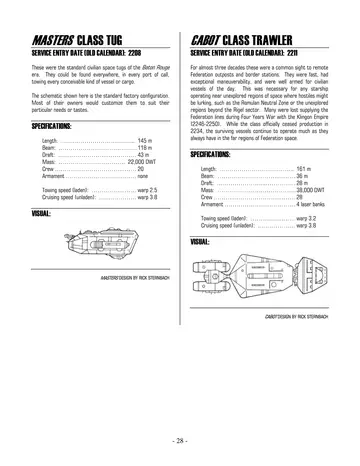
Hunter Class Corvette
Service entry date (old calendar): 2201
Entering service at the turn of the 23rd century, the Hunter class corvette was best known for its long association with Federation intersystem police forces. It was based on a military patrol ship design that had ultimately been rejected for the usual budgetary reasons. Overall, the Hunter class enjoyed an excellent reputation with its crews. It was unmatched in its class against all but dedicated military designs and Orion pirate vessels. The last Hunter was retired from police service in 2225; however, many can still be seen in use under private ownership.
Specifications:
- Length: 85 m
- Beam: 38 m
- Draft: 43 m
- Mass: 4125 DWT
- Crew: 6
- Armament: 4 laser banks
- Cruising speed: warp 3.6
- Maximum speed: warp 4.8
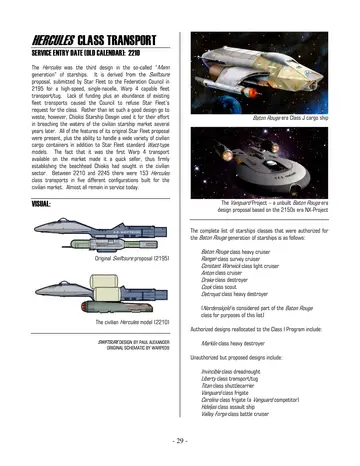
Masters Class Tug
Service entry date (old calendar): 2208
These were the standard civilian space tugs of the Baton Rouge era. They could be found everywhere, in every port of call, towing every conceivable kind of vessel or cargo.
The schematic shown here is the standard factory configuration. Most of their owners would customize them to suit their particular needs or tastes.
Specifications:
- Length: 145 m
- Beam: 118 m
- Draft: 43 m
- Mass: 22,000 DWT
- Crew: 20
- Armament: none
- Towing speed (laden): warp 2.5
- Cruising speed (unladen): warp 3.8
Cabot Class Trawler
Service entry date (old calendar): 2211
For almost three decades these were a common sight to remote Federation outposts and border stations. They were fast, had exceptional maneuverability, and were well armed for civilian vessels of the day. This was necessary for any starship operating near unexplored regions of space where hostiles might be lurking, such as the Romulan Neutral Zone or the unexplored regions beyond the Rigel sector. Many were lost supplying the Federation lines during Four Years War with the Klingon Empire (2246-2250). While the class officially ceased production in 2234, the surviving vessels continue to operate much as they always have in the far regions of Federation space.
Specifications:
- Length: 161 m
- Beam: 36 m
- Draft: 28 m
- Mass: 38,000 DWT
- Crew: 28
- Armament: 4 laser banks
- Towing speed (laden): warp 3.2
- Cruising speed (unladen): warp 3.8
Hercules Class Transport
Service entry date (old calendar): 2210
The Hercules was the third design in the so-called "Mann generation" of starships. It is derived from the Swiftsure proposal, submitted by Star Fleet to the Federation Council in 2195 for a high-speed, single-nacelle, Warp 4 capable fleet transport/tug. Lack of funding plus an abundance of existing fleet transports caused the Council to refuse Star Fleet's request for the class. Rather than let such a good design go to waste, however, Chiokis Starship Desgin used it for their effort in breaching the waters of the civilian starship market several years later. All of the features of its original Star Fleet proposal were present, plus the ability to handle a wide variety of civilian cargo containers in addition to Star Fleet standard Watt-type modules. The fact that it was the first Warp 4 transport available on the market made it a quick seller, thus firmly establishing the beachhead Chiokis had sought in the civilian sector. Between 2210 and 2245 there were 153 Hercules class transports in five different configurations built for the civilian market. Almost all remain in service today.
The complete list of starships classes that were authorized for the Baton Rouge generation of starships is as follows:
- Baton Rouge class heavy cruiser
- Ranger class survey cruiser
- Constant Warwick class light cruiser
- Anton class cruiser
- Drake class destroyer
- Cook class scout
- Detroyat class heavy destroyer
(Nordenskjold is considered part of the Baton Rouge class for purposes of this list)
Authorized designs reallocated to the Class I Program include:
- Marklin class heavy destroyer
Unauthorized but proposed designs include:
- Invincible class dreadnought
- Liberty class transport/tug
- Titan class shuttlecarrier
- Vanguard class frigate
- Carolina class frigate (a Vanguard competitor)
- Hdeljas class assault ship
- Valley Forge class battle cruiser