10.2 Star Fleet Starships
Detailed class entries cover the Star Fleet vessels of the Class I and Class II eras, including the Constitution class heavy cruiser, the single-nacelled Saladin destroyer and Hermes scout, the Ptolemy transport/tug and its container system, the overgunned Marklin heavy destroyer, the Independence transport, the Class II container ships, the Sherman cargo drone, the canted-pylon Larson destroyer and Nelson scout, the Andorian-built Loknar frigate, the Surya and Coventry Anton-derived frigates, the inexpensive Kearsarge light cruiser, the tandem-engine Pompey destroyer, the troubled Akula destroyer, the Santee shuttlecarrier, the phaser-armed Kiaga and Agilis perimeter action ships, and the Miranda cruiser.
Constitution Class Heavy Cruiser
Service entry date (old calendar): 2222
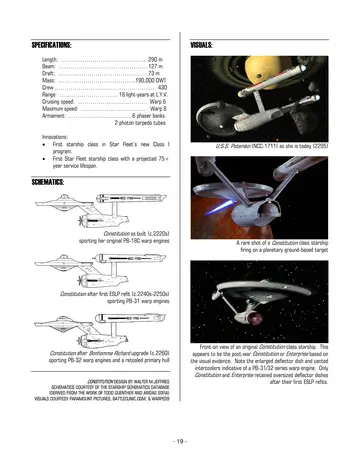
The most famous of all Class I starships, largely due to the exploits of the Enterprise (NCC-1701), the Constitution class starships were the original backbone of the Class I fleet. They were designed to be true multi-mission ships, excelling in both the military and exploration roles. For the first quarter-century of their service lives they were the great explorers, surveying and charting much of what remained of unexplored space within Federation borders (and sometimes without). The Four Years War with the Klingon Empire called upon them in the military role, in which they distinguished themselves in every battle they fought. Upgrades to phaser weaponry in 2247 made them the most powerful capital ships of their time. The valuable Constitution class was removed from the war front, though, once more dedicated combat Class I starships became available, and returned to assignments more worthy of their multi-mission construction. They would continue operating in this manner for the rest of their service lives.
The Constitution class was not the first starship class to serve Star Fleet beyond a standard service lifespan of 30 Terran years. It was, however, the first in which the concept of an extended service life far beyond the norm was applied on a class basis (as opposed to selected ships). This was made possible by its all-tritanium hull and frame, which had already extended the service lives of the older Horizon, Archon, and Baton Rouge era starship classes. The base frame of a Class I heavy cruiser had a theoretical service lifespan of a century (100 Terran years) given proper maintenance and no exposure to extreme stresses. As a whole, though, the Starship Design Bureau rated the lifespan for a Constitution class heavy cruiser at three-quarters of a century (75 Terran years). This allowed for both irregular hull and frame stressing during extreme missions and periodic overhauls of both major and minor ship’s components and onboard systems. An approximate 25-year cycle was established for major overhauls and changeouts of all critical starship components. These would usually last 1-2 years (the linear warp refits of the late 2260s and early 2270s lasting 2½ years). In the meantime, minor overhauls (6-9 months) would occur after every five-year mission while ship’s stores were being replenished and its personnel rotated. A Class I heavy cruiser could thus serve Star Fleet in this manner for 75-80 years before being placed in ready reserve for another 20-30 years before final decommissioning. This meant Star Fleet could always count on having a fleet of spaceworthy starships at its disposal — a luxury that it had never enjoyed before. The Constitution class heavy cruisers were the first to demonstrate the wisdom of such planning. Extended service life program (ESLP) refits, such as those pioneered with the Constitution class, are now a standard part of Star Fleet support operations.
It had been the original intent of Star Fleet to refit all Constitution class starships with PB-31 warp engines starting around 2245. This would have taken place during their first regularly scheduled ESLP refit. The outbreak of the Four Years War in 2246 changed all that. Starships that had already been docked for their ESLP refits were hurriedly put back together and sent to the war front with their original PB-18 warp engines. Because of this, Constitution (NCC-1700) and Enterprise (NCC-1701) were the only two Class I heavy cruisers that received PB-31 warp engines prior to the war, since their refits were already well underway when the war broke out. The others would have to wait for upgraded engines until after the war, by which time the new PB-32 had passed Star Fleet acceptance tests. The remainder of the Constitution class received PB-32 warp engines during post-war ESLP refits. Constitution and Enterprise had to wait until 2260 for theirs.
Two additional build groups of the Constitution class were authorized as part of Star Fleet’s expansion during and after the Four Years War. These are often referred to as the Bonhomme Richard and Achernar sub-classes due to slight variances in design. Bonhomme Richard was the first with PB-32 warp engines “out of the yard,” while Achernar was the first to be fitted with PB-47s and an early version of Star Fleet’s modern dual-purpose deflector grid system.
There is only one “original” Constitution class heavy cruiser still in Star Fleet. The Potemkin (NCC-1711) was converted to a training ship shortly after the Four Years War. It became the main Class I training starship after the decommissioning (and subsequent scrapping) of the aged Class I prototype Republic (NCC-1371) in 2257. It never received a linear warp refit due to its training vessel status. The Potemkin was decommissioned earlier this year and placed in the Star Fleet Reserve. Plans are already underway to convert it to a museum ship at Memory Alpha within the next few years. Its retirement marks the end of one of the most pivotal eras in Star Fleet starship history.
Specifications:
- Length: 290 m
- Beam: 127 m
- Draft: 73 m
- Mass: 190,000 DWT
- Crew: 430
- Range: 18 light-years at L.Y.V.
- Cruising speed: Warp 6
- Maximum speed: Warp 8
- Armament: 6 phaser banks, 2 photon torpedo tubes
Innovations:
- First starship class in Star Fleet’s new Class I program.
- First Star Fleet starship class with a projected 75+ year service lifespan.
Saladin Class Destroyer & Hermes Class Scout
Service entry date (old calendar): 2224
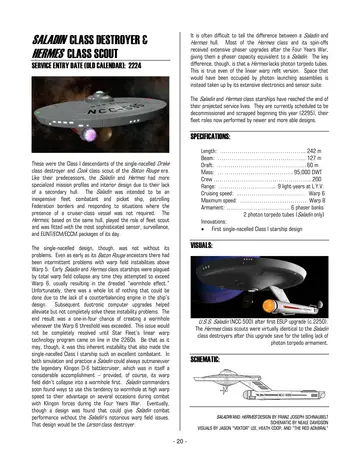
These were the Class I descendants of the single-nacelled Drake class destroyer and Cook class scout out of the Baton Rouge era. Like their predecessors, the Saladin and Hermes had more specialized mission profiles and interior design due to their lack of a secondary hull. The Saladin was intended to be an inexpensive fleet combatant and picket ship, patrolling Federation borders and responding to situations where the presence of a cruiser-class vessel was not required. The Hermes, based on the same hull, played the role of fleet scout and was fitted with the most sophisticated sensor, surveillance, and ELINT/ECM/ECCM packages of its day.
The single-nacelled design, though, was not without its problems. Even as early as its Baton Rouge ancestors there had been intermittent problems with warp field instabilities above Warp 5. Early Saladin and Hermes class starships were plagued by total warp field collapse any time they attempted to exceed Warp 6, usually resulting in the dreaded “wormhole effect.” Unfortunately, there was a whole lot of nothing that could be done due to the lack of a counterbalancing engine in the ship’s design. Subsequent duotronic computer upgrades helped alleviate but not completely solve these instability problems. The end result was a one-in-four chance of creating a wormhole whenever the Warp 6 threshold was exceeded. This issue would not be completely resolved until Star Fleet’s linear warp technology program came on line in the 2260s. Be that as it may, though, it was this inherent instability that also made the single-nacelled Class I starship such an excellent combatant. In both simulation and practice a Saladin could always outmaneuver the legendary Klingon D-6 battlecruiser, which was in itself a considerable accomplishment — provided, of course, its warp field didn’t collapse into a wormhole first. Saladin commanders soon found ways to use this tendency to wormhole at high warp speed to their advantage on several occasions during combat with Klingon forces during the Four Years War. Eventually, though, a design was found that could give Saladin combat performance without the Saladin’s notorious warp field issues. That design would be the Larson class destroyer.
It is often difficult to tell the difference between a Saladin and Hermes hull. Most of the Hermes class and its spin-offs received extensive phaser upgrades after the Four Years War, giving them a phaser capacity equivalent to a Saladin. The key difference, though, is that a Hermes lacks photon torpedo tubes. This is true even of the linear warp refit version. Space that would have been occupied by photon launching assemblies is instead taken up by its extensive electronics and sensor suite.
The Saladin and Hermes class starships have reached the end of their projected service lives. They are currently scheduled to be decommissioned and scrapped beginning this year (2295), their fleet roles now performed by newer and more able designs.
Specifications:
- Length: 242 m
- Beam: 127 m
- Draft: 60 m
- Mass: 95,000 DWT
- Crew: 200
- Range: 9 light-years at L.Y.V.
- Cruising speed: Warp 6
- Maximum speed: Warp 8
- Armament: 6 phaser banks, 2 photon torpedo tubes (Saladin only)
Innovations:
- First single-nacelled Class I starship design.
Ptolemy Class Transport/Tug and Container System
Service entry date (old calendar): 2224
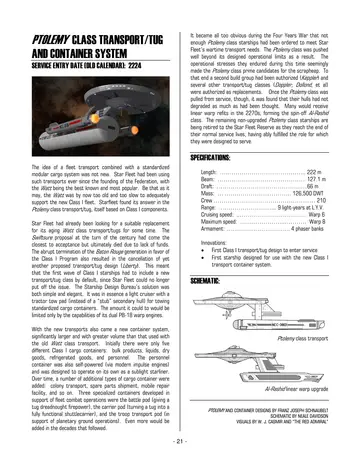
The idea of a fleet transport combined with a standardized modular cargo system was not new. Star Fleet had been using such transports ever since the founding of the Federation, with the Watt being the best known and most popular. Be that as it may, the Watt was by now too old and too slow to adequately support the new Class I fleet. Star Fleet found its answer in the Ptolemy class transport/tug, itself based on Class I components.
Star Fleet had already been looking for a suitable replacement for its aging Watt class transport/tugs for some time. The Swiftsure proposal at the turn of the century had come the closest to acceptance but ultimately died due to lack of funds. The abrupt termination of the Baton Rouge generation in favor of the Class I Program also resulted in the cancellation of yet another proposed transport/tug design (Liberty). This meant that the first wave of Class I starships had to include a new transport/tug class by default, since Star Fleet could no longer put off the issue. The Starship Design Bureau’s solution was both simple and elegant. It was in essence a light cruiser with a tractor tow pad (instead of a “stub” secondary hull) for towing standardized cargo containers. The amount it could tow would be limited only by the capabilities of its dual PB-18 warp engines.
With the new transports also came a new container system, significantly larger and with greater volume than that used with the old Watt class transport. Initially there were only five different Class I cargo containers: bulk products, liquids, dry goods, refrigerated goods, and personnel. The personnel container was also self-powered (via modern impulse engines) and was designed to operate on its own as a sublight starliner. Over time, a number of additional types of cargo container were added: colony transport, spare parts shipment, mobile repair facility, and so on. Three specialized containers developed in support of fleet combat operations were the battle pod (giving a tug dreadnought firepower), the carrier pod (turning a tug into a fully functional shuttlecarrier), and the troop transport pod (in support of planetary ground operations). Even more would be added in the decades that followed.
It became all too obvious during the Four Years War that not enough Ptolemy class starships had been ordered to meet Star Fleet’s wartime transport needs. The Ptolemy class was pushed well beyond its designed operational limits as a result. The operational stresses they endured during this time seemingly made the Ptolemy class prime candidates for the scrapheap. To that end a second build group had been authorized (Keppler) and several other transport/tug classes (Doppler, Dollond, et al) were authorized as replacements. Once the Ptolemy class was pulled from service, though, it was found that their hulls had not degraded as much as had been thought. Many would receive linear warp refits in the 2270s, forming the spin-off Al-Rashid class. The remaining non-upgraded Ptolemy class starships are being retired to the Star Fleet Reserve as they reach the end of their normal service lives, having ably fulfilled the role for which they were designed to serve.
Specifications:
- Length: 222 m
- Beam: 127.1 m
- Draft: 66 m
- Mass: 126,500 DWT
- Crew: 210
- Range: 9 light-years at L.Y.V.
- Cruising speed: Warp 6
- Maximum speed: Warp 8
- Armament: 4 phaser banks
Innovations:
- First Class I transport/tug design to enter service.
- First starship designed for use with the new Class I transport container system.
Marklin Class Heavy Destroyer
Service entry date (old calendar): 2228
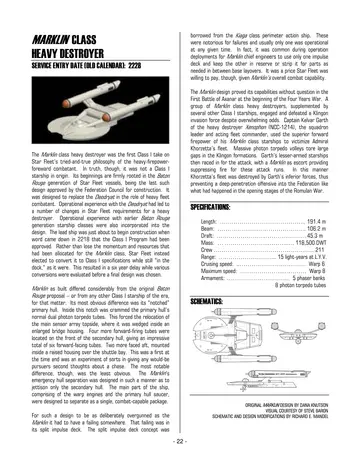
The Marklin class heavy destroyer was the first Class I take on Star Fleet’s tried-and-true philosophy of the heavy-firepower foreward combatant. In truth, though, it was not a Class I starship in origin. Its beginnings are firmly rooted in the Baton Rouge generation of Star Fleet vessels, being the last such design approved by the Federation Council for construction. It was designed to replace the Deodryat in the role of heavy fleet combatant. Operational experience with the Deodryat had led to a number of changes in Star Fleet requirements for a heavy destroyer. Operational experience with earlier Baton Rouge generation starship classes were also incorporated into the design. The lead ship was just about to begin construction when word came down in 2218 that the Class I Program had been approved. Rather than lose the momentum and resources that had been allocated for the Marklin class, Star Fleet instead elected to convert it to Class I specifications while still “in the dock,” as it were. This resulted in a six year delay while various conversions were evaluated before a final design was chosen.
Marklin as built differed considerably from the original Baton Rouge proposal — or from any other Class I starship of the era, for that matter. Its most obvious difference was its “notched” primary hull. Inside this notch was crammed the primary hull’s normal dual photon torpedo tubes. This forced the relocation of the main sensor array topside, where it was wedged inside an enlarged bridge housing. Four more forward-firing tubes were located on the front of the secondary hull, giving an impressive total of six forward-facing tubes. Two more faced aft, mounted inside a raised housing over the shuttle bay. This was a first at the time and was an experiment of sorts in giving any would-be pursuers second thoughts about a chase. The most notable difference, though, was the least obvious. The Marklin’s emergency hull separation was designed in such a manner as to jettison only the secondary hull. The main part of the ship, comprising of the warp engines and the primary hull saucer, were designed to separate as a single, combat-capable package.
For such a design to be as deliberately overgunned as the Marklin it had to have a failing somewhere. That failing was in its split impulse deck. The split impulse deck concept was borrowed from the Kiaga class perimeter action ship. These were notorious for failures and usually only one was operational at any given time. In fact, it was common during operation deployments for Marklin chief engineers to use only one impulse deck and keep the other in reserve or strip it for parts as needed in between base layovers. It was a price Star Fleet was willing to pay, though, given Marklin’s overall combat capability.
The Marklin design proved its capabilities without question in the First Battle of Axanar at the beginning of the Four Years War. A group of Marklin class heavy destroyers, supplemented by several other Class I starships, engaged and defeated a Klingon invasion force despite overwhelming odds. Captain Kelvar Garth of the heavy destroyer Xenophon (NCC-1214), the squadron leader and acting fleet commander, used the superior forward firepower of his Marklin class starships to victimize Admiral Khorzetta’s fleet. Massive photon torpedo volleys tore large gaps in the Klingon formations. Garth’s lesser-armed starships then raced in for the attack, with a Marklin as escort providing suppressing fire for these attack runs. In this manner Khorzetta’s fleet was destroyed by Garth’s inferior forces, thus preventing a deep-penetration offensive into the Federation like what had happened in the opening stages of the Romulan War.
Specifications:
- Length: 191.4 m
- Beam: 106.2 m
- Draft: 45.3 m
- Mass: 118,500 DWT
- Crew: 211
- Range: 15 light-years at L.Y.V.
- Cruising speed: Warp 6
- Maximum speed: Warp 8
- Armament: 5 phaser banks, 8 photon torpedo tubes
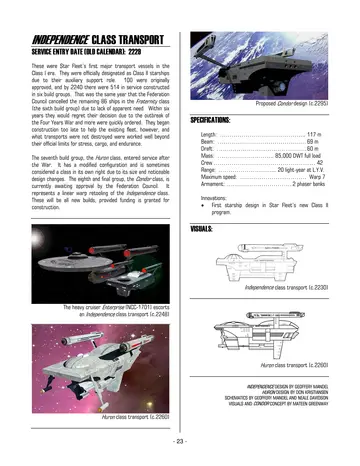
Independence Class Transport
Service entry date (old calendar): 2229
These were Star Fleet’s first major transport vessels in the Class I era. They were officially designated as Class II starships due to their auxiliary support role. 100 were originally approved, and by 2240 there were 514 in service constructed in six build groups. That was the same year that the Federation Council cancelled the remaining 86 ships in the Fraternity class (the sixth build group) due to lack of apparent need. Within six years they would regret their decision due to the outbreak of the Four Years War and more were quickly ordered. They began construction too late to help the existing fleet, however, and what transports were not destroyed were worked well beyond their official limits for stress, cargo, and endurance.
The seventh build group, the Huron class, entered service after the War. It has a modified configuration and is sometimes considered a class in its own right due to its size and noticeable design changes. The eighth and final group, the Condor class, is currently awaiting approval by the Federation Council. It represents a linear warp retooling of the Independence class. These will be all new builds, provided funding is granted for construction.
Specifications:
- Length: 117 m
- Beam: 69 m
- Draft: 60 m
- Mass: 85,000 DWT full load
- Crew: 42
- Range: 20 light-year at L.Y.V.
- Maximum speed: Warp 7
- Armament: 2 phaser banks
Innovations:
- First starship design in Star Fleet’s new Class II program.
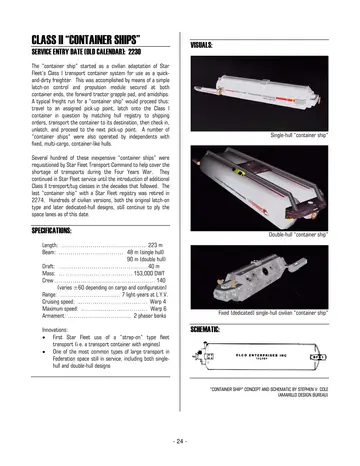
Class II “Container Ships”
Service entry date (old calendar): 2230
The “container ship” started as a civilian adaptation of Star Fleet’s Class I transport container system for use as a quick-and-dirty freighter. This was accomplished by means of a simple latch-on control and propulsion module secured at both container ends, the forward tractor grapple pad, and amidships. A typical freight run for a “container ship” would proceed thus: travel to an assigned pick-up point, latch onto the Class I container in question by matching hull registry to shipping orders, transport the container to its destination, then check in, unlatch, and proceed to the next pick-up point. A number of “container ships” were also operated by independents with fixed, multi-cargo, container-like hulls.
Several hundred of these inexpensive “container ships” were requisitioned by Star Fleet Transport Command to help cover the shortage of transports during the Four Years War. They continued in Star Fleet service until the introduction of additional Class II transport/tug classes in the decades that followed. The last “container ship” with a Star Fleet registry was retired in 2274. Hundreds of civilian versions, both the original latch-on type and later dedicated-hull designs, still continue to ply the space lanes as of this date.
Specifications:
- Length: 223 m
- Beam: 48 m (single hull) / 90 m (double hull)
- Draft: 40 m
- Mass: 153,000 DWT
- Crew: 140 (varies ±60 depending on cargo and configuration)
- Range: 7 light-years at L.Y.V.
- Cruising speed: Warp 4
- Maximum speed: Warp 6
- Armament: 2 phaser banks
Innovations:
- First Star Fleet use of a “strap-on” type fleet transport (i.e. a transport container with engines).
- One of the most common types of large transport in Federation space still in service, including both single-hull and double-hull designs.
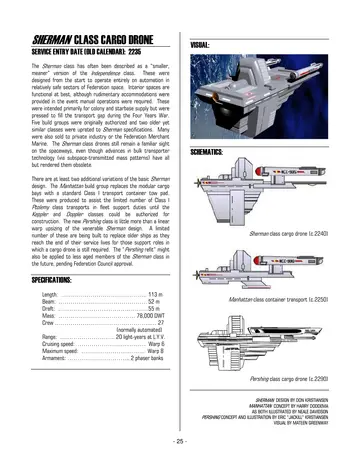
Sherman Class Cargo Drone
Service entry date (old calendar): 2235
The Sherman class has often been described as a “smaller, meaner” version of the Independence class. These were designed from the start to operate entirely on automation in relatively safe sectors of Federation space. Interior spaces are functional at best, although rudimentary accommodations were provided in the event manual operations were required. These were intended primarily for colony and starbase supply but were pressed to fill the transport gap during the Four Years War. Five build groups were originally authorized and two older yet similar classes were uprated to Sherman specifications. Many were also sold to private industry or the Federation Merchant Marine. The Sherman class drones still remain a familiar sight on the spaceways, even though advances in bulk transporter technology (via subspace-transmitted mass patterns) have all but rendered them obsolete.
There are at least two additional variations of the basic Sherman design. The Manhattan build group replaces the modular cargo bays with a standard Class I transport container tow pad. These were produced to assist the limited number of Class I Ptolemy class transports in fleet support duties until the Keppler and Doppler classes could be authorized for construction. The new Pershing class is little more than a linear warp upsizing of the venerable Sherman design. A limited number of these are being built to replace older ships as they reach the end of their service lives for those support roles in which a cargo drone is still required. The “Pershing refit” might also be applied to less aged members of the Sherman class in the future, pending Federation Council approval.
Specifications:
- Length: 113 m
- Beam: 52 m
- Draft: 55 m
- Mass: 78,000 DWT
- Crew: 27 (normally automated)
- Range: 20 light-years at L.Y.V.
- Cruising speed: Warp 6
- Maximum speed: Warp 8
- Armament: 2 phaser banks
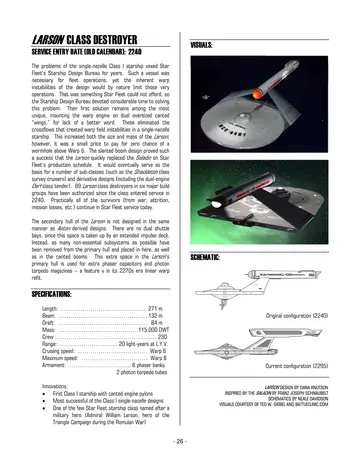
Larson Class Destroyer
Service entry date (old calendar): 2240
The problems of the single-nacelle Class I starship vexed Star Fleet’s Starship Design Bureau for years. Such a vessel was necessary for fleet operations, yet the inherent warp instabilities of the design would by nature limit those very operations. That was something Star Fleet could not afford, so the Starship Design Bureau devoted considerable time to solving this problem. Their first solution remains among the most unique, mounting the warp engine on dual oversized canted “wings,” for lack of a better word. These eliminated the crossflows that created warp field instabilities in a single-nacelle starship. This increased both the size and mass of the Larson; however, it was a small price to pay for zero chance of a wormhole above Warp 6. The slanted boom design proved such a success that the Larson quickly replaced the Saladin on Star Fleet’s production schedule. It would eventually serve as the basis for a number of sub-classes (such as the Shackleton class survey cruisers) and derivative designs (including the dual-engine Derf class tender). 89 Larson class destroyers in six major build groups have been authorized since the class entered service in 2240. Practically all of the survivors (from war, attrition, mission losses, etc.) continue in Star Fleet service today.
The secondary hull of the Larson is not designed in the same manner as Anton derived designs. There are no dual shuttle bays, since this space is taken up by an extended impulse deck. Instead, as many non-essential subsystems as possible have been removed from the primary hull and placed in here, as well as in the canted booms. This extra space in the Larson’s primary hull is used for extra phaser capacitors and photon torpedo magazines — a feature retained in its 2270s era linear warp refit.
Specifications:
- Length: 271 m
- Beam: 132 m
- Draft: 84 m
- Mass: 115,000 DWT
- Crew: 230
- Range: 20 light-years at L.Y.V.
- Cruising speed: Warp 6
- Maximum speed: Warp 8
- Armament: 6 phaser banks, 2 photon torpedo tubes
Innovations:
- First Class I starship with canted engine pylons.
- Most successful of the Class I single-nacelle designs.
- One of the few Star Fleet starship class named after a military hero (Admiral William Larson, hero of the Triangle Campaign during the Romulan War).
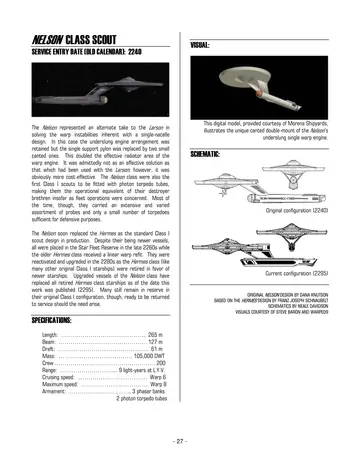
Nelson Class Scout
Service entry date (old calendar): 2240
The Nelson represented an alternate take to the Larson in solving the warp instabilities inherent with a single-nacelle design. In this case the underslung engine arrangement was retained but the single support pylon was replaced by two small canted ones. This doubled the effective radiator area of the warp engine. It was admittedly not as an effective solution as that which had been used with the Larson; however, it was obviously more cost-effective. The Nelson class were also the first Class I scouts to be fitted with photon torpedo tubes, making them the operational equivalent of their destroyer brethren insofar as fleet operations were concerned. Most of the time, though, they carried an extensive and varied assortment of probes and only a small number of torpedoes sufficient for defensive purposes.
The Nelson soon replaced the Hermes as the standard Class I scout design in production. Despite their being newer vessels, all were placed in the Star Fleet Reserve in the late 2260s while the older Hermes class received a linear warp refit. They were reactivated and upgraded in the 2280s as the Hermes class (like many other original Class I starships) were retired in favor of newer starships. Upgraded vessels of the Nelson class have replaced all retired Hermes class starships as of the date this work was published (2295). Many still remain in reserve in their original Class I configuration, though, ready to be returned to service should the need arise.
Specifications:
- Length: 265 m
- Beam: 127 m
- Draft: 61 m
- Mass: 105,000 DWT
- Crew: 200
- Range: 9 light-years at L.Y.V.
- Cruising speed: Warp 6
- Maximum speed: Warp 8
- Armament: 3 phaser banks, 2 photon torpedo tubes
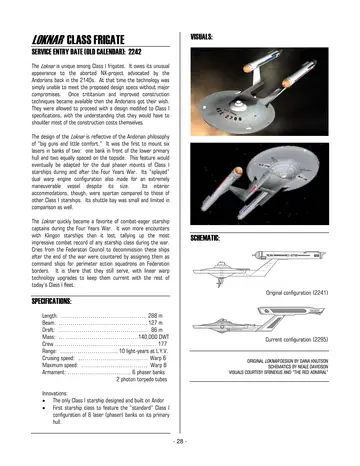
Loknar Class Frigate
Service entry date (old calendar): 2242
The Loknar is unique among Class I frigates. It owes its unusual appearance to the aborted NX-project advocated by the Andorians back in the 2140s. At that time the technology was simply unable to meet the proposed design specs without major compromises. Once trititanium and improved construction techniques became available then the Andorians got their wish. They were allowed to proceed with a design modified to Class I specifications, with the understanding that they would have to shoulder most of the construction costs themselves.
The design of the Loknar is reflective of the Andorian philosophy of “big guns and little comfort.” It was the first to mount six lasers in banks of two: one bank in front of the lower primary hull and two equally spaced on the topside. This feature would eventually be adapted for the dual phaser mounts of Class I starships during and after the Four Years War. Its “splayed” dual warp engine configuration also made for an extremely maneuverable vessel despite its size. Its interior accommodations, though, were spartan compared to those of other Class I starships. Its shuttle bay was small and limited in comparison as well.
The Loknar quickly became a favorite of combat-eager starship captains during the Four Years War. It won more encounters with Klingon starships than it lost, tallying up the most impressive combat record of any starship class during the war. Cries from the Federation Council to decommission these ships after the end of the war were countered by assigning them as command ships for perimeter action squadrons on Federation borders. It is there that they still serve, with linear warp technology upgrades to keep them current with the rest of today’s Class I fleet.
Specifications:
- Length: 288 m
- Beam: 127 m
- Draft: 86 m
- Mass: 140,000 DWT
- Crew: 177
- Range: 10 light-years at L.Y.V.
- Cruising speed: Warp 6
- Maximum speed: Warp 8
- Armament: 6 phaser banks, 2 photon torpedo tubes
Innovations:
- The only Class I starship designed and built on Andor.
- First starship class to feature the “standard” Class I configuration of 6 laser (phaser) banks on its primary hull.
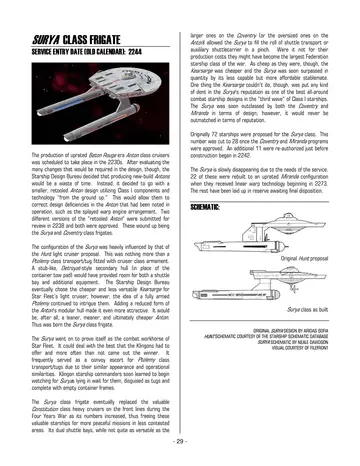
Surya Class Frigate
Service entry date (old calendar): 2244
The production of uprated Baton Rouge era Anton class cruisers was scheduled to take place in the 2230s. After evaluating the many changes that would be required in the design, though, the Starship Design Bureau decided that producing new-build Antons would be a waste of time. Instead, it decided to go with a smaller, retooled Anton design utilizing Class I components and technology “from the ground up.” This would allow them to correct design deficiencies in the Anton that had been noted in operation, such as the splayed warp engine arrangement. Two different versions of the “retooled Anton” were submitted for review in 2238 and both were approved. These wound up being the Surya and Coventry class frigates.
The configuration of the Surya was heavily influenced by that of the Hunt light cruiser proposal. This was nothing more than a Ptolemy class transport/tug fitted with cruiser class armament. A stub-like, Detroyat-style secondary hull (in place of the container tow pad) would have provided room for both a shuttle bay and additional equipment. The Starship Design Bureau eventually chose the cheaper and less versatile Kearsarge for Star Fleet’s light cruiser; however, the idea of a fully armed Ptolemy continued to intrigue them. Adding a reduced form of the Anton’s modular hull made it even more attractive. It would be, after all, a leaner, meaner, and ultimately cheaper Anton. Thus was born the Surya class frigate.
The Surya went on to prove itself as the combat workhorse of Star Fleet. It could deal with the best that the Klingons had to offer and more often than not came out the winner. It frequently served as a convoy escort for Ptolemy class transport/tugs due to their similar appearance and operational similarities. Klingon starship commanders soon learned to begin watching for Suryas lying in wait for them, disguised as tugs and complete with empty container frames.
The Surya class frigate eventually replaced the valuable Constitution class heavy cruisers on the front lines during the Four Years War as its numbers increased, thus freeing these valuable starships for more peaceful missions in less contested areas. Its dual shuttle bays, while not quite as versatile as the larger ones on the Coventry (or the oversized ones on the Anton) allowed the Surya to fill the roll of shuttle transport or auxiliary shuttlecarrier in a pinch. Were it not for their production costs they might have become the largest Federation starship class of the war. As cheap as they were, though, the Kearsarge was cheaper and the Surya was soon surpassed in quantity by its less capable but more affordable stablemate. One thing the Kearsarge couldn’t do, though, was put any kind of dent in the Surya’s reputation as one of the best all-around combat starship designs in the “third wave” of Class I starships. The Surya was soon outclassed by both the Coventry and Miranda in terms of design; however, it would never be outmatched in terms of reputation.
Originally 72 starships were proposed for the Surya class. This number was cut to 28 once the Coventry and Miranda programs were approved. An additional 11 were re-authorized just before construction began in 2242.
The Surya is slowly disappearing due to the needs of the service. 22 of these were rebuilt to an uprated Miranda configuration when they received linear warp technology beginning in 2273. The rest have been laid up in reserve awaiting final disposition.
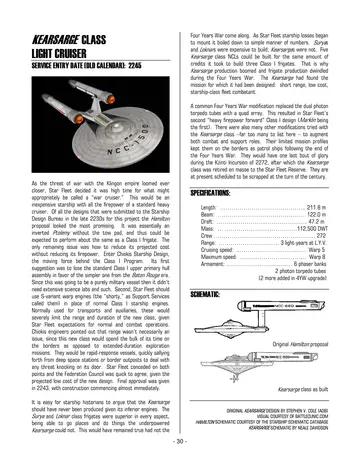
Kearsarge Class Light Cruiser
Service entry date (old calendar): 2245
As the threat of war with the Klingon empire loomed ever closer, Star Fleet decided it was high time for what might appropriately be called a “war cruiser.” This would be an inexpensive starship with all the firepower of a standard heavy cruiser. Of all the designs that were submitted to the Starship Design Bureau in the late 2230s for this project the Hamilton proposal looked the most promising. It was essentially an inverted Ptolemy without the tow pad, and thus could be expected to perform about the same as a Class I frigate. The only remaining issue was how to reduce its projected cost without reducing its firepower. Enter Chiokis Starship Design, the moving force behind the Class I Program. Its first suggestion was to lose the standard Class I upper primary hull assembly in favor of the simpler one from the Baton Rouge era. Since this was going to be a purely military vessel then it didn’t need extensive science labs and such. Second, Star Fleet should use S-variant warp engines (the “shorty,” as Support Services called them) in place of normal Class I starship engines. Normally used for transports and auxiliaries, these would severely limit the range and duration of the new class, given Star Fleet expectations for normal and combat operations. Chiokis engineers pointed out that range wasn’t necessarily an issue, since this new class would spend the bulk of its time on the borders as opposed to extended-duration exploration missions. They would be rapid-response vessels, quickly sallying forth from deep space stations or border outposts to deal with any threat knocking on its door. Star Fleet conceded on both points and the Federation Council was quick to agree, given the projected low cost of the new design. Final approval was given almost immediately, with construction commencing in 2243.
It is easy for starship historians to argue that the Kearsarge should have never been produced given its inferior engines. The Surya and Loknar class frigates were superior in every aspect, being able to go places and do things the underpowered Kearsarge could not. This would have remained true had not the Four Years War come along. As Star Fleet starship losses began to mount it boiled down to simple manner of numbers. Suryas and Loknars were expensive to build; Kearsarges were not. Five Kearsarge class NCLs could be built for the same amount of credits it took to build three Class I frigates. That is why Kearsarge production boomed and frigate production dwindled during the Four Years War. The Kearsarge had found the mission for which it had been designed: short range, low cost, starship-class fleet combatant.
A common Four Years War modification replaced the dual photon torpedo tubes with a quad array. This resulted in Star Fleet’s second “heavy firepower forward” Class I design (Marklin being the first). There were also many other modifications tried with the Kearsarge class — far too many to list here — to augment both combat and support roles. Their limited mission profiles kept them on the borders as patrol ships following the end of the Four Years War. They would have one last bout of glory during the Kzinti Incursion of 2272, after which the Kearsarge class was retired en masse to the Star Fleet Reserve. They are at present scheduled to be scrapped at the turn of the century.
Specifications:
- Length: 211.8 m
- Beam: 122.0 m
- Draft: 47.2 m
- Mass: 112,500 DWT
- Crew: 272
- Range: 3 light-years at L.Y.V.
- Cruising speed: Warp 5
- Maximum speed: Warp 8
- Armament: 6 phaser banks, 2 photon torpedo tubes (2 more added in 4YW upgrade)
Pompey Class Destroyer
Service entry date (old calendar): 2244
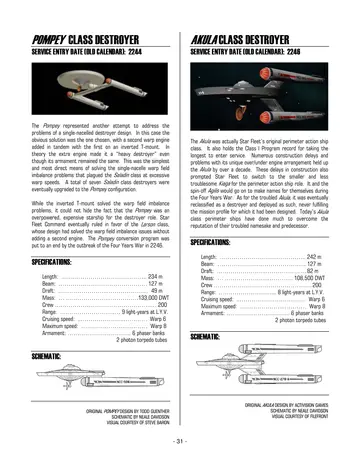
The Pompey represented another attempt to address the problems of a single-nacelled destroyer design. In this case the obvious solution was the one chosen, with a second warp engine added in tandem with the first on an inverted T-mount. In theory the extra engine made it a “heavy destroyer” even though its armament remained the same. This was the simplest and most direct means of solving the single-nacelle warp field balance problems that plagued the Saladin class at excessive warp speeds. A total of seven Saladin class destroyers were eventually upgraded to the Pompey configuration.
While the inverted T-mount solved the warp field imbalance problems, it could not hide the fact that the Pompey was an overpowered, expensive starship for the destroyer role. Star Fleet Command eventually ruled in favor of the Larson class, whose design had solved the warp field imbalance issues without adding a second engine. The Pompey conversion program was put to an end by the outbreak of the Four Years War in 2246.
Specifications:
- Length: 234 m
- Beam: 127 m
- Draft: 49 m
- Mass: 133,000 DWT
- Crew: 200
- Range: 9 light-years at L.Y.V.
- Cruising speed: Warp 6
- Maximum speed: Warp 8
- Armament: 6 phaser banks, 2 photon torpedo tubes
Akula Class Destroyer
Service entry date (old calendar): 2246
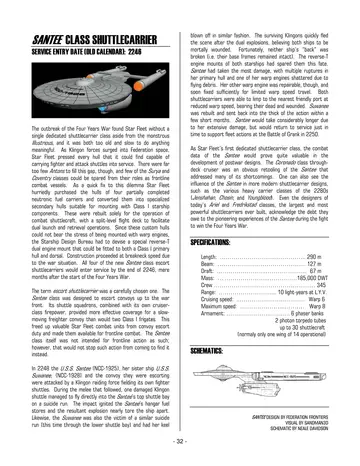
The Akula was actually Star Fleet’s original perimeter action ship class. It also holds the Class I Program record for taking the longest to enter service. Numerous construction delays and problems with its unique over/under engine arrangement held up the Akula by over a decade. These delays in construction also prompted Star Fleet to switch to the smaller and less troublesome Kiaga for the perimeter action ship role. It and the spin-off Agilis would go on to make names for themselves during the Four Years War. As for the troubled Akula, it was eventually reclassified as a destroyer and deployed as such, never fulfilling the mission profile for which it had been designed. Today’s Akula class perimeter ships have done much to overcome the reputation of their troubled namesake and predecessor.
Specifications:
- Length: 242 m
- Beam: 127 m
- Draft: 82 m
- Mass: 108,500 DWT
- Crew: 200
- Range: 8 light-years at L.Y.V.
- Cruising speed: Warp 6
- Maximum speed: Warp 8
- Armament: 6 phaser banks, 2 photon torpedo tubes
Santee Class Shuttlecarrier
Service entry date (old calendar): 2246
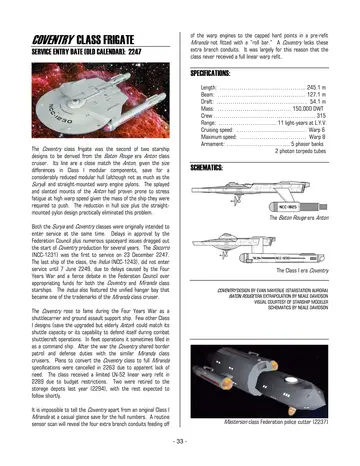
The outbreak of the Four Years War found Star Fleet without a single dedicated shuttlecarrier class aside from the monstrous Illustrious, and it was both too old and slow to do anything meaningful. As Klingon forces surged into Federation space, Star Fleet pressed every hull that it could find capable of carrying fighter and attack shuttles into service. There were far too few Antons to fill this gap, though, and few of the Surya and Coventry classes could be spared from their roles as frontline combat vessels. As a quick fix to this dilemma Star Fleet hurriedly purchased the hulls of four partially completed neutronic fuel carriers and converted them into specialized secondary hulls suitable for mounting with Class I starship components. These were rebuilt solely for the operation of combat shuttlecraft, with a split-level flight deck to facilitate dual launch and retrieval operations. Since these custom hulls could not bear the stress of being mounted with warp engines, the Starship Design Bureau had to devise a special reverse-T dual engine mount that could be fitted to both a Class I primary hull and dorsal. Construction proceeded at breakneck speed due to the war situation. All four of the new Santee class escort shuttlecarriers would enter service by the end of 2246, mere months after the start of the Four Years War.
The term escort shuttlecarrier was a carefully chosen one. The Santee class was designed to escort convoys up to the war front. Its shuttle squadrons, combined with its own cruiser-class firepower, provided more effective coverage for a slow-moving freighter convoy than would two Class I frigates. This freed up valuable Star Fleet combat units from convoy escort duty and made them available for frontline combat. The Santee class itself was not intended for frontline action as such; however, that would not stop such action from coming to find it instead.
In 2248 the U.S.S. Santee (NCC-1925), her sister ship U.S.S. Suwanee (NCC-1928) and the convoy they were escorting were attacked by a Klingon raiding force fielding its own fighter shuttles. During the melee that followed, one damaged Klingon shuttle managed to fly directly into the Santee’s top shuttle bay on a suicide run. The impact ignited the Santee’s hangar fuel stores and the resultant explosion nearly tore the ship apart. Likewise, the Suwanee was also the victim of a similar suicide run (this time through the lower shuttle bay) and had her keel blown off in similar fashion. The surviving Klingons quickly fled the scene after the dual explosions, believing both ships to be mortally wounded. Fortunately, neither ship’s “back” was broken (i.e. their base frames remained intact). The reverse-T engine mounts of both starships had spared them this fate. Santee had taken the most damage, with multiple ruptures in her primary hull and one of her warp engines shattered due to flying debris. Her other warp engine was repairable, though, and soon fixed sufficiently for limited warp speed travel. Both shuttlecarriers were able to limp to the nearest friendly port at reduced warp speed, bearing their dead and wounded. Suwanee was rebuilt and sent back into the thick of the action within a few short months. Santee would take considerably longer due to her extensive damage, but would return to service just in time to support fleet actions at the Battle of Grank in 2250.
As Star Fleet’s first dedicated shuttlecarrier class, the combat data of the Santee would prove quite valuable in the development of postwar designs. The Coronado class through-deck cruiser was an obvious retooling of the Santee that addressed many of its shortcomings. One can also see the influence of the Santee in more modern shuttlecarrier designs, such as the various heavy carrier classes of the 2280s (Jenshahan, Chosin, and Youngblood). Even the designers of today’s Ariel and Fredrikstad classes, the largest and most powerful shuttlecarriers ever built, acknowledge the debt they owe to the pioneering experiences of the Santee during the fight to win the Four Years War.
Specifications:
- Length: 290 m
- Beam: 127 m
- Draft: 67 m
- Mass: 185,000 DWT
- Crew: 345
- Range: 10 light-years at L.Y.V.
- Cruising speed: Warp 6
- Maximum speed: Warp 8
- Armament: 6 phaser banks, 2 photon torpedo tubes, up to 30 shuttlecraft (normally only one wing of 14 operational)
Coventry Class Frigate
Service entry date (old calendar): 2247
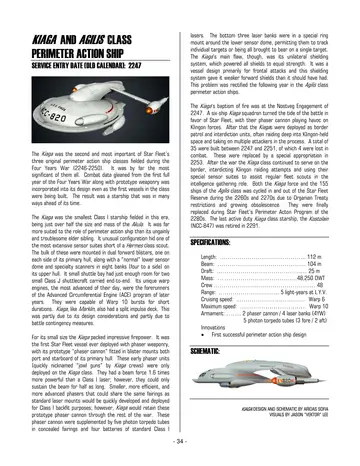
The Coventry class frigate was the second of two starship designs to be derived from the Baton Rouge era Anton class cruiser. Its lines are a close match to the Anton, given the size differences in Class I modular components, save for a considerably reduced modular hull (although not as much as the Surya) and straight-mounted warp engine pylons. The splayed and slanted mounts of the Anton had proven prone to stress fatigue at high warp speed given the mass of the ship they were required to push. The reduction in hull size plus the straight-mounted pylon design practically eliminated this problem.
Both the Surya and Coventry classes were originally intended to enter service at the same time. Delays in approval by the Federation Council plus numerous spaceyard issues dragged out the start of Coventry production for several years. The Socorro (NCC-1231) was the first to service on 23 December 2247. The last ship of the class, the Indus (NCC-1243), did not enter service until 7 June 2249, due to delays caused by the Four Years War and a fierce debate in the Federation Council over appropriating funds for both the Coventry and Miranda class starships. The Indus also featured the unified hangar bay that became one of the trademarks of the Miranda class cruiser.
The Coventry rose to fame during the Four Years War as a shuttlecarrier and ground assault support ship. Few other Class I designs (save the upgraded but elderly Anton) could match its shuttle capacity or its capability to defend itself during combat shuttlecraft operations. In fleet operations it sometimes filled in as a command ship. After the war the Coventry shared border patrol and defense duties with the similar Miranda class cruisers. Plans to convert the Coventry class to full Miranda specifications were cancelled in 2263 due to apparent lack of need. The class received a limited LN-52 linear warp refit in 2289 due to budget restrictions. Two were retired to the storage depots last year (2294), with the rest expected to follow shortly.
It is impossible to tell the Coventry apart from an original Class I Miranda at a casual glance save for the hull numbers. A routine sensor scan will reveal the four extra branch conduits feeding off of the warp engines to the capped hard points in a pre-refit Miranda not fitted with a “roll bar.” A Coventry lacks these extra branch conduits. It was largely for this reason that the class never received a full linear warp refit.
Specifications:
- Length: 245.1 m
- Beam: 127.1 m
- Draft: 54.1 m
- Mass: 150,000 DWT
- Crew: 315
- Range: 11 light-years at L.Y.V.
- Cruising speed: Warp 6
- Maximum speed: Warp 8
- Armament: 5 phaser banks, 2 photon torpedo tubes
Kiaga and Agilis Class Perimeter Action Ship
Service entry date (old calendar): 2247
The Kiaga was the second and most important of Star Fleet’s three original perimeter action ship classes fielded during the Four Years War (2246-2250). It was by far the most significant of them all. Combat data gleaned from the first full year of the Four Years War along with prototype weaponry was incorporated into its design even as the first vessels in the class were being built. The result was a starship that was in many ways ahead of its time.
The Kiaga was the smallest Class I starship fielded in this era, being just over half the size and mass of the Akula. It was far more suited to the role of perimeter action ship than its ungainly and troublesome elder sibling. Its unusual configuration hid one of the most extensive sensor suites short of a Hermes class scout. The bulk of these were mounted in dual forward blisters, one on each side of its primary hull, along with a “normal” lower sensor dome and specialty scanners in eight banks (four to a side) on its upper hull. Its small shuttle bay had just enough room for two small Class J shuttlecraft carried end-to-end. Its unique warp engines, the most advanced of their day, were the forerunners of the Advanced Circumferential Engine (ACE) program of later years. They were capable of Warp 10 bursts for short durations. Kiaga, like Marklin, also had a split impulse deck. This was partly due to its design considerations and partly due to battle contingency measures.
For its small size the Kiaga packed impressive firepower. It was the first Star Fleet vessel ever deployed with phaser weaponry, with its prototype “phaser cannon” fitted in blister mounts both port and starboard of its primary hull. These early phaser units (quickly nicknamed “jowl guns” by Kiaga crews) were only deployed on the Kiaga class. They had a beam force 1.6 times more powerful than a Class I laser; however, they could only sustain the beam for half as long. Smaller, more efficient, and more advanced phasers that could share the same fairings as standard laser mounts would be quickly developed and deployed for Class I backfit purposes; however, Kiaga would retain these prototype phaser cannon through the rest of the war. These phaser cannon were supplemented by five photon torpedo tubes in concealed fairings and four batteries of standard Class I lasers. The bottom three laser banks were in a special ring mount around the lower sensor dome, permitting them to track individual targets or being all brought to bear on a single target.
The Kiaga’s main flaw, though, was its unilateral shielding system, which powered all shields to equal strength. It was a vessel designed primarily for frontal attacks and this shielding system gave it weaker forward shields than it should have had. This problem was rectified the following year in the Agilis class perimeter action ships.
The Kiaga’s baptism of fire was at the Nostveg Engagement of 2247. A six-ship Kiaga squadron turned the tide of the battle in favor of Star Fleet, with their phaser cannon playing havoc on Klingon forces. After that the Kiagas were deployed as border patrol and interdiction units, often raiding deep into Klingon-held space and taking on multiple attackers in the process. A total of 35 were built between 2247 and 2251, of which 4 were lost in combat. These were replaced by a special appropriation in 2253. After the war the Kiaga class continued to serve on the border, interdicting Klingon raiding attempts and using their special sensor suites to assist regular fleet scouts in the intelligence gathering role. Both the Kiaga force and the 155 ships of the Agilis class was cycled in and out of the Star Fleet Reserve during the 2260s and 2270s due to Organian Treaty restrictions and growing obsolescence. They were finally replaced during Star Fleet’s Perimeter Action Program of the 2280s. The last active duty Kiaga class starship, the Kostolain (NCC-847) was retired in 2291.
Specifications:
- Length: 112 m
- Beam: 104 m
- Draft: 25 m
- Mass: 48,250 DWT
- Crew: 48
- Range: 5 light-years at L.Y.V.
- Cruising speed: Warp 6
- Maximum speed: Warp 10
- Armament: 2 phaser cannon / 4 laser banks (4YW), 5 photon torpedo tubes (3 fore / 2 aft)
Innovations:
- First successful perimeter action ship design.
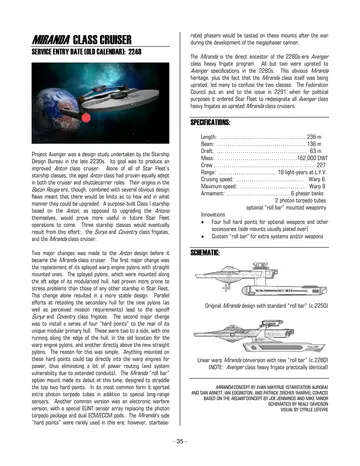
Miranda Class Cruiser
Service entry date (old calendar): 2248
Project Avenger was a design study undertaken by the Starship Design Bureau in the late 2230s. Its goal was to produce an improved Anton class cruiser. Alone of all of Star Fleet’s starship classes, the aged Anton class had proven equally adept in both the cruiser and shuttlecarrier roles. Their origins in the Baton Rouge era, though, combined with several obvious design flaws meant that there would be limits as to how and in what manner they could be upgraded. A purpose-built Class I starship based on the Anton, as opposed to upgrading the Antons themselves, would prove more useful in future Star Fleet operations to come. Three starship classes would eventually result from this effort: the Surya and Coventry class frigates, and the Miranda class cruiser.
Two major changes was made to the Anton design before it became the Miranda class cruiser. The first major change was the replacement of its splayed warp engine pylons with straight mounted ones. The splayed pylons, which were mounted along the aft edge of its modularized hull, had proven more prone to stress problems than those of any other starship in Star Fleet. This change alone resulted in a more stable design. Parallel efforts at retooling the secondary hull for the new pylons (as well as perceived mission requirements) lead to the spinoff Surya and Coventry class frigates. The second major change was to install a series of four “hard points” to the rear of its unique modular primary hull. These were two to a side, with one running along the edge of the hull, in the old location for the warp engine pylons, and another directly above the new straight pylons. The reason for this was simple. Anything mounted on these hard points could tap directly into the warp engines for power, thus eliminating a lot of power routing (and system vulnerability due to extended conduits). The Miranda “roll bar” option mount made its debut at this time, designed to straddle the top two hard points. In its most common form it sported extra photon torpedo tubes in addition to special long-range sensors. Another common version was an electronic warfare version, with a special ELINT sensor array replacing the photon torpedo package and dual ECM/ECCM pods. The Miranda’s side “hard points” were rarely used in this era; however, starbase-rated phasers would be tested on these mounts after the war during the development of the megaphaser cannon.
The Miranda is the direct ancestor of the 2280s-era Avenger class heavy frigate program. All but two were uprated to Avenger specifications in the 2280s. This obvious Miranda heritage, plus the fact that the Miranda class itself was being uprated, led many to confuse the two classes. The Federation Council put an end to the issue in 2291 when for political purposes it ordered Star Fleet to redesignate all Avenger class heavy frigates as uprated Miranda class cruisers.
Specifications:
- Length: 236 m
- Beam: 136 m
- Draft: 63 m
- Mass: 162,000 DWT
- Crew: 227
- Range: 18 light-years at L.Y.V.
- Cruising speed: Warp 6
- Maximum speed: Warp 8
- Armament: 6 phaser banks, 2 photon torpedo tubes, optional “roll bar” mounted weaponry
Innovations:
- Four hull hard points for optional weapons and other accessories (side mounts usually plated over).
- Custom “roll bar” for extra systems and/or weapons.