11.8 Balson and Citadel Class Command Cruisers
BALSON AND CITADEL CLASS COMMAND CRUISERS SERVICE ENTRY DATE (OLD CALENDAR): 2268, 2271 The premature end of the Federation building program
BALSON AND CITADEL CLASS COMMAND CRUISERS SERVICE ENTRY DATE (OLD CALENDAR): 2268, 2271
The premature end of the Federation building program had left tarfleet with a major shortage in starships with the C3 S capability needed to coordinate fleet actions. In the past ships fro m other classes, such as Constitution, Bonhomme Richard, and Miranda class cruisers had been pressed into the role, but none were really up to the task. All of them lacked the dedicated equipment and communications facilities so necessary in a purpose-built, C3-capable starship. Starfleet Command found its answer in the pre-dreadnought program Project Citadel, which had looked at producing a command cruiser based o n or modified from existing Class I components. The program e known unofficially as Starfleet’s was revived, and soon becam hirteenth dreadnought.” * “t
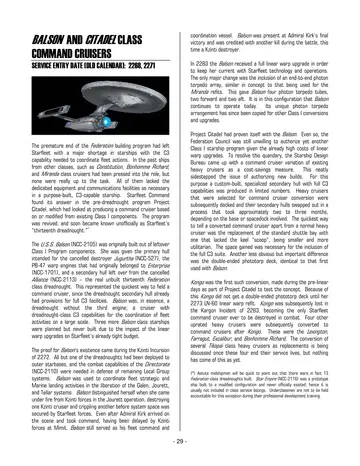
The U.S.S. Balson (NCC-2105) was originally built out of leftover Class I Program components. She was given the primary hull intended for the cancelled destroyer Jugurtha (NCC-527), the PB-47 warp engines that had originally belonged to Enterprise (NCC-1701), and a secondary hull left over from the cancelled Alliance (NCC-2113) – the real unbuilt thirteenth Federation class dreadnought. This represented the quickest way to field a command cruiser, since the dreadnought secondary hull already had provisions for full C3 facilities. Balson was, in essence, a dreadnought without the third engine; a cruiser with dreadnought-class C3 capabilities for the coordination of fleet activities on a large scale. Three more Balson class starships were planned but never built due to the impact of the linear warp upgrades on Starfleet’s already tight budget.
The proof for Balson’s existence came during the Kzinti Incursion of 2272. All but one of the dreadnoughts had been deployed to e Directorate outer starbases, and the combat capabilities of th CC-2110) were needed in defense of remaining Local Group (N systems. Balson was used to coordinate fleet strategic and Marine landing activities in the liberation of the Galen, Jourett, and Tellar systems. Balson distinguished herself when she came under fire from Kzinti forces in the Jourett operation, destroying one Kzinti cruiser and crippling another before system space was secured by Starfleet forces. Even after Admiral Kirk arrived on the scene and took command, having been delayed by Kzinti forces at Mimit, Balson still served as his fleet command and coordination vessel. Balson was present at Admiral Kirk’s final victory and was credited with another kill during the battle, this time a Kzinti destroyer.
In 2283 the Balson received a full linear warp upgrade in order ions. to keep her current with Starfleet technology and operat e only major change was the inclusion of an end-to-end photon Th r the torpedo array, similar in concept to that being used fo tubes, Miranda refits. This gave Balson four photon torpedo wo on t forward and two aft. It is in this configuration that Bals cont o inues to operate today. Its unique photon torped arra ns o ngement has since been copied for other Class I conversi and upgrades.
Proj ect Citadel had proven itself with the Balson. Even so, the Fede ration Council was still unwilling to authorize yet another Clas s I starship program given the already high costs of linear warp upgrades. To resolve this quandary, the Starship Design Bureau came up with a command cruiser variation of existing heav y cruisers as a cost-savings measure. This neatly sides tepped the issue of authorizing new builds. For this purp ose a custom-built, specialized secondary hull with full C3 capa y cruisers bilities was produced in limited numbers. Heav that were s er conversion were elected for command cruis subs equently docked and their secondary hulls swapped out in a proc ess that took approximately two to three months, depe ng on the base or sp ndi acedock involved. The quickest way to te ll a converted command cruiser apart from a normal heavy ser w with as the replacement of the standard shuttle bay crui ne that lacked the keel “scoop”, being smaller and more o The space gained was necessary for the inclusion of utilitarian. uite. Another less obvious but important difference the full C3 s was the double-ended phototorp deck, identical to that first used with Balson.
Kongo was the first such conversion, made during the pre-linear days as part of Project Citadel to test the concept. Because of this Kongo did not get a double-ended phototorp deck until her 2273 LN-60 linear warp refit. Kongo was subsequently lost in the Kargon Incident of 2283, becoming the only Starfleet command cruiser ever to be destroyed in combat. Four other uprated heavy cruisers were subsequently converted to command cruisers after Kongo. These were the Lexington, Farragut, Excalibur, and Bonhomme Richard. The conversion of several Tikopai class heavy cruisers as replacements is being discussed once these four end their service lives, but nothing has come of this as yet.
(*) Astute midshipmen will be quick to point out that there were in fact 13 Federation class dreadnoughts built. Star Empire (NCC-2116) was a prototyp e ip built to a modified configuration and never officially existed; hence it i s sh ually not included in class service listings. Underclassmen are not to be held us accountable for this exception during their professional development training.
- 29 -
VISUALS:
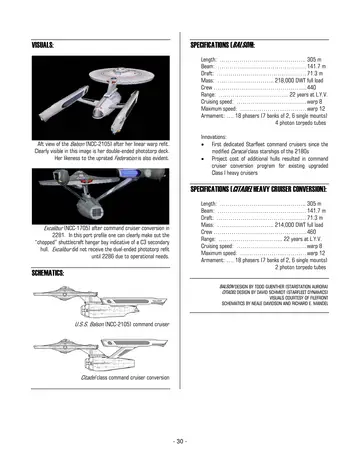
Aft view of the Balson (NCC-2105) after her linear warp refit. Clearly visible in this image is her double-ended phototorp deck. Her likeness to the uprated Federation is also evident.
Excalibur (NCC-1705) after command cruiser conversion in 2281. In this port profile one can clearly make out the “chopped” shuttlecraft hangar bay indicative of a C3 secondary hull. Excalibur did not receive the dual-ended phototorp refit until 2286 due to operational needs.
SCHEMATICS:
U.S.S. Balson (NCC-2105) command cruiser
Citadel class command cruiser conversion SPECIFICATIONS (BALSON):
Length: …………………………………….. 305 m Beam: ……………………………………… 141.7 m Draft: …………………….………………… 71.3 m Mass: ……………………….. 218,000 DWT full load Crew ………………………………………... 440 Range: ……………………………... 22 years at L.Y.V. Cruising speed: ………………….………….. warp 8 Maximum speed: ………………….………… warp 12 Armament: …. 18 phasers (7 banks of 2, 6 single mounts) 4 photon torpedo tubes
Innovations: • First dedicated Starfleet command cruisers since the modified Caracal class starships of the 2180s • Project cost of additional hulls resulted in command cruiser conversion program for existing upgraded Class I heavy cruisers
SPECIFICATIONS (CITADEL HEAVY CRUISER CONVERSION):
Length: …………………………………….. 305 m Beam: ……………………………………… 141.7 m Draft: …………………….………………… 71.3 m Mass: ……………………….. 214,000 DWT full load Crew ………………………………………... 460 Range: …………………………... 22 years at L.Y.V. Cruising speed: ………………….………….. warp 8 Maximum speed: ………………….………… warp 12 Armament: …. 18 phasers (7 banks of 2, 6 single mounts) 2 photon torpedo tubes
BALSON DESIGN BY TODD GUENTHER (STARSTATION AURORA) CITADEL DESIGN BY DAVID SCHMIDT (STARFLEET DYNAMICS) VISUALS COURTESY OF FILEFRONT SCHEMATICS BY NEALE DAVIDSON AND RICHARD E. MANDEL
- 30 -