10.3 Civilian Starships
Entries for the civilian vessels of the Class I era cover the popular Cochrane Industries Mark IV one-man scout, the Eagle class starliner, the Cochrane class colonial transport, the Canopus class research ship, the Aakenn class transport (famous as the "tribble" ship S.S. Mundy), and the Chariot class high-speed space tug.
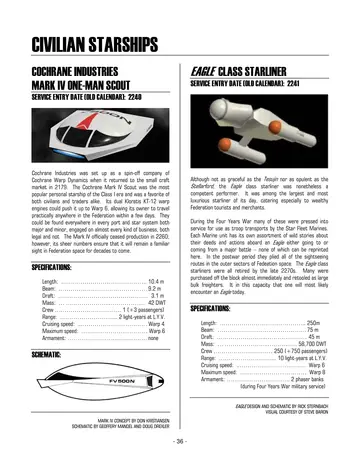
Cochrane Industries Mark IV One-Man Scout
Service entry date (old calendar): 2240
Cochrane Industries was set up as a spin-off company of Cochrane Warp Dynamics when it returned to the small craft market in 2179. The Cochrane Mark IV Scout was the most popular personal starship of the Class I era and was a favorite of both civilians and traders alike. Its dual Kloratis KT-12 warp engines could push it up to Warp 6, allowing its owner to travel practically anywhere in the Federation within a few days. They could be found everywhere in every port and star system both major and minor, engaged on almost every kind of business, both legal and not. The Mark IV officially ceased production in 2260; however, its sheer numbers ensure that it will remain a familiar sight in Federation space for decades to come.
Specifications:
- Length: 10.4 m
- Beam: 9.2 m
- Draft: 3.1 m
- Mass: 42 DWT
- Crew: 1 (+3 passengers)
- Range: 2 light-years at L.Y.V.
- Cruising speed: Warp 4
- Maximum speed: Warp 6
- Armament: none
Eagle Class Starliner
Service entry date (old calendar): 2241
Although not as graceful as the Tesujin nor as opulent as the Stellarford, the Eagle class starliner was nonetheless a competent performer. It was among the largest and most luxurious starliner of its day, catering especially to wealthy Federation tourists and merchants.
During the Four Years War many of these were pressed into service for use as troop transports by the Star Fleet Marines. Each Marine unit has its own assortment of wild stories about their deeds and actions aboard an Eagle either going to or coming from a major battle — none of which can be reprinted here. In the postwar period they plied all of the sightseeing routes in the outer sectors of Federation space. The Eagle class starliners were all retired by the late 2270s. Many were purchased off the block almost immediately and retooled as large bulk freighters. It is in this capacity that one will most likely encounter an Eagle today.
Specifications:
- Length: 250 m
- Beam: 75 m
- Draft: 45 m
- Mass: 58,700 DWT
- Crew: 250 (+750 passengers)
- Range: 10 light-years at L.Y.V.
- Cruising speed: Warp 6
- Maximum speed: Warp 8
- Armament: 2 phaser banks (during Four Years War military service)
Cochrane Class Transport
Service entry date (old calendar): 2242
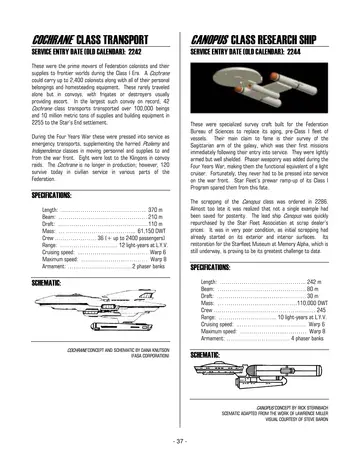
These were the prime movers of Federation colonists and their supplies to frontier worlds during the Class I Era. A Cochrane could carry up to 2,400 colonists along with all of their personal belongings and homesteading equipment. These rarely traveled alone but in convoys, with frigates or destroyers providing escort. In the largest such convoy on record, 42 Cochrane class transports transported over 100,000 beings and 10 million metric tons of supplies and building equipment in 2255 to the Star’s End settlement.
During the Four Years War these were pressed into service as emergency transports, supplementing the harried Ptolemy and Independence classes in moving personnel and supplies to and from the war front. Eight were lost to the Klingons in convoy raids. The Cochrane is no longer in production; however, 120 survive today in civilian service in various parts of the Federation.
Specifications:
- Length: 370 m
- Beam: 210 m
- Draft: 110 m
- Mass: 61,150 DWT
- Crew: 36 (+ up to 2400 passengers)
- Range: 12 light-years at L.Y.V.
- Cruising speed: Warp 6
- Maximum speed: Warp 8
- Armament: 2 phaser banks
Canopus Class Research Ship
Service entry date (old calendar): 2244
These were specialized survey craft built for the Federation Bureau of Sciences to replace its aging, pre-Class I fleet of vessels. Their main claim to fame is their survey of the Sagittarian arm of the galaxy, which was their first missions immediately following their entry into service. They were lightly armed but well shielded. Phaser weaponry was added during the Four Years War, making them the functional equivalent of a light cruiser. Fortunately, they never had to be pressed into service on the war front. Star Fleet’s prewar ramp-up of its Class I Program spared them from this fate.
The scrapping of the Canopus class was ordered in 2286. Almost too late it was realized that not a single example had been saved for posterity. The lead ship Canopus was quickly repurchased by the Star Fleet Association at scrap dealer’s prices. It was in very poor condition, as initial scrapping had already started on its exterior and interior surfaces. Its restoration for the Starfleet Museum at Memory Alpha, which is still underway, is proving to be its greatest challenge to date.
Specifications:
- Length: 242 m
- Beam: 80 m
- Draft: 30 m
- Mass: 110,000 DWT
- Crew: 245
- Range: 10 light-years at L.Y.V.
- Cruising speed: Warp 6
- Maximum speed: Warp 8
- Armament: 4 phaser banks
Aakenn Class Transport
Service entry date (old calendar): 2248
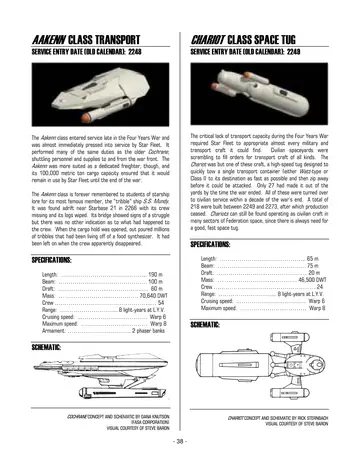
The Aakenn class entered service late in the Four Years War and was almost immediately pressed into service by Star Fleet. It performed many of the same duties as the older Cochrane, shuttling personnel and supplies to and from the war front. The Aakenn was more suited as a dedicated freighter, though, and its 100,000 metric ton cargo capacity ensured that it would remain in use by Star Fleet until the end of the war.
The Aakenn class is forever remembered to students of starship lore for its most famous member, the “tribble” ship S.S. Mundy. It was found adrift near Starbase 21 in 2266 with its crew missing and its logs wiped. Its bridge showed signs of a struggle but there was no other indication as to what had happened to the crew. When the cargo hold was opened, out poured millions of tribbles that had been living off of a food synthesizer. It had been left on when the crew apparently disappeared.
Specifications:
- Length: 190 m
- Beam: 100 m
- Draft: 60 m
- Mass: 70,640 DWT
- Crew: 54
- Range: 8 light-years at L.Y.V.
- Cruising speed: Warp 6
- Maximum speed: Warp 8
- Armament: 2 phaser banks
Chariot Class Space Tug
Service entry date (old calendar): 2249
The critical lack of transport capacity during the Four Years War required Star Fleet to appropriate almost every military and transport craft it could find. Civilian spaceyards were scrambling to fill orders for transport craft of all kinds. The Chariot was but one of these craft, a high-speed tug designed to quickly tow a single transport container (either Watt-type or Class I) to its destination as fast as possible and then zip away before it could be attacked. Only 27 had made it out of the yards by the time the war ended. All of these were turned over to civilian service within a decade of the war’s end. A total of 218 were built between 2249 and 2273, after which production ceased. Chariots can still be found operating as civilian craft in many sectors of Federation space, since there is always need for a good, fast space tug.
Specifications:
- Length: 65 m
- Beam: 75 m
- Draft: 20 m
- Mass: 46,500 DWT
- Crew: 24
- Range: 8 light-years at L.Y.V.
- Cruising speed: Warp 6
- Maximum speed: Warp 8