5.9 Terran Explorations: Vulcan, Kaferia, Tellar, Andor & Vega IX
Planetary profiles of the major worlds humanity explored in this era: harsh, volcanic Vulcan; the botanical-paradise hive world Kaferia; average but quake-free Tellar Prime; the cold, subterranean Class K world Andor; and Vega IX, the ruined former homeworld of the cybernetic Vegan Tyranny now shared by human and Deltan colonies.
Vulcan
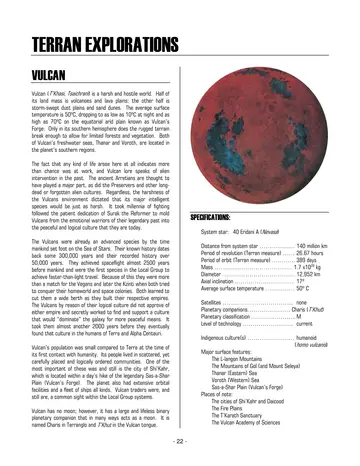
Vulcan (T’Khasi, Tsaichrani) is a harsh and hostile world. Half of its land mass is volcanoes and lava plains; the other half is storm-swept dust plains and sand dunes. The average surface temperature is 50ºC, dropping to as low as 10ºC at night and as high as 70ºC on the equatorial arid plain known as Vulcan’s Forge. Only in its southern hemisphere does the rugged terrain break enough to allow for limited forests and vegetation. Both of Vulcan’s freshwater seas, Thanar and Voroth, are located in the planet’s southern regions.
The fact that any kind of life arose here at all indicates more than chance was at work, and Vulcan lore speaks of alien intervention in the past. The ancient Arretians are thought to have played a major part, as did the Preservers and other long-dead or forgotten alien cultures. Regardless, the harshness of the Vulcan environment dictated that its major intelligent species would be just as harsh. It took millennia of fighting followed by the patient dedication of Surak the Reformer to mold Vulcans from the emotional warriors of their legendary past into the peaceful and logical culture that they are today.
The Vulcans were already an advanced species by the time mankind set foot on the Sea of Stars. Their known history dates back some 300,000 years and their recorded history over 50,000 years. They achieved spaceflight almost 2500 years before mankind and were the first species in the Local Group to achieve faster-than-light travel. Because of this they were more than a match for the Vegans and later the Kzinti when both tried to conquer their homeworld and space colonies. Both learned to cut them a wide berth as they built their respective empires. The Vulcans by reason of their logical culture did not approve of either empire and secretly worked to find and support a culture that would “dominate” the galaxy for more peaceful means. It took them almost another 2000 years before they eventually found that culture in the humans of Terra and Alpha Centauri.
Vulcan’s population was small compared to Terra at the time of its first contact with humanity. Its people lived in scattered, yet carefully placed and logically ordered communities. One of the most important of these was and still is the city of Shi’Kahr, which is located within a day’s hike of the legendary Sas-a-Shar Plain (Vulcan’s Forge). The planet also had extensive orbital facilities and a fleet of ships of all kinds. Vulcan traders were, and still are, a common sight within the Local Group systems.
Vulcan has no moon; however, it has a large and lifeless binary planetary companion that in many ways acts as a moon. It is named Charis in Terranglo and T’Khut in the Vulcan tongue.
Specifications
- System star: 40 Eridani A (Nevasa)
- Distance from system star: 140 million km
- Period of revolution (Terran measure): 26.67 hours
- Period of orbit (Terran measure): 389 days
- Mass: 1.7 x1028 kg
- Diameter: 12,952 km
- Axial inclination: 17º
- Average surface temperature: 50º C
- Satellites: none
- Planetary companions: Charis (T’Khut)
- Planetary classification: M
- Level of technology: current
- Indigenous culture(s): humanoid (homo vulcanis)
Major surface features: The L-langon Mountains; The Mountains of Gol (and Mount Seleya); Thanar (Eastern) Sea; Voroth (Western) Sea; Sas-a-Shar Plain (Vulcan’s Forge).
Places of note: The cities of Shi’Kahr and Daicood; The Fire Plains; The T’Karath Sanctuary; The Vulcan Academy of Sciences.
Kaferia
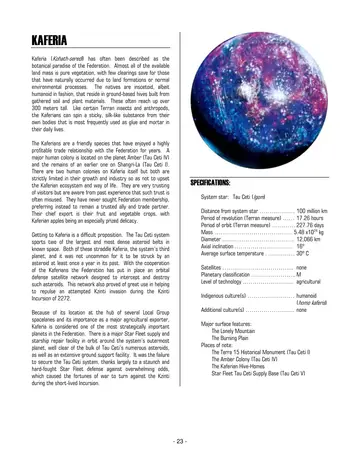
Kaferia (Kohath-seredi) has often been described as the botanical paradise of the Federation. Almost all of the available land mass is pure vegetation, with few clearings save for those that have naturally occurred due to land formations or normal environmental processes. The natives are insectoid, albeit humanoid in fashion, that reside in ground-based hives built from gathered soil and plant materials. These often reach up over 300 meters tall. Like certain Terran insects and arthropods, the Kaferians can spin a sticky, silk-like substance from their own bodies that is most frequently used as glue and mortar in their daily lives.
The Kaferians are a friendly species that have enjoyed a highly profitable trade relationship with the Federation for years. A major human colony is located on the planet Amber (Tau Ceti IV) and the remains of an earlier one on Shangri-La (Tau Ceti I). There are two human colonies on Kaferia itself but both are strictly limited in their growth and industry so as not to upset the Kaferian ecosystem and way of life. They are very trusting of visitors but are aware from past experience that such trust is often misused. They have never sought Federation membership, preferring instead to remain a trusted ally and trade partner. Their chief export is their fruit and vegetable crops, with Kaferian apples being an especially prized delicacy.
Getting to Kaferia is a difficult proposition. The Tau Ceti system sports two of the largest and most dense asteroid belts in known space. Both of these straddle Kaferia, the system’s third planet, and it was not uncommon for it to be struck by an asteroid at least once a year in its past. With the cooperation of the Kaferians the Federation has put in place an orbital defense satellite network designed to intercept and destroy such asteroids. This network also proved of great use in helping to repulse an attempted Kzinti invasion during the Kzinti Incursion of 2272.
Because of its location at the hub of several Local Group spacelanes and its importance as a major agricultural exporter, Kaferia is considered one of the most strategically important planets in the Federation. There is a major Star Fleet supply and starship repair facility in orbit around the system’s outermost planet, well clear of the bulk of Tau Ceti’s numerous asteroids, as well as an extensive ground support facility. It was the failure to secure the Tau Ceti system, thanks largely to a staunch and hard-fought Star Fleet defense against overwhelming odds, which caused the fortunes of war to turn against the Kzinti during the short-lived Incursion.
Specifications
- System star: Tau Ceti (Igom)
- Distance from system star: 100 million km
- Period of revolution (Terran measure): 17.26 hours
- Period of orbit (Terran measure): 227.76 days
- Mass: 5.48 x1024 kg
- Diameter: 12,066 km
- Axial inclination: 16º
- Average surface temperature: 30º C
- Satellites: none
- Planetary classification: M
- Level of technology: agricultural
- Indigenous culture(s): humanoid (homo kaferis)
- Additional culture(s): none
Major surface features: The Lonely Mountain; The Burning Plain.
Places of note: The Terra 15 Historical Monument (Tau Ceti I); The Amber Colony (Tau Ceti IV); The Kaferian Hive-Homes; Star Fleet Tau Ceti Supply Base (Tau Ceti V).
Tellar Prime
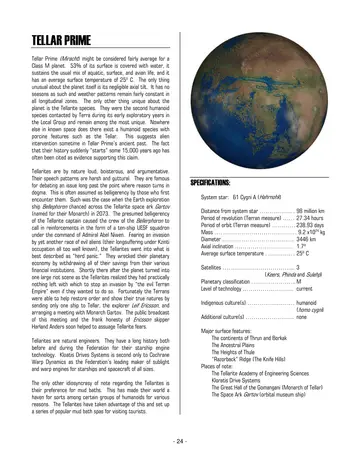
Tellar Prime (Miracht) might be considered fairly average for a Class M planet. 53% of its surface is covered with water, it sustains the usual mix of aquatic, surface, and avian life, and it has an average surface temperature of 25º C. The only thing unusual about the planet itself is its negligible axial tilt. It has no seasons as such and weather patterns remain fairly constant in all longitudinal zones. The only other thing unique about the planet is the Tellarite species. They were the second humanoid species contacted by Terra during its early exploratory years in the Local Group and remain among the most unique. Nowhere else in known space does there exist a humanoid species with porcine features such as the Tellar. This suggests alien intervention sometime in Tellar Prime’s ancient past. The fact that their history suddenly “starts” some 15,000 years ago has often been cited as evidence supporting this claim.
Tellarites are by nature loud, boisterous, and argumentative. Their speech patterns are harsh and guttural. They are famous for debating an issue long past the point where reason turns into dogma. This is often assumed as belligerency by those who first encounter them. Such was the case when the Earth exploration ship Bellephoron chanced across the Tellarite space ark Gartov (named for their Monarch) in 2073. The presumed belligerency of the Tellarite captain caused the crew of the Bellerphoron to call in reinforcements in the form of a ten-ship UESF squadron under the command of Admiral Abel Niwen. Fearing an invasion by yet another race of evil aliens (their long-suffering under Kzinti occupation all too well known), the Tellarites went into what is best described as “herd panic.” They wrecked their planetary economy by withdrawing all of their savings from their various financial institutions. Shortly thereafter the planet turned into one large riot scene as the Tellarites realized they had practically nothing left with which to stop an invasion by “the evil Terran Empire” even if they wanted to do so. Fortunately the Terrans were able to help restore order and show their true natures by sending only one ship to Tellar, the explorer Leif Ericsson, and arranging a meeting with Monarch Gartov. The public broadcast of this meeting and the frank honesty of Ericsson skipper Harland Anders soon helped to assuage Tellarite fears.
Tellarites are natural engineers. They have a long history both before and during the Federation for their starship engine technology. Kloratis Drive Systems is second only to Cochrane Warp Dynamics as the Federation’s leading maker of sublight and warp engines for starships and spacecraft of all sizes.
The only other idiosyncrasy of note regarding the Tellarites is their preference for mud baths. This has made their world a haven of sorts among certain groups of humanoids for various reasons. The Tellarites have taken advantage of this and set up a series of popular mud bath spas for visiting tourists.
Specifications
- System star: 61 Cygni A (Hahrnohk)
- Distance from system star: 98 million km
- Period of revolution (Terran measure): 27.34 hours
- Period of orbit (Terran measure): 238.93 days
- Mass: 9.2 x1024 kg
- Diameter: 3446 km
- Axial inclination: 1.7º
- Average surface temperature: 25º C
- Satellites: 3 (Keers, Phinda and Sulehp)
- Planetary classification: M
- Level of technology: current
- Indigenous culture(s): humanoid (homo cygni)
- Additional culture(s): none
Major surface features: The continents of Thrun and Borkak; The Ancestral Plains; The Heights of Thule; “Razorback” Ridge (The Knife Hills).
Places of note: The Tellarite Academy of Engineering Sciences; Kloratis Drive Systems; The Great Hall of the Gomangani (Monarch of Tellar); The Space Ark Gartov (orbital museum ship).
Andor
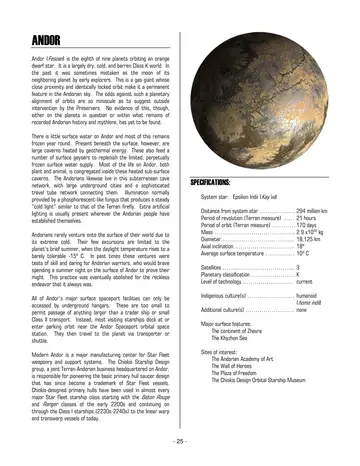
Andor (Fesoan) is the eighth of nine planets orbiting an orange dwarf star. It is a largely dry, cold, and barren Class K world. In the past it was sometimes mistaken as the moon of its neighboring planet by early explorers. This is a gas giant whose close proximity and identically locked orbit make it a permanent feature in the Andorian sky. The odds against such a planetary alignment of orbits are so miniscule as to suggest outside intervention by the Preservers. No evidence of this, though, either on the planets in question or within what remains of recorded Andorian history and mythlore, has yet to be found.
There is little surface water on Andor and most of this remains frozen year round. Present beneath the surface, however, are large caverns heated by geothermal energy. These also feed a number of surface geysers to replenish the limited, perpetually frozen surface water supply. Most of the life on Andor, both plant and animal, is congregated inside these heated sub-surface caverns. The Andorians likewise live in this subterranean cave network, with large underground cities and a sophisticated travel tube network connecting them. Illumination is normally provided by a phosphorescent-like fungus that produces a steady “cold light” similar to that of the Terran firefly. Extra artificial lighting is usually present wherever the Andorian people have established themselves.
Andorians rarely venture onto the surface of their world due to its extreme cold. Their few excursions are limited to the planet’s brief summer, when the daylight temperature rises to a barely tolerable -15º C. In past times these ventures were tests of skill and daring for Andorian warriors, who would brave spending a summer night on the surface of Andor to prove their might. This practice was eventually abolished for the reckless endeavor that it always was.
All of Andor’s major surface spaceport facilities can only be accessed by underground hangars. These are too small to permit passage of anything larger than a trader ship or small Class II transport. Instead, most visiting starships dock at or enter parking orbit near the Andor Spaceport orbital space station. They then travel to the planet via transporter or shuttle.
Modern Andor is a major manufacturing center for Star Fleet weaponry and support systems. The Chiokis Starship Design group, a joint Terran-Andorian business headquartered on Andor, is responsible for pioneering the basic primary hull saucer design that has since become a trademark of Star Fleet vessels. Chiokis-designed primary hulls have been used in almost every major Star Fleet starship class starting with the Baton Rouge and Ranger classes of the early 2200s and continuing on through the Class I starships (2230s-2240s) to the linear warp and transwarp vessels of today.
Specifications
- System star: Epsilon Indii (Kay’va)
- Distance from system star: 294 million km
- Period of revolution (Terran measure): 21 hours
- Period of orbit (Terran measure): 170 days
- Mass: 2.9 x1026 kg
- Diameter: 18,125 km
- Axial inclination: 18º
- Average surface temperature: 10º C
- Satellites: 3
- Planetary classification: K
- Level of technology: current
- Indigenous culture(s): humanoid (homo indii)
- Additional culture(s): none
Major surface features: The continent of Zhevra; The Khyzhon Sea.
Sites of interest: The Andorian Academy of Art; The Wall of Heroes; The Plaza of Freedom; The Chiokis Design Orbital Starship Museum.
Vega IX
Vega IX (Kesir-Tosharra in the Deltan tongue) was once the homeworld of the Vegan Tyranny. It was an interstellar empire ruled by a cybernetic species akin to the Borg that at one time dominated most of the Local Group and beyond. Their empire went into decline about the same time as the rise of the Kzinti. This was due to the outbreak of vegan choriomeningitis, an extremely virulent disease known in surviving Vegan records as “the Green Death.” This swept the Vegan Tyranny in epidemic form sometime around the 21st century (Terran Old Calendar). This has led some to speculate that the Kzinti took advantage of the Vegan’s downfall and took over most of Vegan territory as their own with little opposition. When humanity first visited Vega IX in 2094 they found a Deltan colony already there amid the ruins. This was humanity’s first encounter with the Deltans. After an initial rough start, growing relations between the two cultures eventually led to formal relations. Both settlements, human and Deltan, continue to grow and thrive as of this date.
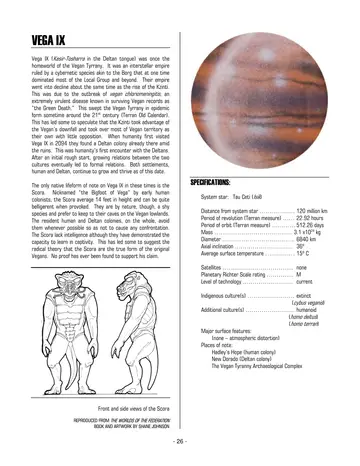
The only native lifeform of note on Vega IX in these times is the Scora. Nicknamed “the Bigfoot of Vega” by early human colonists, the Scora average 14 feet in height and can be quite belligerent when provoked. They are by nature, though, a shy species and prefer to keep to their caves on the Vegan lowlands. The resident human and Deltan colonies, on the whole, avoid them whenever possible so as not to cause any confrontation. The Scora lack intelligence although they have demonstrated the capacity to learn in captivity. This has led some to suggest the radical theory that the Scora are the true form of the original Vegans. No proof has ever been found to support this claim.
Specifications
- System star: Tau Ceti (Isik)
- Distance from system star: 120 million km
- Period of revolution (Terran measure): 22.92 hours
- Period of orbit (Terran measure): 512.26 days
- Mass: 3.1 x1024 kg
- Diameter: 6840 km
- Axial inclination: 36º
- Average surface temperature: 15º C
- Satellites: none
- Planetary Richter Scale rating: M
- Level of technology: current
- Indigenous culture(s): extinct (cybus veganis)
- Additional culture(s): humanoid (homo deltus) (homo terran)
Major surface features: (none – atmospheric distortion).
Places of note: Hadley’s Hope (human colony); New Dorado (Deltan colony); The Vegan Tyranny Archaeological Complex.