5.10 Historical Articles
A collection of period news reports and logs: UESPA’s discredited study denying non-human intelligence, the Amity’s rescue of stranded Vulcans, the discovery of the Kaferians, the launch of the last space ark, the loss of the Valiant, the resolution of the Tellarite standoff, the opening of the space lane network, the activation of subspace radio, the wonders of the Orion market at Rigel, and the first Vulcan to serve in a human crew.
Study Proves Real Aliens Don’t Exist
UNS Newswire – 8 June 2057
Today the Xenobiological Studies Committee of UESPA released its report on the probability of life outside the Solar System. In a press conference, chairman Dr. Maurice Bertrand, former head of the International Space Agency, expressed his committee’s conclusion that the probability of non-human life in space is so low as to be practically nonexistent. This statement brought an immediate barrage of questions from reporters concerning the Kzinti, who are obviously not human. Dr. Bertrand was quick to respond.
“If you will but read the report, ladies and gentlemen, you will see that we say ‘human life form’ versus ‘non-human life form.’ The Kzinti are obviously a human life form – overgrown cats that have evolved along human lines. They walk on two feet, have vocal cords, and even collarbones as do humans. Their tails are the same that we would have if our tailbones had not receded during our development. Let us change viewpoints. If we humans still had body hair we might still be regarded as apes. That is why I must reiterate our conclusions that intelligent life must evolve from mammalian life and along recognizably human lines. This obviously limits what forms of intelligence you might see. You will never see intelligent insects, for example. It is impossible for an insect to evolve along human lines.”
Reaction to Dr. Bertrand’s statement was quick. “He’s nuts,” said one spectator. “What a bunch of morons,” said another. UESF Corporal Benjamin Dixon, recovering from battle wounds and who attended the conference out of curiosity, was more blunt. “That’s a bunch of bulls**t. Stuffed shirts, all of them. They haven’t been out there. All they do is sit behind their desks and play with their papers and pencils. I’ve been out there, and I’ve got the scars to prove it. I’ve seen some pretty strange things, and I’m telling you. One of these days we’re gonna find a planet with some of the weirdest lookin’ critters you’ve ever seen, and they’re gonna be as smart as us. And when they do, this bin of loonies are gonna be lookin’ for new jobs.”
Amity Finds New Aliens
UNS Newswire – 16 January 2065
UESPA has announced that one of its ships, the explorer vessel Amity, is assisting a disabled alien ship in space. These aliens are not Kzinti but a humanoid type never encountered before. Captain Peter O’Brien, commander of the Amity, reports that they were peaceful, nonviolent, and in desperate need of assistance. UESPA permitted Captain O’Brien a brief interview with UNS reporter Tamilyn Wesley, and this is what he had to say about the encounter:
O’BRIEN: It was a design I had never seen before – all rings and hull, like the old starliners. Red, like a Kzinti ship, but a lot darker. They were broadcasting in almost perfect English – a little too perfect, with a trace of a weird accent. Kind of like somebody back on Earth might learn at a language school. Anyhow no Kzinti I’ve ever saw or heard could talk in English like that.
WESLEY: And that’s when you made the decision to go ahead and board the ship?
O’BRIEN: I exercised my command discretion Article EOP-113, Deep Space Rescue, of the UESF Code of Conduct. I answered their distress call, just like I would any other space mayday.
WESLEY: And what did you find?
O’BRIEN: I found 42 Vulcans – that’s what they call themselves – huddled together in the central compartments of the ship. Their engines and life support systems had gone down at the same time and there weren’t enough suits on board for everyone. The captain had already taken their shuttle to try to get help. They were lucky we found them first.
WESLEY: Why is that?
O’BRIEN: Because they would have been dead inside an hour if we hadn’t found them. That’s what they said in their distress call and their story checked out after we gave their ship a once-over.
WESLEY: At any time during the rescue did you think this might be a Kzinti ploy or trap?
O’BRIEN: I had my doubts at first. Just like any of us would have after the war. After I heard their distress message and saw their ship, though, I changed my mind. Kzinti aren’t known for subtlety and this was completely out of their style. Once we got on board and met the Vulcans, I knew I was right.
WESLEY: And your impression?
O’BRIEN: They’re a very logical people. A bit cold and aloof at times, and they can do numbers and make calculations as fast as any computer I’ve ever seen. They don’t understand slang very well. Still, though, very friendly in spite of this. Remember, they reached out to us. They didn’t have to. I think that’s significant.
Ms. Wesley got the opportunity to speak with Stahl, the Vulcan First Officer, before the interview ended.
WESLEY: So your captain has returned now?
STAHL: Yes.
WESLEY: Was he surprised that you had been found by an Earth ship?
STAHL: No.
WESLEY: Why is that?
STAHL: We knew that human ships were in the sector. We have been aware of your presence in space for some time.
WESLEY: Why were you so sure the Amity would help you?
STAHL: We have visited your world in the past many times, although you have not been aware of us. We know that despite your emotionalism you are a caring and compassionate people. We knew you would help if we asked, so we asked.
WESLEY: You’ve been to Earth before?
STAHL: Yes. Why does that surprise you?
WESLEY: It’s just that—well, I mean—you never told us you were there?
STAHL: For what reason would we reveal our existence?
WESLEY: You could have landed on the White House lawn or something.
STAHL: Why would we want to land on the frontal turf of a bleach-toned residence?
WESLEY: Why would we—oh, never mind.
Real Aliens Found
UNS Newswire – 7 March 2066
They’re intelligent, peaceful, friendly, and very alien. They’re the Kaferians of Tau Ceti, the third major alien species discovered by UESPA within the past 50 years. UESPA public affairs director David van Dreesen had this to say about his agency’s latest discovery:
“They go totally against what our past study had predicted, yet here they are. I must be honest and say that we are completely baffled to find intelligent insects anywhere in the universe, let alone humanoid ones. This is going to require us to abandon our previous theory concerning alien life and come up with a new one.”
The author of that theory, Dr. Maurice Bertrand of the New Paris L-4 space city, was unavailable for comment.
Last Space Ark Leaves Terra
Extract from The Space Flight Chronology by Stan & Fred Goldstein (New York: Pocket Books, 2269).
At the time this was written the authors had apparently overlooked the launch of Terra 15, the real last “space ark.”
There were some people, though, for whom all governments were equally to be shunned. During this period, several multigenerational colony ships were launched to seek out new worlds to settle, undisturbed by any outside interference. Using by-then outmoded fusion propulsion, these pilgrims knew they were destined almost assuredly never to return … and none did. The lifeless wreckage of eight of these valiant, doomed ships has been salvaged. One (Terra 10) survived, marooned on a barely habitable, volcanic world. One has never been found.
The world that Terra 10 finally reached was a previously undocumented planet orbiting the star Cepheus in the Arachna sector. Upon making planetfall, the colonists discovered (much to their chagrin) that their new sun’s constant spiroid epsilion ray bombardment caused their molecular structure to compact, shrinking all of them to an average height of one centimeter in just over half-an-hour. Despite this, or perhaps because of it, they survived and flourished, cannibalizing their space ark over generations for raw materials. They remained missing until they were found by the starship Enterprise in 2264.
Valiant Missing, Feared Lost
UNS Newswire – 19 March 2071
Today UESPA announced that the galactic survey cruiser Valiant, on a special mission to the galactic rim, is officially declared as missing and presumed destroyed. There has been no communication with the Valiant since the ship was lost in an ion storm almost two years ago. No more efforts will be made to probe its flight path and attempt to discover what happened to it and its crew.
The Valiant was one of the first UESPA survey cruisers to leave the Solar System on a peaceful mission of exploration following the end of the Earth-Kzin Wars. It left in 2065 under the command of Captain Carlos Tarasco with orders to follow the flight path of the doomed spaceship Courageous, which was lost with all hands due to an engine accident in 2022. It rocketed out of the Solar System at full speed headed upward towards the northern galactic rim until all contact was lost. Tarasco’s orders were to follow the flight path of the Courageous for as long as he could, replenishing his supplies along the way if possible and surveying nearby star systems for wreckage or other signs in the event the Courageous somehow made planetfall, until he reached the point of no return and had to turn back. Instead of finding the Courageous, though, the Valiant found a severe ion storm a year out from Pluto and all contact was lost. It is believed that the ion storm which appears to have claimed the Valiant probably claimed the Courageous as well. A memorial service is being planned.
Standoff in Space Resolved
Interstellar Newsline with Lisa Caulfield – 24 August 2073
CAULFIELD: The newest alien threat to humanity turns out not to be a threat after all. The porcine Tellarites, who first threatened the Star Fleet cruiser Bellerophon with an attack and then ran for home at the first sight of a Star Fleet squadron, have turned out to be more bluster than brawn. Lots of bluster, in fact. These beings seem to live to argue, and they argue about anything. The near state of war between Terra and Tellar this past week appears to have been the result of a simple misunderstanding. Star Fleet Captain Harland Anders of the starship Ericsson recently concluded talks with Gartov, the Tellarite monarch in order to clear up the misunderstanding. Captain Anders?
ANDERS: Yes, Lisa.
CAULFIELD: Captain, how did you and Monarch Gartov resolve this situation?
ANDERS: Well, Lisa, the last thing we needed was another war. We had seen only one Tellarite ship and no other since. Star Fleet Command had a hunch that the Tellarites were bluffing and decided to call them on it.
CAULFIELD: But why just one ship? Why not a show of force?
ANDERS: It was a calculated risk. We had already shown them force. They had turned tail and ran all the way back to their homeworld. We wanted to give them the chance for peace instead of more force.
CAULFIELD: What did you find once your ship arrived at the Tellarite homeworld?
ANDERS: Total chaos. Sporadic riots, buildings on fire, mobs in the street. You see, and I didn’t learn this until my talks with Monarch Gartov, but they had been invaded by the Kzinti a long time ago. The ratcats had killed almost everyone and stripped the planet of everything. They had to start all over again, just like the Middle East did after the Post Atomic Horror. When our fleet showed up and called their space ark captain’s bluff they thought we were going to be the next Kzinti and panicked. I guess I can’t blame them.
CAULFIELD: Well, I’m glad we got that all worked out. They seem to be a very … interesting species.
ANDERS: Don’t let appearances deceive you, Lisa. They are smart as whips and they learn fast. Some of their engineers are already trying to copy our ships based solely on the visuals they’ve recorded. You should see that space ark of theirs. It’s like nothing I’ve ever seen, not even in the Star Fleet Archives. Come to think of it, the Tellarites are the ones who really invented the jump drive the Kzinti were using.
CAULFIELD: They are?
ANDERS: Yes. It’s all recorded in their historical archives. It was stolen from them by the Kzinti and the inventors hauled off or killed right after they invaded.
CAULFIELD: Interesting. Not to change the subject, Captain Anders, but I would like to hear more about this arguing of theirs.
ANDERS: Yes. (laughs) They almost consider it a sport. Kind of like the old Monty Python “Argument” routine at times, when you end up yelling at each other for something small and petty. It takes some getting used to, I’ll admit.
CAULFIELD: Did you argue with Monarch Gartov?
ANDERS: But of course. If I hadn’t it would have been an insult and we would have gotten nowhere.
CAULFIELD: What did you argue about?
ANDERS: Oh, the usual. Religion, politics. Things like that. Who was really at fault, who was going to cave first, who was going to apologize first, who was to make the announcement about our new alliance. They really do argue about everything.
Space Lane Network Established
UNS Newswire – 16 April 2071
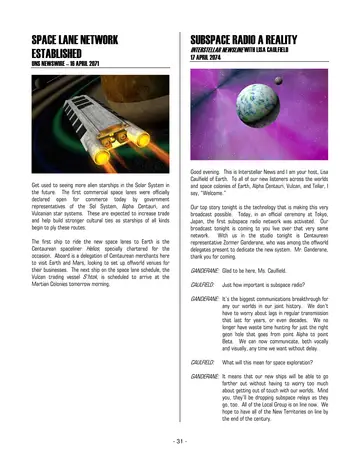
Get used to seeing more alien starships in the Solar System in the future. The first commercial space lanes were officially declared open for commerce today by government representatives of the Sol System, Alpha Centauri, and Vulcanian star systems. These are expected to increase trade and help build stronger cultural ties as starships of all kinds begin to ply these routes.
The first ship to ride the new space lanes to Earth is the Centaurean spaceliner Helios, specially chartered for the occasion. Aboard is a delegation of Centaurean merchants here to visit Earth and Mars, looking to set up offworld venues for their businesses. The next ship on the space lane schedule, the Vulcan trading vessel S’htok, is scheduled to arrive at the Martian Colonies tomorrow morning.
Subspace Radio a Reality
Interstellar Newsline with Lisa Caulfield – 17 April 2074
Good evening. This is Interstellar News and I am your host, Lisa Caulfield of Earth. To all of our new listeners across the worlds and space colonies of Earth, Alpha Centauri, Vulcan, and Tellar, I say, “Welcome.”
Our top story tonight is the technology that is making this very broadcast possible. Today, in an official ceremony at Tokyo, Japan, the first subspace radio network was activated. Our broadcast tonight is coming to you live over that very same network. With us in the studio tonight is Centaurean representative Zormer Ganderane, who was among the offworld delegates present to dedicate the new system. Mr. Ganderane, thank you for coming.
GANDERANE: Glad to be here, Ms. Caulfield.
CAULFIELD: Just how important is subspace radio?
GANDERANE: It’s the biggest communications breakthrough for any of our worlds in our joint history. We don’t have to worry about lags in regular transmission that last for years, or even decades. We no longer have to waste time hunting for just the right geon hole that goes from point Alpha to point Beta. We can now communicate, both vocally and visually, any time we want without delay.
CAULFIELD: What will this mean for space exploration?
GANDERANE: It means that our new ships will be able to go farther out without having to worry too much about getting out of touch with our worlds. Mind you, they’ll be dropping subspace relays as they go, too. All of the Local Group is on line now. We hope to have all of the New Territories on line by the end of the century.
The Wonders of Rigel
Ship’s Log – Marco Polo – 27 July 2079
The following was recorded by Captain Lorenzo Malfatti of the starship Marco Polo on his first night after making planetfall in the Orion Colonies.
Ship’s log, Earth time 27 July 2079, 0245 hours. I have just come from the most exotic and bizarre market I have ever seen in all my life. It’s called Rralrark, whatever that means. Aliens of every size, shape, and description – including many I’ve never seen before – are everywhere buying and selling. We attracted attention at once. Seems they’d never seen humans before. We could say the same about them. Barga quickly steered us toward the Rigellian officials, who look like Vulcans but sure don’t act like them. More like us. Anyway, some of them could speak a little Tellar, so Barga was able to make arrangements for us. We got room and board and an invite to no less than 57 different booths within the hour. I called the ship to make sure Jake and Jess were okay, then we set off for a little sightseeing.
I saw things today I thought I’d never see. A little creature like a hairy porcupine arguing with a Rigellian over the price of a diamond – a diamond as big as my fist. His whole table was full of them along with jewels of every other size and color. An Andorian swordsmith demonstrating how sharp his blades were to an eager crowd. A Vulcan merchant, quietly sitting at his stall while aliens yelled and ran all around him. Clothes that shrink or grow to fit your size and never need washing. Oh, that shop was a lu-lu. The owner offered me his whole inventory for my belt buckle, so I let him have it. Guess he’d never seen a titanium alloy before. I guess he was a he. Come to think of it, I don’t exactly know if he was a he or not.
Speaking of which, there’s the green women. “A specialty of Orion,” their owner told us. “Green animal women slaves trained to fulfill your every desire and pleasure.” I had to pass – Kathryn would have killed me before I even put my first foot down on the landing ramp – but, man, are they tempting. They have this … well, I can’t really describe it. They make you want them. It’s powerful. Too bad slavery’s illegal back home, otherwise they couldn’t sell enough of ‘em.
First Earth-Alien Crews
UNS Newswire – 9 November 2083
It wasn’t that long ago when “little green men” were the subjects of fear, speculation, and science fiction. Space aliens became a fact not that long ago with the Earth-Kzin Wars and the harsh Kzinti. The end of the war saw more peaceful aliens in the Vulcans and Kaferians. Today history is being made, with the first-ever alien to serve aboard a human starship taking his post.
Supak is a communications specialist on his homeworld of Vulcan. He hails from the ancient city of Shi’Kahr. Forty-two years old, he is still considered young on a planet where the average lifespan is 150 years or more. Supak volunteered to be the first Vulcan to serve aboard a human ship in a special exchange between Star Fleet and the Vulcan Space Command.
“I am looking forward to serving with humans despite your predilection towards emotionalism. It will give me the opportunity to observe humans in their natural work environment and become accustomed to their idioms and mores. I know that Captain Tse Sum is also looking forward to learning more about my culture from me.”
Captain Shu Tse Sum is a fifteen-year Chinese veteran of Star Fleet and one of its leading commanders during the Earth-Kzin War.
“I know that things will be difficult for Supak at first. We are a more emotional people than he and to that he is not accustomed. Still, I for one will be glad to have him aboard. The Vulcan way is very much like my own Buddhist upbringing. In our common desire for peace and tranquility we have common ground. I hope that together we can work to make his assignment an enjoyable one. Pardon, that isn’t the right word – an interesting one.”
Supak is starting a temporary six-month assignment to the Pollux as communications officer.