11.2 Starfleet Starship Classes: The Dreadnought Program (Part 1)
STARFLEET STARSHIPS THE DREADNOUGHT PROGRAM (Pt. 1) SERVICE ENTRY DATES (OLD CALENDAR): FEDERATION CLASS – 2255 UPRATEDFEDERATION CLASS – 22
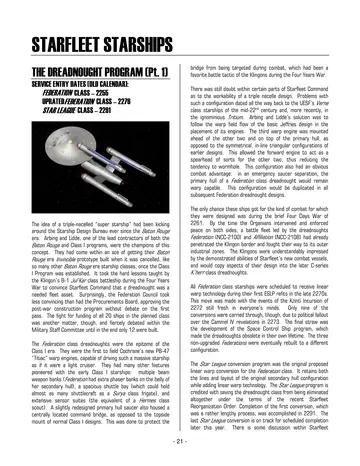
STARFLEET STARSHIPS THE DREADNOUGHT PROGRAM (Pt. 1) SERVICE ENTRY DATES (OLD CALENDAR): FEDERATION CLASS – 2255 UPRATEDFEDERATION CLASS – 2276 STAR LEAGUE CLASS – 2291
The idea of a triple-nacelled “super starship” had been kicking around the Starship Design Bureau ever since the Baton Rouge era. A rbing and Lidde, one of the lead contractors of both the Baton R ouge and Class I programs, were the champions of this concept. They had come within an ace of getting their Baton Rouge era Invincible prototype built when it was cancelled, like so many other Baton Rouge era starship classes, once the Class I Program was established. It took the hard lessons taught by the Klingon’s B-1 Jul’Kar class battleship during the Four Years War to convince Starfleet Command that a dreadnought was a needed fleet asset. Surprisingly, the Federation Council took less convincing than had the Procurements Board, approving the post-war construction program without debate on the first pass. The fight for funding of all 20 ships in the planned class was anot her matter, though, and fiercely debated within the Military S taff Committee until in the end only 12 were built.
The Federation class dreadnoughts were the epitome of the Class I era. They were the first to field Cochrane’s new PB-47 “Titiac” warp engines, capable of driving such a massive starship as if it were a light cruiser. They had many other features pioneered with the early Class I starships: multiple beam weapon banks (Federation had extra phaser banks on the belly of her secondary hull), a spacious shuttle bay (which could hold almost as many shuttlecraft as a Surya class frigate), and extensive sensor suites (the equivalent of a Hermes class scout). A slightly redesigned primary hull saucer also housed a centrally located command bridge, as opposed to the topside mount of normal Clas s I designs. This was done to protect the bridge from being targeted during combat, which had been a favorite battle tactic of the Klingons during the Four Years War.
There was still doubt within certain parts of Starfleet Command as to the workability of a triple nacelle design. Problems with such a configuration dated all the way back to the UESF’s Verne class starships of the mid-22nd century and, more recently, in the ignominious Tritium. Arbing and Lidde’s solution was to follow the warp field flow of the basic Jeffries design in the placement of its engines. The third warp engine was mounted ahead of the other two and on top of the primary hull, as opposed to the symmetrical, in-line triangular configurations of earlier designs. This allowed the forward engine to act as a spearhead of sorts for the other two, thus reducing the tendency to wormhole. This configuration also had an obvious combat advantage: in an emergency saucer separation, the primary hull of a Federation class dreadnought would remain warp capable. This configuration would be duplicated in all subsequent Federation dreadnought designs.
The only chance these ships got for the kind of combat for which they were designed was during the brief Four Days War of 2261. By the time the Organians intervened and enforced peace on both sides, a battle fleet led by the dreadnoughts Federation (NCC-2100) and Affiliation (NCC-2108) had already penetrated the Klingon border and fought their way to its outer industrial zones. The Klingons were understandably impressed by the demonstrated abilities of Starfleet’s new combat vessels, and would copy aspects of their design into the later C-series K’herr class dreadnoughts.
All Federation class starships were scheduled to receive linear warp technology during their first ESLP refits in the late 2270s. This move was made with the events of the Kzinti Incursion of 2272 still fresh in everyone’s minds. Only nine of the conversions were carried through, though, due to political fallout over the Cammel IV revelations in 2273. The final straw was the development of the Space Control Ship program, which made the dreadnoughts obsolete in their own lifetime. The three non-upgraded Federations were eventually rebuilt to a different configuration.
The Star League conversion program was the original proposed linear warp conversion for the Federation class. It retains both the lines and layout of the original secondary hull configuration while adding linear warp technology. The Star League program is credited with saving the dreadnought class from being eliminated altogether under the terms of the recent Starfleet Reorganization Order. Completion of the first conversion, which was a rather lengthy process, was accomplished in 2291. The last Star League conversion is on track for scheduled completion later this year. There is some discussion within Starfleet
- 21 -
Command of converting the other Federation class dreadnoughts to the Star League configuration for greater mission flexibility. This would take place, if at all, during their second ESLP refits ometime around 2310. Nothing has come of this proposal as s of yet.
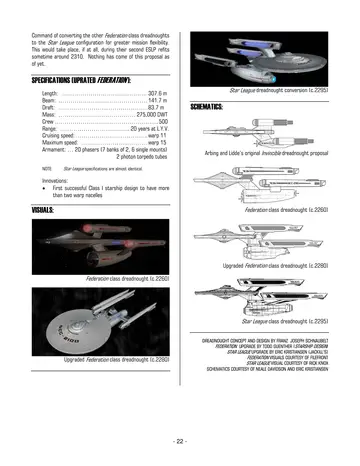
SPECIFICATIONS (UPRATED FEDERATION ):
Length: …………………………………….. 307.6 m …… 141.7 m Beam: ………………………………… 83.7 m Draft: …………………….………………… Mass: ………………………………… 275,000 DWT Crew …………………………………………….. 500 Range: ……………………………... 20 years at L.Y.V. Cruising speed: ………………….………….. warp 11 Maximum speed: ………………….………… warp 15 Armament: … 20 phasers (7 banks of 2, 6 single mounts) 2 photon torpedo tubes
NOTE: Star League specifications are almost identical.
Innovations: • First successful Class I starship design to have more than two warp nacelles
VISUALS:
Federation class dreadnought (c.2260)
Upgraded Federation class dreadnought (c.2280) Star League dreadnought conversion (c.2295)
SCHEMATICS:
Arbing and Lidde’s original Invincible dreadnought proposal
Federation class dreadnought (c.2260)
Upgraded Federation class dreadnought (c.2280)
Star League class dreadnought (c.2295)
DREADNOUGHT CONCEPT AND DESIGN BY FRANZ JOSEPH SCHNAUBELT FEDERATION UPGRADE BY TODD GUENTHER (STARSHIP DESIGN) STAR LEAGUE UPGRADE BY ERIC KRISTIANSEN (JACKILL’S) FEDERATION VISUALS COURTESY OF FILEFRONT STAR LEAGUE VISUAL COURTESY OF RICK KNOX SCHEMATICS COURTESY OF NEALE DAVIDSON AND ERIC KRISTIANSEN
- 22 -