9.5 Historical Articles
A collection of period news articles and broadcast transcripts covers the Mann breaking the Warp 4 barrier, the founding of the Back-to-Earth Movement, the birth of the superconvoy, the largest spacelift in history at Bayard's Planet, the death of Mark Chausser, the launch of the Baton Rouge, the first successful materializer test, the development of the photon torpedo, and a contentious talk-show interview with Franz Joseph IV about the Class I Program.
New Starship Exceeds Warp 4
Sir Reginald Barclay, guest commentator — Jaynz Defense Weekly, 27 May 2192
The future of Star Fleet appears to lie in one of the oddest-looking craft ever to sail out of spacedock. The Mann, the latest in a series of general-purpose survey cruisers mandated by the Federation Council, has seemingly done the impossible. It has sustained a speed of Warp 4 without going to pieces. Not only has it done this once, it has done it repeatedly. And how, may you ask, that a starship that looks like it would be more at home wallowing in a mudbath accomplish such an amazing feat? By its frame, we're told, made from a new wonder metal they call trititanium. One can only hope that the minds behind this breakthough can find a way to work this metal into a more aesthetically pleasing shape. Otherwise, the very look of our starships will frighten away any potential threats to Federation peace.
Back-to-Earth Movement Proclaimed
Benecia Herald, 16 August 2194 — Benecia Colony
A dissident group calling itself the Back-to-Earth Movement held its first public meeting today at the Benecia Community Hall. Thirty-nine beings were in attendance. Dr. Raleigh Mitnick of the space city Tsiolkovskygrad and Symmetrist Stlak of Vulcan were guest speakers. The group calls for the dissolution of "the imperialist Federation government." Although primarily Terro-centric, the group also encourages beings of other worlds to leave the Federation and resume management of their own affairs, forming common ground between Back-to-Earth and the Vulcan Symmetrist Party. The meeting was carried out in a peaceable manner despite protests from local pro-Federation activists.
Birth of the Superconvoy
UFP Infonet, 15 May 2197
What to some is impossible is to this man a challenge waiting to be solved. His name is Alberto Sabella, chief engineer of the space tug Muletrain, who is the genius behind the new superconvoy concept.
"They need to move lotsa goods real fast, they say. Only problem? No way to pull it. You canna build a space tug big enough to pull a cargo can the size of a colony. So me, I look at the problem. I think of my little space tug, my Muletrain, my tiny bambino, and it hits me. If we canna pull it with one mule, then why not a pack of mules? Just like they did in the old days. Spread the load and pull more. If a mule could do it, then my Muletrain and his brothers, they can do it, too."
Largest Spacelift in History
Federaton Newsflash, 4 December 2200
This is Gina Jameson for Federation Newsflash. I'm standing in the shuttle bay of the Star Fleet cruiser USS Endurance, looking out at the view behind the ship. Below us receeds the surface of Bayard's Planet, from which every single person, pet, or other living being has been removed. Too close for comfort is an angry wave of gas and light that has just passed the system star and is on its way towards us. The Endurance can outrun it and is even now getting up to warp speed so it can jump away. Still, this is as close as I ever want to come to death. It's hard to believe that something so beautiful as the Phi Puma shockwave could be so deadly.
Most other worlds in the Federation are capable of dealing with this shockwave by virtue of their natural radiation belts and precautions by their residents. Bayard's Planet has no proper belt, leaving it wide open to the devastating effects of the shockwave's intense energy and radiation. Admiral Nelson, commander of the Endurance and overall leader of the evacuation effort, is to be commended for making sure that no stone was left unturned in the total evacuation of Bayard's Planet. This is a feat that will go down in the history books, thanks to his dedication and leadership.
Death of a Legend
UFP Infonet, 17 September 2204
Earlier today, Chiokis starship designer Mark Chausser was killed in a shuttlecar accident just outside of Paris, France. Chausser was hit head-on by a drunken driver and died instantly.
"It's a tragic loss," said Franz Joseph IV, Chausser's second at Chiokis. "He was a visionary ahead of his time. He saw the path that starships needed to go and fought with all his skill to make them go there. I know that I and everybody at both Chiokis and Star Fleet are going to miss him."
The son of an itinerant trader, Chausser was raised on at least a dozen different worlds. As a youth, he got to see more of the Federation that most beings do in their lifetime. Eschewing his father's profession, he settled down in the Earth colony at Tellar and quickly made a name for himself in the planetary shipyards. By his late twenties he had earned a nomination to the University of Oreas on Alpha Centauri, where he graduated summa cum laude. Upon graduation he was drafted by Chiokis Starship Design of Andor, for whom he would work the rest of his life.
Chausser's main claim to fame was in reviving the works of starship design pioneer W. M. Jeffries, the genius behind the rebuilding of the Bonaventure. Chausser staunchly argued that the technology had finally caught up with the vision of Jeffries and did all that he could to move Star Fleet in that direction. His two main contributions were in pioneering the use of trititanium for starship construction and in producing the first workable "thin disk" primary hull saucer for Federation starships. These and other Chausser design concepts are embodied in the Baton Rouge and Ranger class starships, which will be joining the fleet next year.
Chausser is survived a younger brother, Gregory Chausser, and a younger sister, the lady Anne of Tellar. His body is being returned to the family home on Tellar for services and burial.
Baton Rouge Marks New Starship Era
UFP Infonet, 21 June 2205
One of the most emotionally charged construction "races" of modern times ended today with Star Fleet's newest cruiser, the USS Baton Rouge being launched just over seven hours ahead of the survey cruiser USS Ranger. As such the Baton Rouge is officially the first vessel in Star Fleet's newest generation of starships to join the fleet.
"This … this is an incredible moment," said Franz Joseph IV, senior Chiokis engineer and one of the minds behind these new vessels. "I just wish Mark were here to see this. It was his baby. It was so beautiful, watching it slowly slip out of drydock like a baby chick coming out of its shell. Ranger will be joining her in a few hours, and I'm not going to miss that launch, either. It's the dawn of a new starship age, folks."
Joseph was referring to his late mentor Mark Chausser, the man who invented the tritianium starship frame and the lead designer of both the Baton Rouge and Ranger. Chausser was tragically killed in a shuttlecar accident last year. The starships that he brought to life are perhaps the greatest tribute in his behalf.
The USS Baton Rouge, under the command of Captain William van Anling, will be undergoing a shakedown cruise to Tau Ceti. From there the new starship will proceed to Andor for additional evaluation and check-out at Chiokis company headquarters. The USS Ranger, under the command of Captain Maximillian Reinhardt, will be taking its shakedown cruise to Vulcan once it launches.
First Materializer Test Successful
UFP Infonet, 07 July 2208
"Let's beam over." Those words will soon become part of the lexicon of Federation citizens everywhere. Today, high in orbit above Terra, the final verification test of the materializer was successfully completed. Science Officer Jordan Winslow of the USS Moscow beamed over from his own ship to the nearby USS Tehran without loss of life and with all of his body parts and organs 100% intact. Materializers will now be added to Star Fleet's formidable repertoire of starship support systems, as well as promising to change travels in civilian life.
"This could be the most significant breakthrough for the travel industry since the invention of warp drive," noted Dr. Fredrick Ravishol, UFP Infonet science adviser. "No more mucking about in sublight shuttlecraft, or magtrams, or aircars or such. Once materializers are in place you can just beam from one place to another in a fraction of a second. Look at what materializers are doing already for the transport of bulk goods. It's driving down the cost of goods and services, since they're cheaper to beam than to ship. Imagine going from Terra to Vulcan for the price of a magtram ride to San Francisco. It could very well happen within our lifetime."
As optimistic as Dr. Ravishol's predictions may be, however, materialzers still have a long way to go in order to win public acceptance. The recent court battle over the ethics involved in converting a being from matter to energy and back again has caused heated debate within Federation religious and political movements. Many believe that the soul is lost at the moment of transit and thus have come out with statements advocating their followers not to use materializers. "Oh, that's poppycock," Dr. Ravishol retorts. "Idiots choosing superstition over reality. They said the same thing about cameras back in the 19th century and it isn't any more true then than it is now. Materializers are perfectly safe. I haven't seen any lost souls drifting around yet."
A New Type of Torpedo
Star Fleet News, 06 March 2212
Say goodbye to fusion torpedoes. A new secondary weapons system, the photon torpedo, promises to provide even more "bang for the buck" than Star Fleet's old standby.
The basis for the two systems is the same: an unstable mixture of elements held at just below critical mass until it impacts its target. The force of the impact combines the mixture, resulting in the explosion. The material uses to make the "bang," however, is quite different. Fusion torpedos are in essence a rocket-propelled, multimegaton thermonuclear warhead. A photon torpedo derives its explosion from a matter-antimatter mixture. Loraxial Corporation of Andor, the inventors of the fusion torpedo, are also the ones behind the development of the photon torpedo.
"The biggest problem we had was in developing a warhead-sized, low-power containment field," notes Priscilla Fredric. She is the genius behind Star Fleet's new weapon. "We obviously couldn't use a standard warp engine containment bottle because that was too big. This is the first time we've been able to make one small enough for warhead use." Fredric was quick to point out that the potential works both ways. "This isn't just limited to weapons development, you know. Within a few decades you're going to start seeing warp engines with matter-antimatter containment bottles the size of, say, a large drink dispenser."
Both Star Fleet and Loraxial are in the final round of testing for the new weapon. A Star Fleet spokesmen says that Star Fleet Command is looking forward to seeing photon torpedoes enter service within the next five years.
The Class I Program
The Alan Riddick Show — Terran United News Network, 4 July 2218
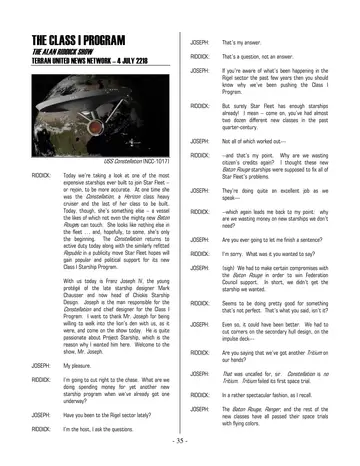
RIDDICK: Today we're taking a look at one of the most expensive starships ever built to join Star Fleet – or rejoin, to be more accurate. At one time she was the Constellation, a Horizon class heavy cruiser and the last of her class to be built. Today, though, she's something else – a vessel the likes of which not even the mighty new Baton Rouges can touch. She looks like nothing else in the fleet … and, hopefully, to some, she's only the beginning. The Constellation returns to active duty today along with the similarly refitted Republic in a publicity move Star Fleet hopes will gain popular and political support for its new Class I Starship Program.
With us today is Franz Joseph IV, the young protégé of the late starship designer Mark Chausser and now head of Chiokis Starship Design. Joseph is the man responsible for the Constellation and chief designer for the Class I Program. I want to thank Mr. Joseph for being willing to walk into the lion's den with us, as it were, and come on the show today. He is quite passionate about Project Starship, which is the reason why I wanted him here. Welcome to the show, Mr. Joseph.
JOSEPH: My pleasure.
RIDDICK: I'm going to cut right to the chase. What are we doing spending money for yet another new starship program when we've already got one underway?
JOSEPH: Have you been to the Rigel sector lately?
RIDDICK: I'm the host, I ask the questions.
JOSEPH: That's my answer.
RIDDICK: That's a question, not an answer.
JOSEPH: If you're aware of what's been happening in the Rigel sector the past few years then you should know why we've been pushing the Class I Program.
RIDDICK: But surely Star Fleet has enough starships already! I mean – come on, you've had almost two dozen different new classes in the past quarter-century.
JOSEPH: Not all of which worked out—
RIDDICK: —and that's my point. Why are we wasting citizen's credits again? I thought these new Baton Rouge starships were supposed to fix all of Star Fleet's problems.
JOSEPH: They're doing quite an excellent job as we speak—
RIDDICK: —which again leads me back to my point: why are we wasting money on new starships we don't need?
JOSEPH: Are you ever going to let me finish a sentence?
RIDDICK: I'm sorry. What was it you wanted to say?
JOSEPH: (sigh) We had to make certain compromises with the Baton Rouge in order to win Federation Council support. In short, we didn't get the starship we wanted.
RIDDICK: Seems to be doing pretty good for something that's not perfect. That's what you said, isn't it?
JOSEPH: Even so, it could have been better. We had to cut corners on the secondary hull design, on the impulse deck—
RIDDICK: Are you saying that we've got another Tritium on our hands?
JOSEPH: That was uncalled for, sir. Constellation is no Tritium. Tritium failed its first space trial.
RIDDICK: In a rather spectacular fashion, as I recall.
JOSEPH: The Baton Rouge, Ranger, and the rest of the new classes have all passed their space trials with flying colors.
RIDDICK: So if you had to cut corners and wound up with a less-than-perfect batch of starships, then why are they doing so well?
JOSEPH: Lots of reasons. The new trititanium frames are the chief reason. We couldn't go Warp 4 without them.
RIDDICK: That I'll grant you.
JOSEPH: Thank you. Adopting the Jeffries design philosophy, with the saucer-and-nacelle approach, has dramatically improved warp performance as—
RIDDICK: Whoa, whoa, whoa, you're starting to use those ten-credit words on me. I'm not a starship designer and neither is my audience.
JOSEPH: It's not built like a flying box, like past starships, so it moves faster and takes corners better.
RIDDICK: I see. What about the new weapons the Constellation is carrying?
JOSEPH: The new warp engines that Star Fleet is using have a lot more power than the old ones. The laser banks we've installed on the Constellation are the same that Star Fleet was putting on its starbases just five years ago.
RIDDICK: That's a helluva lot of juice. I'd hate to be the space pirate to tangle with a ship like that.
JOSEPH: And that's not all. She's got twin photon torpedo tubes, too, and I'm sure you aware of what those can do.
RIDDICK: Well, I'm no military expert, but I hear those things are pretty powerful.
JOSEPH: Which brings me to my point. The generation of starships that's following the Baton Rouge are as big a jump above them as they were over everything that was built after the Romulan War. When you look at the Constellation you're looking at the future of Star Fleet.
RIDDICK: So we're going back to a purely military Star Fleet, then, I take it? I thought the Federation Council outlawed that.
JOSEPH: (sigh) Constellation is not just a warship.
RIDDICK: I wouldn't have guessed, based on the way you were talking, but go ahead.
JOSEPH: With the new design we've been able to significantly increase the Constellation's science and survey capability. She's not just a fighter, Alan. She's also an explorer. She's got at least the same science capability as a Ranger class survey cruiser, and that's a lot. She's got heavy cruiser firepower, yes, but its there only if it's needed.
RIDDICK: Well, I know some Star Fleet captains with some pretty itchy trigger fingers. Just ask the Klingons.
JOSEPH: Ah, so you do know what's happening out beyond Rigel.
RIDDICK: Whether I do or not makes no difference. Looks to me like you've built a warship, not a deep space explorer. We're in a time of peace, Mr. Joseph. The last thing we need is a warp-powered battlestation to fight another war.
JOSEPH: As I recall, we're not the ones who picked a fight with the Klingons, but that's not why—
RIDDICK: —oh?! That's not what they say.
JOSEPH: (sigh) As I was saying, I'm not here to discuss the Klingons. I'm here to discuss the Class I Program.
RIDDICK: But isn't that what the Class I Program is all about? Build a better warship and the Klingons will come knocking at your door?
JOSEPH: I'm a starship designer, not a soldier. I think Star Fleet can answer that question for you.
RIDDICK: Well, tell me this. With all of this weaponry at its disposal, do you think there's anything the Klingons have that could take out the Constellation?
JOSEPH: I honestly can't say. I can tell you this, though. It's going to take a lot to knock out the Constellation and her crew. Star Fleet will do what they can to avoid that fight, like it always does, but if it comes right down to it, she'll go down fighting with every inch of life left in her frame. That is something you can count on, Mr. Riddick.
RIDDICK: I can't argue with that. Thank you for your time, Mr. Joseph.
to be continued …