11.9 Belknap Class Strike Cruiser
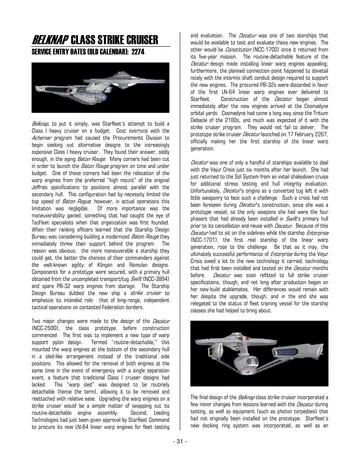
BELKNAP CLASS STRIKE CRUISER SERVICE ENTRY DATES (OLD CALENDAR): 2274 Belknap, to put it simply, was Starfleet’s attempt to build a Class I
BELKNAP CLASS STRIKE CRUISER SERVICE ENTRY DATES (OLD CALENDAR): 2274
Belknap, to put it simply, was Starfleet’s attempt to build a Class I heavy cruiser on a budget. Cost overruns with the Achernar program had caused the Procurements Division to be gin seeking out alternative designs to the increasingly e xpensive Class I heavy cruiser. They found their answer, oddly enough, in the aging Baton Rouge. Many corners had been cut in order to launch the Baton Rouge program on time and unde r budget. One of those corners had been the relocation of the warp engines from the preferred “high mount” of the original Jeffries specifications to positions almost parallel with the secondary hull. This configuration had by necessity limited the top speed of Baton Rogue; however, in actual operations this limitation was negligible. Of more importance was the maneuverability gained, something that had caught the eye of TacFleet specialists when that organization was first founded . When their ranking officers learned that the Starship Design Bureau w as considering building a modernized Baton Rouge they im mediately threw their support behind the program. The rea son was obvious: the more maneuverable a starship they could get, the better the c hances of their commanders against e well-known agility of Klingon and Romulan designs. th a prototype were secured, with a primary hull Components for e uncompleted transport/tug Swift (NCC-3894) obtained from th and spare PB-32 warp engines from storage. The Starship Design Bureau dubbed the new ship a strike cruiser to emphasize its intended role: that of long-range, independent tactical operations on contested Federation borders.
Two major changes were made to the design of the Decatur (NCC-2500), the cl ass prototype, before construction commenced. The first was to implement a new type of warp support pylon design. Termed “routine-detachable,” this mounted the warp engines at the bottom of the secondary hull in a sled-like arrangement instead of the traditional side positions. This allowed for the removal of both engines at the same time in the event of emergency with a single separation event, a feature that traditional Class I cruiser designs had cked. This “warp sled” was designed to be routinely la detachable (hence the term), allowing it to be removed and reattached with relative ease. Upgrading the warp engines on a strike cruiser would be a simple matter of swapping out its routine-detachable engine assembly. Second, Leeding Technologies had just been given approval by Starfleet Command to procure its new LN-64 linear warp engines for fleet testing nd evaluation. The Decatur was one of two starships that a valuate these new engines. The would be available to test and e CC-1700) once it returned from ther would be Constitution (N o s e it five-year mission. The routine-detachable feature of th Dec atur design made installing linear warp engines appealing; furth ermore, the planned connection point happened to dovetail nicel t y with the intermix shaft conduit design required to suppor the r avo new engines. The procured PB-32s were discarded in f of t he first LN-64 linear warp engines ever delivered to Star t fleet. Construction of the Decatur began almos imm ediately after the new engines arrived at the Cosmadyne orbit al yards. Cosmadyne had come a long way since the Tritium Debacl e of the 2180s, and much was expected of it with the strike cruiser program. They would not fail to deliver. The prot uiser Decatur launched on 17 February 2267, otype strike cr offici ally making her the first starship of the linear warp generatio n.
Decatur was one of only a handful of starships available to deal with the Vejur Crisis just six months after her launch. She had st retur from an initial shakedown cruise ned to the Sol System ju for additional stress testing and hull integrity evaluation. Unfortunately, Decatur’s origins as a converted tug left it with tle weaponry to face such a challenge. Such a crisis had not lit been a foreseen during Decatur’s construction, since she was prot otype vessel, so the only weapons she had were the four phas ll ers that had already been installed in Swift’s primary hu prior s to its cancellation and reuse with Decatur. Because of thi Dec prise atur had to sit on the sidelines while the starship Enter (NCC p -1701), the first real starship of the linear war gene e ration, rose to the challenge. Be that as it may, th ultim ately successful performance of Enterprise during the Vejur Crisi s owed a lot to the new technology it carried, technology that had first been installed and t te es d on the Decatur months before. Decatur was soon refitted to full strike cruiser pecifications, though, and not long after production began on s her new-build stablemates. Her differences would remain with her despite th e upgrade, though, and in the end she was relegated to t he status of fleet training vessel for the starship classes she had helped to bring about.
The final design of the Belknap class strike cruiser incorporated a few minor changes from lessons learned with the Decatur during testing, as well as equipment (such as photon torpedoes) that had not originally been installed on the prototype. Starfleet’s new docking ring system was incorporated, as well as an
- 31 -
E gned nterprise-style enlarged primary hull saucer and redesi p haser power systems. An elliptical recessed navigational the place deflector, similar to the one used on Enterprise, re also ircular mount used on Decatur. The shuttlecraft bay was c , although it was still noticeably smaller than the enlarged a bit one used for Enterprise. As soon as each Belknap was finished it was immediately rushed to the border for its “shakedown cruise,” which amounted to little more than filling in for retiring Kiaga and Agilis class perimeter action ships. They would remain on the border for the rest of their service lives.
l of the Belknap class strike cruisers are scheduled to be Al r etired as a group to the Starfleet Reserve in 2296. This was forced by the imposition of the Starfleet Reorganization Order in 2295 by the Federation Council despite vociferous objections from TacFleet, which is losing one of the most powerful starships in its inventory. The Belknap class will cease active duty status just short of its first ESLP refit, with none planned in the immediate future. Belknap was sacrificed so that larger numbers of Tikopai and new-build Miranda class starships could remain in service. The entire class will soon sit idly in storage depots, a still-young group of vessels whose service life was cut short by nothing more than the expedience of politics.
SPECIFICATIONS:
Length: …………………………………….. 290 m Beam: ……………………………………… 141.7 m Draft: …………………….………………… 67.5 m Mass: …………………………………. 187,000 DWT Crew ………………………………………….… 395 Range: ……………………….…….. 20 years at L.Y.V. Cruising speed: ………………….………….. warp 8 Maximum speed: ………………….………… warp 12 Armament: ….. 15 phasers (7 banks of 2, 1 single mount) 2 photon torpedo tubes
Innovations: • First Class I starship equipped with linear warp technology (Decatur prototype) • First starship design fitted with a routine-detachable warp engine assembly
SCHEMATIC:
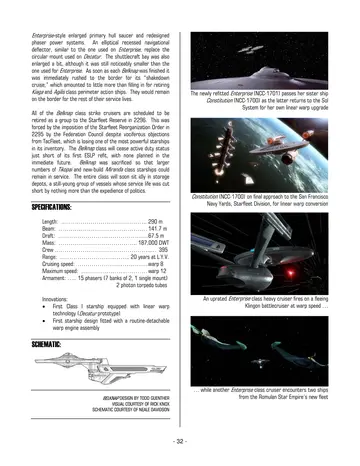
BELKNAP DESIGN BY TODD GUENTHER VISUAL COURTESY OF RICK KNOX SCHEMATIC COURTESY OF NEALE DAVIDSON The newly refitted Enterprise (NCC-1701) passes her sister ship Constitution (NCC-1700) as the latter returns to the Sol System for her own linear warp upgrade
Constitution (NCC-1700) on final approach to the San Francisco Navy Yards, Starfleet Division, for linear warp conversion
An uprated Enterprise class heavy cruiser fires on a fleeing Klingon battlecruiser at warp speed …
… while another Enterprise class cruiser encounters two ships from the Romulan Star Empire’s new fleet
- 32 -