6.8 Alien Encounters: The Early Romulan Encounters
Drawn from Hideki Osasaki’s The Earth-Romulan War, this account traces the first covert Romulan contacts — the Carrizal’s 2134 survey of the Romii system, the destruction of the Balboa and Stone Mountain, and the escalating “pirate” raids on the Atlas, Delta VII, and Dinai Station — that Star Fleet failed to recognize as a coordinated alien threat.
Piracy in High Space: The Early Romulan Encounters
Extracted from The Earth-Romulan War by Hideki Osasaki (Terra: New Century Press, 2270)In 2134 the Star Fleet survey cruiser Carrizal conducted a deep probe of unexplored space on the far side of the New Territories border. Its mission was to chart the region for any Class M worlds suitable for future Federation colonies. Even though the fledgling Federation had not as yet completed detailed surveys of its own interior, nonetheless it was already looking beyond its borders. The Carrizal was but one of several long-range survey ships sent on such missions, looking to push Federation influence into previously unexplored space. The irony here was that the Carrizal was a ringship, of the same design lineage as the ill-fated Sakharov over eight decades before. The hand of Fate enjoys inflicting such coincidences on human destiny.
Among the many worlds that the Carrizal charted was a previously unknown Class M planet in the Romii star system. It was part of a binary planetary pair, one of the few in known space. The world appeared to be already inhabited by a sentient life form, thus eliminating any possibility for colonization. Normal procedure would have been for the Carrizal to initiate first contact proceedings, however, it was already behind schedule on its survey mission and both captain and crew wanted to return home. Instead, the Carrizal made two orbits of this new Class M world at what it believed to be a safe distance, made its sensor recordings, and then left. Had its captain followed proper procedure on this occasion, history might have been written far differently than it is known to us today.
Three years later, the Federation survey cruiser ship USS Balboa returned to the Romii star system. It was accompanied by another Federation starship, the USS Stone Mountain. Their mission was to initiate the first contact proceedings that the Carrizal’s captain had so blatantly ignored before. Data from the Carrizal’s sensor logs had revealed what appeared to be an intelligent culture on the verge of spaceflight. The crews of the Balboa and Stone Mountain went in with every hope and expectation of welcoming a fellow spacefaring race to the stars, just as the Vulcans had done with humanity in 2064. What neither expected was a hostile reception. The Balboa was blown to pieces in a carefully coordinated attack by both orbital weapons and over fifty small craft that swarmed into the area just a few minutes after the two starships had entered orbit. The Stone Mountain, damaged by flying debris from the Balboa and desperately trying to flee the scene, had its outer hull pierced in multiple locations by both missiles and lasers. It lost all atmosphere within seven minutes. The fate of any survivors who might have made it to their spacesuits is not recorded. The Stone Mountain, along with the wreckage of the Balboa, would be carefully studied by these mysterious, hostile, humanoid aliens for the next few years. As with many other survey cruisers of the era, the two Federation starships were simply logged as “missing, presumed lost,” memorialized in brief, then forgotten.
On 10 November 2144 the Star Fleet transport USS Atlas failed to return from a supply mission to Federation colonies along the far border of the New Territories. The ship was officially declared missing a week later and a search conducted by all nearby starships. Not long after the ore carrier SS Muleskinner was rammed, its cargo looted, and its crew murdered execution-style. Also around the same time the Star Fleet transport USS Chandeleur simply disappeared without a trace. Both the Muleskinner and the Chandeleur had been operating in the same general area where the Atlas was lost. The Federation Council immediately ordered a moratorium on all activity in the area while Star Fleet tried to deal with the problem. It would only get worse with time.
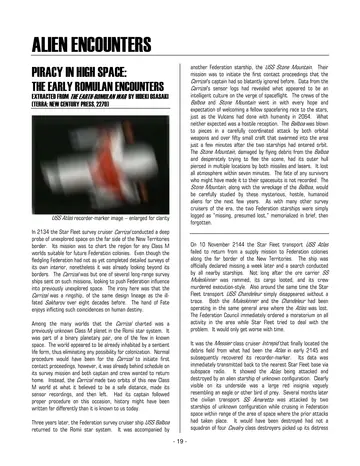
It was the Messier class cruiser Intrepid that finally located the debris field from what had been the Atlas in early 2145 and subsequently recovered its recorder-marker. Its data was immediately transmitted back to the nearest Star Fleet base via subspace radio. It showed the Atlas being attacked and destroyed by an alien starship of unknown configuration. Clearly visible on its underside was a large red insignia vaguely resembling an eagle or other bird of prey. Several months later the civilian transport SS Amaretto was attacked by two starships of unknown configuration while cruising in Federation space within range of the area of space where the prior attacks had taken place. It would have been destroyed had not a squadron of four Cavalry class destroyers picked up its distress call and arrived on the scene. The unknown ships quickly withdrew at high warp speed, much to the irritation of the destroyer crews. Later, when the sensor logs of all five ships were played back and compared, the two intruders were discovered to be the same type of vessel that had attacked and destroyed the Atlas.
These incidents, occurring less a year apart but apparently involving the same culprits, convinced many in the Federation Council that space pirates had begun operating on the New Territories border. There had been trouble with piracy since the days of the Coalition, and their boldness and flair for grandiose gestures were well known. It was believed by many Federation politicians that the unusual “bird-of-prey” insignia on the mystery starships was one such gesture. As a result Star Fleet received increased funding for new starship construction, with the understanding that more vessels would be dispatched to the New Territories to “crush the pirates” as they became available.
These “pirates” didn’t wait for Star Fleet to get ready. On 12 April 2146 they made their boldest move yet, looting and destroying a small Federation outpost on Delta VII and killing all of its personnel. The act prompted the Federation Council to order Star Fleet to dispatch almost three dozen warp probes into the general area in a vain attempt to establish contact with the “pirates,” with no success. The following year, the “pirates” got even bolder. On 21 February 2147 they raided Dinai Station, a civilian sector supply base within cruising range of nearby Star Fleet outposts. This was their deepest penetration yet into Federation space and followed the same pattern as the Delta VII attack: the station was looted, stripped of any removable technology, and all of its personnel killed execution-style. This raid, the boldest yet, set off a fierce round of debate within the Federation Council that eventually resulted in even more orders and appropriations for Star Fleet.
Star Fleet was having considerable difficulty locating the “pirates” and putting an end to their vicious acts. They employed hit-and-run tactics, always fleeing the scene whenever warships arrived to engage them. No matter how many ships Star Fleet assigned to the New Territories border, it seemed that the “pirates” always found a way to slip pass them. Most vexing of all was the new enemy’s anonymity. Nothing was known about them except for the design of their ships and the “bird-of-prey” emblem on their undersides. Also, there was simply no comprehending the unintelligible subspace radio intercepts they were constantly monitoring in the area. They were either in code or in an alien tongue or perhaps both. Had someone thought to ask the Vulcans for help then the situation might have become more clear. That was not done. Instead, based on the available data, only one conclusion was clear to Star Fleet: the “pirates” were a well-organized and disciplined group, with a central command structure and raiders almost as powerful as some of Star Fleet’s smaller warships. Such activity might threaten the existence of Starbase 10, the newest such facility to be constructed and one of the first that would serve the New Territories. If the “pirates” could take out Starbase 10 then they could conceivably threaten the whole quadrant and perhaps even Local Group systems as well.
With this in mind Star Fleet made arrangements for two new fleets to join the forces it already had in the New Territories. On 30 November 2147 a 12-ship “black ops” fleet under the direct command of Star Fleet Intelligence quietly left for the New Territories. It was equipped with starships fitted with the latest in Federation stealth technology, weapons and drive systems, and manned by all-volunteer crews. Their mission was to go beyond the New Territories in the general area from which the “pirates” seemed to be originating and, to quote the operational order, “deal with the situation.” At the same time the 159th Combat Squadron, under the command of Commodore Tonsum Han, was dispatched to the still-building Starbase 10. His orders were to keep his fleet in a constant state of readiness, prepared to defend the starbase against any attack by “outside forces.” In support of these operations many of the border fleets were redeployed to new patrol areas as well.
This shake-up in Star Fleet strength in the New Territories corresponded with a marked decrease in “pirate” activity. It would cease completely by the middle of 2149. The Federation Council was confident that its actions had brought an end to the “pirate” threat. Star Fleet was complemented on dealing with “the pirate scourge,” as one politician put it. There was just one problem with this rose-tinted picture. Star Fleet really hadn’t done anything. It was still failing to intercept the “pirates” in time. The recent drop-off in “pirate” activity seemed to suggest that the recent fleet redeployment might have had something to do with it, but the aging combat veterans of Star Fleet weren’t so sure. The new garrison fleet at Starbase 10 had encountered nothing since its arrival and already Commodore Han was itching for action. Most curious of all, Star Fleet’s 12-ship “black ops” fleet had simply vanished. Like the Chandeleur, it was never heard from again.