1.4 Spacecraft: Vostok, Soyuz & Apollo
Illustrated profiles, with specifications and innovations, of the early manned spacecraft Vostok, Soyuz, Apollo, and the Skylab space station.
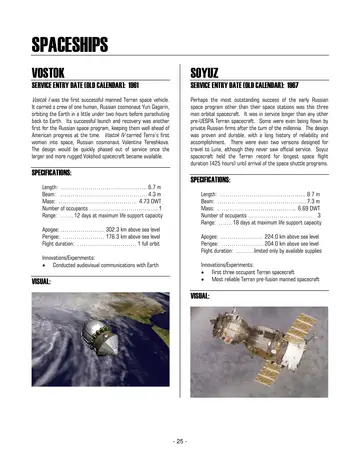
Vostok
Service entry date (Old Calendar): 1961
Vostok I was the first successful manned Terran space vehicle. It carried a crew of one human, Russian cosmonaut Yuri Gagarin, orbiting the Earth in a little under two hours before parachuting back to Earth. Its successful launch and recovery was another first for the Russian space program, keeping them well ahead of American progress at the time. Vostok IV carried Terra's first woman into space, Russian cosmonaut Valentina Tereshkova. The design would be quickly phased out of service once the larger and more rugged Voskhod spacecraft became available.
Specifications: Length 6.7 m; Beam 4.3 m; Mass 4.73 DWT; Number of occupants 1; Range 12 days at maximum life support capacity; Apogee 302.3 km above sea level; Perigee 176.3 km above sea level; Flight duration 1 full orbit.
Innovations/Experiments:
- Conducted audiovisual communications with Earth
Soyuz
Service entry date (Old Calendar): 1967
Perhaps the most outstanding success of the early Russian space program other than their space stations was this three man orbital spacecraft. It was in service longer than any other pre-UESPA Terran spacecraft. Some were even being flown by private Russian firms after the turn of the millennia. The design was proven and durable, with a long history of reliability and accomplishment. There were even two versions designed for travel to Luna, although they never saw official service. Soyuz spacecraft held the Terran record for longest space flight duration (425 hours) until arrival of the space shuttle programs.
Specifications: Length 8.7 m; Beam 7.3 m; Mass 6.69 DWT; Number of occupants 3; Range 18 days at maximum life support capacity; Apogee 224.0 km above sea level; Perigee 204.0 km above sea level; Flight duration limited only by available supplies.
Innovations/Experiments:
- First three occupant Terran spacecraft
- Most reliable Terran pre-fusion manned spacecraft
Apollo
Service entry date (Old Calendar): 1968
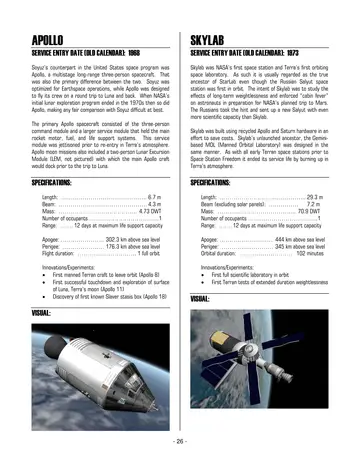
Soyuz's counterpart in the United States space program was Apollo, a multistage long-range three-person spacecraft. That was also the primary difference between the two. Soyuz was optimized for Earthspace operations, while Apollo was designed to fly its crew on a round trip to Luna and back. When NASA's initial lunar exploration program ended in the 1970s then so did Apollo, making any fair comparison with Soyuz difficult at best.
The primary Apollo spacecraft consisted of the three-person command module and a larger service module that held the main rocket motor, fuel, and life support systems. This service module was jettisoned prior to re-entry in Terra's atmosphere. Apollo moon missions also included a two-person Lunar Excursion Module (LEM, not pictured) with which the main Apollo craft would dock prior to the trip to Luna.
Specifications: Length 6.7 m; Beam 4.3 m; Mass 4.73 DWT; Number of occupants 1; Range 12 days at maximum life support capacity; Apogee 302.3 km above sea level; Perigee 176.3 km above sea level; Flight duration 1 full orbit.
Innovations/Experiments:
- First manned Terran craft to leave orbit (Apollo 8)
- First successful touchdown and exploration of surface of Luna, Terra's moon (Apollo 11)
- Discovery of first known Slaver stasis box (Apollo 18)
Skylab
Service entry date (Old Calendar): 1973
Skylab was NASA's first space station and Terra's first orbiting space laboratory. As such it is usually regarded as the true ancestor of StarLab even though the Russian Salyut space station was first in orbit. The intent of Skylab was to study the effects of long-term weightlessness and enforced “cabin fever” on astronauts in preparation for NASA's planned trip to Mars. The Russians took the hint and sent up a new Salyut with even more scientific capacity than Skylab.
Skylab was built using recycled Apollo and Saturn hardware in an effort to save costs. Skylab's unlaunched ancestor, the Gemini-based MOL (Manned Orbital Laboratory) was designed in the same manner. As with all early Terran space stations prior to Space Station Freedom it ended its service life by burning up in Terra's atmosphere.
Specifications: Length 29.3 m; Beam (excluding solar panels) 7.2 m; Mass 70.9 DWT; Number of occupants 1; Range 12 days at maximum life support capacity; Apogee 444 km above sea level; Perigee 345 km above sea level; Orbital duration 102 minutes.
Innovations/Experiments:
- First full scientific laboratory in orbit
- First Terran tests of extended duration weightlessness