9.0 A New Direction: Overview
An overview of the early 23rd century recounts how Star Fleet's next-generation starship program took shape through Mark Chausser's modular component procurement program, the adoption of the Kloratis VX-28 "Pegasys" warp engine and the compromised Baton Rouge secondary hull, Chausser's death, the breaking of the Warp 4 barrier by the USS Mann, the legal clearance and shipboard testing of materializer (transporter) technology, the duotronics and dilithium breakthroughs, and the first hostile encounters with the newly discovered Klingon Empire.
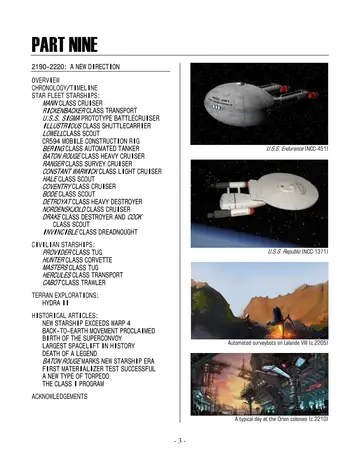
By the beginning of the 23rd century Star Fleet knew where it needed to go in with its next generation of starships. All of the experimentation over the past 25 years had paid off in the form of a series of design specifications that, once combined, would produce the ideal starship. These were a flattened, preferably thin disc-shaped primary hull; a streamlined "Block IV" style secondary hull, and twin warp engines on booms mounted up and away from the secondary hull.
There were two more hurdles Star Fleet had to jump before it could start work in earnest on its next generation of starships. The first was the obvious cost. The recent funding cuts made in Star Fleet's appropriations from the Federation Council limited just how "modern" an all-new build program could be. In order to be cost-effective this new program would have to be a mix of both old and new: just enough old in the right places to keep the budget down while as new as possible everywhere else. The second was limited yard space. Star Fleet still had several ship classes building, both from older programs and from many side projects (such as science and survey vessels) mandated by the Federation Council. In addition, many civilian spaceyards that had once catered exclusively to Star Fleet now had slipways full of civilian spacecraft of all kinds, with more on order for this ever-expanding market. Vickers Shipbuilding was the one spaceyard with space available (saved, in fact) for a new starship program. The new ships that Star Fleet was proposing, though, could not be built by Vickers alone. It simply didn't have the capacity to fabricate all of the major components and control systems by itself. Many of these would be brand new and had never been incorporated into a single Star Fleet vessel before. A solution would have to be found to all of these issues before Star Fleet could proceed with its next generation starship program.
The famed Terran scientist Thomas Alva Edison once said that "necessity is the mother of invention." So it was that Mark Chausser of Chiokis Starship Design, the lead engineer for Star Fleet's next generation starship program, proposed a innovative (and rather radical) solution in early 2201. Instead of awarding a full naval construction contract to a single contractor, multiple contracts would be awarded for individual components – such as what Star Fleet was already doing with its warp engines. One major contractor (in this case Vickers Shipbuilding) would be in charge of the hulls and frames, while Star Fleet itself coordinated the work of component contractors and supervised final starship assembly. The finished starship could then be launched in considerably less time than it would take to have one contractor do everything for Star Fleet. The potential savings in administrative costs alone were significant. This method would also free up more yard space for additional construction, since less dock time would be required for a given build class under this scheme. Construction of individual components would take place in parallel in smaller facilities. Only when the time came for final free-space assembly of the frame and all of its components would a starship-sized spacedock be required. An obvious side benefit of such a program would be standardized starship components. These could then be interchanged across vessels in the same class, starship classes using similar components, or even arranged in different configurations for new starship classes. It seems so obvious today but at the time it was a major breakthrough in starship design philosophy. Chausser called this the modular component procurement program. Star Fleet's Starship Design Bureau called it a godsend. This program was first implemented with the Baton Rouge and Ranger class cruisers program in 2205. It has remained the standard for Star Fleet starship design ever since.
As part of its move to keep the costs down on its next generation of starships, Star Fleet switched warp engine suppliers for the first time in its history. There was no question that the Cochrane Dynamics PB-18 series was going to be one of the best warp engines of its generation, given its maker. Unfortunately, Cochrane was still having problems working out technical glitches with the energy regulation systems of the PB-18, meaning it would not be ready in time for the new starship program. Facing a looming production deadline and the potential for rising development costs, Star Fleet had no choice but switch suppliers and go with the VX-28 "Pegasys" warp engine from Kloratis Drive Systems. This was an opportunity heaven-sent for this Tellarite firm, which had already proven its capabilities twice before with the Baikonur class cruisers and the revamping of the Tritium class battlecruisers during Star Fleet's experimental period (2166-2190). The new VX-28 had already been suggested for the Mann class survey cruisers but had been passed over due to mount incompatibilities with the Mann hull design. Their overall similarities to Cochrane's Perth PB-series, however, made them an excellent substitute for the problem-plagued PB-18. They would perform exceptionally well with the Jeffries-type hull configuration being adopted for Star Fleet's next generation starship program. The Kloratis VX-28 "Pegasys" warp engine was one of the best designs of its generation. It would also become the visible trademark of all Baton Rouge generation starships.
Star Fleet would eventually adopt Cochrane-derived warp engines again in a few short years for other starship classes. Nevertheless, Star Fleet engineers would always have a special place in their hearts for their "odd child," as they lovingly called the VX-28 "Pegasys." Although somewhat less powerful than Cochrane's original PB-18 design, the VX-28 was easier to operate and required minimal maintenance in comparison. It was the first modularized Star Fleet warp engine that was rated for a cruising speed above Warp 4. It was also the last operational Star Fleet warp engine produced before the dawn of dilithium-regulated designs. It is interesting to note that even today Star Fleet has yet to completely abandon the venerable VX-28 despite its "odd child" status. One can still find several of them at every starbase and major port facility, ostensibly for the few Baton Rouge era starships still in fleet service. There is a method to this seeming madness, however. It was not unheard of during the Four Years War for a damaged Class I starship with warp engines beyond repair to be temporarily fitted with VX-28s in order to get it operational again. Such seems to be part of the reasoning behind Star Fleet's continued maintenance of its remaining VX-28 inventories around the Federation. Its excellent operational record, despite its age, has no doubt ensured that Star Fleet will keep the VX-28 around, even if only as a quick-fit "fill-in" engine, for years to come.
The use of the Kloratis VX-28 "Pegasys" warp engine was not the only compromise Star Fleet had to make with the Baton Rouge generation. The secondary hull for the program was nothing close to what had originally been planned. That too was a necessary, cost-savings compromise. In order to gain support for the Baton Rouge generation Star Fleet had to court some of its fiercest political foes, ones who had long been advocates of the old Terran "slab hull" designs. It didn't matter that this particular design philosophy had reached a dead end. What was needed were construction funds and political support in the Federation Council if Star Fleet was going to get all the ships that it wanted. Both Mark Chausser and his assistant Franz Joseph IV were upset when they heard about this. They understood, though, that insofar as this generation of Star Fleet vessels were concerned they couldn't have their cake and eat it, too. The most important thing, as Star Fleet liaison Captain William van Anling pointed out, was to get them to accept the new primary hull saucer. Once that was in place then the rest of the Jeffries Project concept would follow. It was a natural, given what was already happening with the experimental Mann class cruisers. Of all the parts of the Baton Rouge design that were required, the secondary hull was the only one left that could be compromised. The real next generation design – "Project Starship," as some jokingly called it – would have to wait a few more years until Star Fleet could be confident of Federation Council approval. Chausser and Joseph grudgingly agreed to incorporate a redesigned "slab hull" type secondary hull into the Baton Rouge program as close to Jeffries Project specs as this antiquated philosophy permitted. In the meantime, though, Chausser kept himself busy working up a "real" secondary hull once the time was right to for it to be accepted. He never got the chance to see it become reality.
Mark Chausser, the genius behind the Baton Rouge generation of starships, the creator of the Star Fleet primary hull saucer, and the man who almost single-handedly changed the direction of Star Fleet starship design, was tragically killed in a shuttlecar accident in 2204. He was on his way to a meeting of the Procurement Sub-Committee of the Federation Council when he was hit head-on by a drunk driver. Chausser was killed instantly. He never got to see the new generation of starships that he helped bring about come to life. Franz Joseph IV, his protégé, who was only twenty-nine at the time, succeeded him as chief starship designer of Chiokis. It would be up to Joseph to oversee his mentor's dream as it became reality … and to make sure that no compromises were made once it came time for Project Starship's turn at the docks.
For all that it was about to do for Star Fleet and the Federation, there was one honor that would forever be denied the USS Baton Rouge. On 27 May 2192, the new survey cruiser USS Mann officially broke the legendary Warp 4 barrier. It achieved and maintained a cruising speed of Warp 4.2 for three hours without any signs of stress to its hull or frame. Later space trials would push the cruising speed limit up to Warp 4.5 as far as the Mann and the rest of its class was concerned. The event was hailed in the press of the day as the most significant in the history of warp drive since its invention by Zefram Cochrane. To be more accurate, though, it proved Mark Chausser's theory that the use of a trititanium frame would remove all known limits on starship design. Warp engine upgrades would allow the similarly equipped, older Horizon and Archon class cruisers to also exceed Warp 4 by the time the Baton Rouge neared completion. The Baton Rouge class and its derivates, the first with all-trititanium hulls and frames, would be the first to exceed Warp 5. The situation that had so plagued starship designers in the 21st and 22nd centuries was new effectively reversed. From this point forward it would be the warp engines, not the hull or space frame, which would effectively limit just how fast a properly designed 23rd century starship could go.
During the past decade all research on the materializer, the ancestor of the modern transported, had come to a virtual standstill. The issue of its use with living organic manner, such as an intelligent lifeform, had been bogged down in Federation courts due to ethical concerns. The key question at the heart of the matter was this: did a being put through a materailizer "die" in the process? In other words, was the lifeform that came out the other side the same one that had gone in? The case eventually worked its way up to the Federation Worlds Court, which made its landmark ruling on the subject in 2200. Its summation reads as follows:
As has been demonstrated to the satisfaction of this Court, the essence of Materializer operation is the total conversion of a living being from a matter state to a pure energy state, transporting that energy over a distance while maintaining its cohesion, then reversing the process and totally converting said energy back to a matter state identical to its previous form with the use of a previously stored pattern. As the conversion from matter to energy is total and complete, as cohesiveness is maintained in transit, and as reconversion is in effect a successful total reversion of said process, then there is no chance for the quality known as life to be lost through the use of a Materializer save for problems with the equipment or a premeditated act. This is in effect the same guiding principle as for any other tool, instrument, or system with the potential to cause harm to or take the life from any being. To this end this court sees no ethical issues associated with the use of the Materializer on a living being so long as the proper safety precautions are taken with regards to operating procedures and the equipment involved. This court rules in favor of the Defendant.
With those words the Federation Worlds Court cleared the last remaining hurdle in the development of what we know today as transporter technology. Star Fleet, realizing its implications, promptly threw its backing behind the efforts of the renewed research effort at the Deneva Research Station. In 2206 the first successful transport of a living being with a materializer was conducted at the Deneva Research Station. In 2208 the Baton Rouge class starships USS Moscow and USS Tehran participated in the first successful shipboard test of materializer technology. Within a few years they would become a standard part of shipboard systems aboard all Star Fleet starships. Materializers would never completely replace short-range shuttlecraft and warp shuttles for various reasons (such as energy field interferences); however, within the century they would become the preferred method of transit for all Star Fleet landing party teams and Star Fleet Marine insertion/extraction operations.
It is a fact of technology that one important breakthrough inevitably leads to another. William Abramson's development of the theory of transtator physics led to the invention of the transtator by Vukovic and Govindarajan. This is the fundamental building block on which all of modern Federation computer and electronics technology is based. The development of the transtator in turn enabled Dr. Richard Daystrom, one of the Federation's most pre-eminent computer scientists, to bring to life a theory he had been developing since his teenage years. There is not space enough in this document to describe how he took his dream and made it reality. Suffice it to say that when he was done, his duotronic computer system revolutionized the industry. It changed the face of applied Federation computer technology as thoroughly as did the introduction of the first personal computers in Terra's late 20th century. Once again, the power and processing capabilities of systems that had once filled rooms and even whole buildings became available in small and compact form. The impact on the starship industry alone was enormous. Duotronic-based ship's computers, among the largest such systems of their day, were capable of controlling and regulating every single major function of a starship with only routine crew maintenance. This alone freed up manpower previously needed for starship operations, which resulted in less deck and more science personnel being assigned to Star Fleet vessels. The most important asset of a duotronic ship's computer, though, was its split-second ability to dynamically control and adjust a starship's warp field. This allowed Star Fleet designers to not only break the old "Roddenberry Twin-Nacelle Rule" but to solve all the problems associated with the old trinacelle configuration in one stroke. Single-nacelle starships would be the first such previously "impossible" designs to enter service with the Drake and Cooke class starships. Limited funding and Council indifference, though, did not permit Arbing and Lidde's initial proposal for a Baton Rouge era triple-engine dreadnought to become reality at this time. That development would have to wait several more decades and another interstellar war before it too would come to life – an "impossibility" made possible by the duotronics breakthrough.
As has been mentioned before, the energy regulation issues that plagued Cochrane Warp Dynamic's new PB-18 warp engines prevented their acceptance by Star Fleet for several years. It even caused Cochrane to lose the warp engine contracts for the entire Baton Rouge generation of starships. The fact of the matter was that current warp engine designs had reached their limits, yielding a designed cruising speed in the Warp 4 to 4.5 range and a designed emergency "burst" speed of Warp 6. Beyond those limits, regulating the required energy flow was practically impossible for the warp engine technology of the day to handle. The next major breakthrough in this field would be accomplished by chance. When the rubindium focusing crystal of a mining laser was broken at the Lalande VIII mining complex in 2208, a quick-thinking local engineer quickly fabbed a new crystal from a nearby dilithium deposit. The first time the rebuilt laser was tried, it had suddenly gained four times as much power despite having the same fusion generator as before. Word soon spread, with mining engineers all over the sector making the same adaptations to their equipment. It was inevitable that Star Fleet would learn of this discovery and pass it on. As the reader might have guessed, this discovery would eventually lead to the development of phaser technology some four decades later. More important for its time, however, the unusual energy moderating properties of dilithium crystals proved the solution to the problems plaguing Cochrane's PB-18 warp engine.
Dilithium-moderated PB-18s first saw service in 2209 with their successful refitting to several Horizon class cruisers. All of the Horizon and Archon class cruisers would receive the PB-18 by 2220. An improved design, the PB-20, was first tested with the cruisers Constellation and Republic in 2214. It was not that much of an improvement, though, given its high cost, and overall performance was essentially the same as the older PB-18. This would cause Star Fleet to revert to the PB-18 as a cost-savings measure once it came time for the Class I Program to get underway.
It was a good thing that the modernization of Star Fleet was no longer being neglected. A new threat to the Pax Federationis, as some called the long peace that followed the Romulan War, was making itself felt on the Federation border beyond the Rigel sector. As in the days before the Romulan War, Federation starships were disappearing or being attacked by a mysterious foe. The Orions obviously knew who they were; however, the Orions weren't talking. A chance encounter by Federation trader E.A. Jacoby would not be realized for the significant event that it was and his first contact report subsequently lost in bureaucratic red tape. The attack on the transport Millie Sue and the subsequent attack on the Star Fleet vessel Sentry proved to all concerned the overt belligerency of the "newly discovered" Klingon Empire. Unlike the Romulans, though, the Klingons were openly aggressive and showed no fear of Star Fleet's current border forces. The Baton Rouge and her sister ships were subsequently rushed to the border as fast as they could be completed, where their sudden appearance had the desired effect. The number of Klingon border incidents went on a marked decline, with only the occasional incursion or ambush taking place for the next few decades. War with the Klingon Empire seemed a certainty in the near future given its bellicose nature. Even so, the introduction of the Baton Rouge generation of starships is credited by many with delaying the start of that war for decades.