4.5 DY-X Series Assault Cruiser
DY-X SERIES ASSAULT CRUISER SERVICE ENTRY DATE (OLD CALENDAR): 2057 Around the same time that the Mahan project got underway the firm of Dys
DY-X SERIES ASSAULT CRUISER SERVICE ENTRY DATE (OLD CALENDAR): 2057
Around the same time that the Mahan project got underway the firm of Dyson-Yoyodyne proposed a combat design based on their proven DY-series technology. This would be able to fill both the space combat and ground assault roles. The UESF, which was desperate for anything that could be used to fight the Kzinti, quickly approved the project. The armored DY-X assault cruiser entered service just in time for the Third Earth-Kzin War (2058-2060). Its unique design allowed it to operate in theaters and under conditions that were unsuitable for a Mahan class heavy cruiser or other UESF “heavy.” The design proved so versatile that it remained in the UESF inventory, with minor upgrades and improvements, until the UESF was formally dissolved in the 22nd century. Many still remain in service with their civilian owners as of this date.
The DY-X was the first warship in Terran spacecraft history with an emergency separation capability. In the event of extensive damage or extreme circumstances the entire command section, from the bow all the way back to the base of the boom, could be ttisoned and operate as its own spaceship. Inside the boom je ed top-to-bottom, so as to allow were two fusion rockets arrang ys to the rest of the ship. These rockets oom for accesswa r ere w quite capable of propelling the DY-X boom outside of the pote ntial blast radius of an exploding aft section within 15 seco nds.
Alth l ough Dyson-Yoyodyne no longer makes the DY-X it stil supp lies parts and service to their many owners. The Kloratis Driv p e Systems division of Cochrane Industries offers a full war rive upgrade using trititanium replacement frame supports and d Pegasys VX-28, non-dilithium moderated warp its reproduction ives any suitably modified DY-X a cruising speed engines. This g of Warp 4 and a maximum speed of Warp 5.5.
The Kzinti could not help but take note of the many “Vargas” and anime girls often painted as “nose art” on the front of the many DY-Xs by their crews. It is said by some that the post-war infatuation that some Kzinti had with young human females arose from seeing these suggestive pictures so many times on the destroyers they fought during the War. It was because of this that all spacecraft nose art other than fleet-approved general designs (such as t he ever-popular Evil Eyes and Tiger’s Maw) were banned from the early 22nd century onward. In its place the UESF substituted the non-suggestive Squadron Insignia Scheme (SIS) for all ships in the same class. A planned whole family of second-generation DY-X designs was b have ut never built. The MacArthur class assault ship would er DY-X oth been a next-generation DY-X. The Pegasus was an , that was ariant, somewhat smaller and more streamlined v intend to fill the “light” roles for less important missions. The John Paul Jones class cruiser traded the delta-shaped secondary hull for a Kzinti-like spherical secondary hull bristling with weapons. The end of the Earth-Kzin Wars plus the perfection of warp drive put an end to all future development of the DY-X program, with only a reduced-scale John Paul Jones prototype being built. This one-of-a-kind DY-X orphan was quickly sold and converted for use by its new civilian owner as an interstellar transport. Its ultimate fate remains unknown.
SPECIFICATIONS:
Length: …………………………………….. 167 m Beam: ……………………………………… 90 m Draft: …………………….………………… 24 m Mass: ………………………………… 23,000 DWT Crew ……………………………………….. 94 Range: ……………………………. 3 years at 0.5c Maximum speed: ………………….………… 0.65c f Warp 1.2 “jumps” of up to 12 minutes) (capable o ll craft:…………………………….. 2 Number of sma Armament: ………………….…… 3 forward lasers Dual bay hard points (36-pack missile racks common) 2 wingtip particle cannons (Fourth Earth-Kzin War)
Innovations: • First production Terran starship with a CDP generator • n First Terran starship with an emergency separatio capability for its command section • First DY-series designed for planetary landings
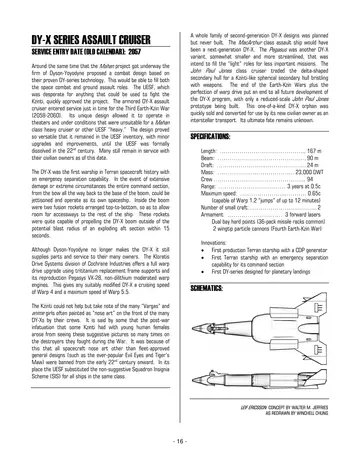
SCHEMATICS:
LEIF ERICSSON CONCEPT BY WALTER M. JEFFRIES AS REDRAWN BY WINCHELL CHUNG
- 16 -