11.24 Acknowledgements — Volume 11: 2251–2275
ACKNOWLEDGEMENTS VOLUME 11: 2251-2275 AUTHOR’S COMMENTS: Perceptive readers will note that I differ with Dixon (Prime Zero) as to the number

ACKNOWLEDGEMENTS VOLUME 11: 2251-2275
AUTHOR’S COMMENTS:
Perceptive readers will note that I differ with Dixon (Prime Zero) as to the number of and dates for the “early” adventures of Captain Kirk and the crew of the starship Enterprise. This is largely a matter of interpretation. I do not accept the proposal of a number of pre-“Where No Man” adventures as posited in some of the more recent TREK novels. I instead fall back to the premise of the original Graham-Mandel timeline, that which we old-school fans always understood, that the five-year mission of the Enterprise (save for “Where No Man”) took place from mid2260 to early 2265. This allows time for both the Bonhomme Richard (TOS) and Achernar (TAS) refits, and on that point at least Dixon and I are somewhat in tune. “Where No Man,” the second series pilot, is an obvious exception due to the set and uniform styles, which are closer to the Pike era (“The Cage” and “The Menagerie”). It has always been my belief based on the on-screen evidence that this episode took place not long after Kirk took command, which would place it somewhere in early to mid-2259. Gary Mitchell’s reference to a prior adventure with Kirk on Dimorus in no way implie s that it took place after he signed on as Enterprise execu tive officer. That is TREK novel/comic retconning. As a ma tter of fact “Where No Man” makes clear that he and Kirk had been friends ever since their Academy days, so the visit to Dimorus could have taken place at any time between those two bookends. The only time for such pre-TOS “early adventures” of the Enterprise, in my opinion, is between “Where No Man” and the first production TOS episode, “The Corbomite Maneuver.” Unfortunately, since the Enterprise was in drydock most of this time getting its Bonhomme Richard upgrade then the scope of such tales is by default severely limited. I’m afraid this is some more of that insidious retconning that the TREK novel writers are especially guilty of taking upon themselves – even more so with the incorrect suppositions of the Church of Okuda and the encouragement of the Official Franchise Heirs to back them up. It’s the only real problem I have with Dixon’s work regarding this era in TREK history, but as I said it’s a matter of interpretation. I know a lot of you have your own ideas on the topic and you’re welcome to them.
The debate concerning the use of Starfleet as opposed to Star Fleet is as old as STAR TREK itself. Star Fleet is the form used by old-school TREK tech fans and is derived directly from Franz Joseph Schnaubelt’s Star Fleet Technical Manual (SFTM), the standard by which all TREK technical publications are judged. Unfortunately this form of the word was but one of several errors that found their way into the SFTM. The only time we ever see the term on screen in classic TREK is in the TOS episode “The Menagerie.” It is printed on the cover of the top secret report that Commodore Mendez hands Captain Kirk on Talos IV. It is very clearly written as Starfleet on the cover of that folder (“FOR THE EYES OF STARFLEET COMMAND ONLY”). Geoffery Mandel “corrected” this to Starfleet in his classic fanon reference work U.S.S. Enterprise Officer’s Manual, thus perpetuating the error. It was finally returned to its true form, Starfleet, in the “Headquarters scene” near the beginning of STAR TREK: The Motion Picture. Still, who am I to try to swim against the current of years of classic TREK fanon? That’s why I have the term changed in 2260, so the use will be somewhat consistent both with what’s on screen (“Tommorow Is Yesterday,” “The Menagerie”) and with the beloved SFTM. It’s a compromise, yes, but a necessary one.
The photoshopped picture of Vice Admiral Lori Ciana is my little gift to “canon” TREK, in the same vein Okuda’s “Captain April.” Mine is more accurate, though. It’s a picture of Susan Sullivan, the actress who actually played Admiral Ciana in Star Trek: The Motion Picture. You never saw her face because she died along with Commander Sonak in a horrible transporter malfunction. Now that we know what she looks like, it’s easy to see why Kirk was attracted to her. I photoshopped my pic because I don’t ST:TMP set of Ms. Sullivan in know of any photos from the nd could send it to me, I’d be costume. If anybody has one a happy to include it in place of my own.
The Citadel class command cruiser is my attempt to combine three somewhat different concepts into one design. Those are the Federation CC of Starfleet Battles (Stephen V. Cole), the Citadel class command cruiser from Starfleet Line Officer Requirements (David Schmidt), and the “Enterprise upgrade” from the old FASA RPG (Dana Knutson). I’ve tried to describe it as a fallback measure, something Starfleet had to do when the Council refused to fund the rest of the Balson class. Not every Enterprise-type heavy cruiser would get such an upgrade, though – just the bare minimum needed for fleet operations. That’s why I’ve limited the number of Class I heavy cruisers that got a CC-type upgrade. Oh, by the way, C3 is Navy slang for “command, control, and communications.” Those are the three things you want in a ship of this type.
I described megaphaser cannon the way I do for a reason. I see them as an evolutionary step in developing more powerful phasers, the kind we see in the 24th century, just as the original phaser cannon of the Kiaga helped usher in phaser technology in the first place during the Four Years War. This is how most canon and fanon tech sources treat what would otherwise be a technological anomaly within the TREK franchise, and it makes sense to me.
- 53 -
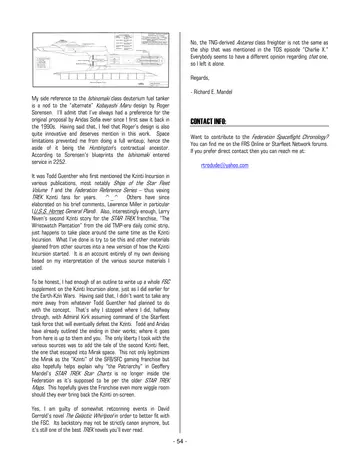
My side reference to the Ishinomaki class deuterium fuel tanker is a nod to the “alternate” Kobayashi Maru design by Roger Sorensen. I’ll admit that I’ve always had a preference for the original proposal by Aridas Sofia ever since I first saw it back in the 1990s. Having said that, I feel that Roger’s design is also quite innovative and deserves mention in this work. Space limitations prevented me from doing a full writeup; hence the aside of it being the Huntington’s contractual ancestor. According to Sorensen’s blueprints the Ishinomaki entered service in 2252.
It was Todd Guenther who first mentioned the Kzinti Incursion in various publications, most notably Ships of the Star Fleet Volume 1 and the Federation Reference Series – thus vexing TREK Kzinti fans for years. ^_^ Others have since elaborated on his brief comments, Lawrence Miller in particular (U.S.S. Hornet General Plans). Also, interestingly enough, Larry Niven’s second Kzinti story for the STAR TREK franchise, “The Wristwatch Plantation” from the old TMP-era daily comic strip, just happens to take place around the same time as the Kzinti Incursion. What I’ve done is try to tie this and other materials gleaned from other sources into a new version of how the Kzinti Incursion started. It is an account entirely of my own devising based on my interpretation of the various source materials I used.
To be honest, I had enough of an outline to write up a whole FSC supplement on the Kzinti Incursion alone, just as I did earlier for the Earth-Kzin Wars. Having said that, I didn’t want to take any more away from whatever Todd Guenther had planned to do with the concept. That’s why I stopped where I did, halfway through, with Admiral Kirk assuming command of the Starfleet task force that will eventually defeat the Kzinti. Todd and Aridas have already outlined the ending in their works; where it goes from here is up to them and you. The only liberty I took with the various sources was to add the tale of the second Kzinti fleet, the one that escaped into Mirak space. This not only legitimizes the Mirak as the “Kzinti” of the SFB/SFC gaming franchise but also hopefully helps explain why “the Patriarchy” in Geoffery Mandel’s STAR TREK Star Charts is no longer inside the Federation as it’s supposed to be per the older STAR TREK Maps. This hopefully gives the Franchise even more wiggle room should they ever bring back the Kzinti on-screen.
Yes, I am guilty of somewhat retconning events in David Gerrold’s novel The Galactic Whirlpool in order to better fit with the FSC. Its backstory may not be strictly canon anymore, but it’s still one of the best TREK novels you’ll ever read. No, the TNG-derived Antares class freighter is not the same as the ship that was mentioned in the TOS episode “Charlie X.” Everybody seems to have a different opinion regarding that one, so I left it alone.
Regards,
- Richard E. Mandel
CONTACT INFO:
Want to contribute to the Federation Spaceflight Chronology? You can find me on the FRS Online or Starfleet Network forums. If you prefer direct contact then you can reach me at:
rtrodude@yahoo.com
- 54 -
SPECIAL THANKS TO:
Amarillo Design Bureau (selected timeline data) Jason Bogguess (Star Fleet Network) Manny Coto Neale Davidson (Pixel Sagas) Sharmon Divond and Ron Harris James Dixon FASA Corporation (selected timeline data) Todd Guenther Bernard Guigand (Treknografix) Shane Johnson Court Jones Jan Hendrik Kolbarg (The Andorian’s Office at K7) Memory Alpha and Memory Beta Larry Niven Timo Saloniemi Bernd Schnieder (Ex Astris Scienta) (Federation Reference Series Online) Aridas Sofia
VISUAL SOURCES:
Activision Games Randy Asplund Atolm Atrahasis (Outlance Shipyards) Michael Kurt Bartel (The Trekker's Galactopedia) W. J. Casmir William S. Cullars (The IDIC Page) Neale Davidson (Pixel Sagas) Demon Renegade Studios The “Duct Tape Wonder” Filefront Ted W. Giebel (SFB Nexus) Glitchwerk Studios Maeteen Greenway Andrew J. Hodges Don Karnage Rick Knox (aka “Pneumonic81”) The Light Works Chris Martin (aka “EG180”) McDaniels Models The Mego Museum Masao Ozazaki “The Red Admiral” (http://www.trekmania.net/) Paramount Pictures Sony Tristar Pictures Star Trek Communicator magazine Starforce Productions Starship Modeler The Stress Puppy TallGuy Productions Thomas Models Adam Turner Warped9 ZambieZan coming soon
also available
- 55 -
- 56 -