2.6 Alien Encounters: Earth-Saturn Probe & The Phobos Incident
First-hand and documentary accounts of the era's alien encounters: Christopher's discovery of the Builders' ruins and the Iapetus hulk, fossil life on Mars, the loss of the Nautilus, and the secret-shrouded Phobos disaster.
Findings of the Earth-Saturn Probe
Excerpted from Awakening by retired Major General Shaun Geoffery Christopher, former UESF Chief of Staff
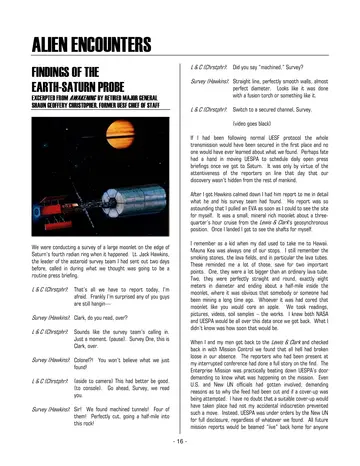
We were conducting a survey of a large moonlet on the edge of Saturn’s fourth radian ring when it happened. Lt. Jack Hawkins, the leader of the asteroid survey team I had sent out two days before, called in during what we thought was going to be a routine press briefing.
L & C (Chrstphr): That’s all we have to report today, I’m afraid. Frankly I’m surprised any of you guys are still hangin—
Survey (Hawkins): Clark, do you read, over?
L & C (Chrstphr): Sounds like the survey team’s calling in. Just a moment. (pause). Survey One, this is Clark, over.
Survey (Hawkins): Colonel?! You won’t believe what we just found!
L & C (Chrstphr): (aside to camera) This had better be good. (to console). Go ahead, Survey, we read you.
Survey (Hawkins): Sir! We found machined tunnels! Four of them! Perfectly cut, going a half-mile into this rock!
L & C (Chrstphr): Did you say “machined,” Survey?
Survey (Hawkins): Straight line, perfectly smooth walls, almost perfect diameter. Looks like it was done with a fusion torch or something like it.
L & C (Chrstphr): Switch to a secured channel, Survey.
(video goes black)
If I had been following normal UESF protocol the whole transmission would have been secured in the first place and no one would have ever learned about what we found. Perhaps fate had a hand in moving UESPA to schedule daily open press briefings once we got to Saturn. It was only by virtue of the attentiveness of the reporters on line that day that our discovery wasn’t hidden from the rest of mankind.
After I got Hawkins calmed down I had him report to me in detail what he and his survey team had found. His report was so astounding that I pulled an EVA as soon as I could to see the site for myself. It was a small, mineral rich moonlet about a three-quarter’s hour cruise from the Lewis & Clark’s geosynchronous position. Once I landed I got to see the shafts for myself.
I remember as a kid when my dad used to take me to Hawaii. Mauna Kea was always one of our stops. I still remember the smoking stones, the lava fields, and in particular the lava tubes. These reminded me a lot of those, save for two important points. One, they were a lot bigger than an ordinary lava tube. Two, they were perfectly straight and round, exactly eight meters in diameter and ending about a half-mile inside the moonlet, where it was obvious that somebody or someone had been mining a long time ago. Whoever it was had cored that moonlet like you would core an apple. We took readings, pictures, videos, soil samples – the works. I knew both NASA and UESPA would be all over this data once we got back. What I didn’t know was how soon that would be.
When I and my men got back to the Lewis & Clark and checked back in with Mission Control we found that all hell had broken loose in our absence. The reporters who had been present at my interrupted conference had done a full story on the find. The Enterprise Mission was practically beating down UESPA’s door demanding to know what was happening on the mission. Even U.S. and New UN officials had gotten involved, demanding reasons as to why the feed had been cut and if a cover-up was being attempted. I have no doubt that a suitable cover-up would have taken place had not my accidental indiscretion prevented such a move. Instead, UESPA was under orders by the New UN for full disclosure, regardless of whatever we found. All future mission reports would be beamed “live” back home for anyone who wanted to follow them. Those who might have wanted to suppress our discovery for reasons of their own would never get the chance.
We found the ruins three days later on another moonlet rich in organic salts. Together, I and my men walked down ways and among places when no man had ever set foot before. What we saw were ruins everywhere, obviously the work of intelligent and guided hands. They looked like the pictures from Sidonia that we were sent by Graham Harper’s team at the Enterprise Mission. A few small collapsed pyramids, worn by the solar winds and local forces, but mostly ruined buildings and strip mining scars. Our initial analysis coupled with data from UESPA suggested that it might have been a base camp for mining activities in the area. I remember feeling humble for the first time in a way I’ve never felt before as I walked among those ruins. They were here first, I told myself – the Builders, as I called them – the culture that had created this incredible place. They came, took what they needed, and left, with no trace as to who or what they were.
We were given an extra day to swing by Iapetus before returning home. UESPA wanted us to send an EVA down to its surface for a quick look before our supplies ran short. Based on what we had found and additional data from the Enterprise Mission they were certain we would find something at Iapetus. “Whatever,” I remember saying on the comm. “This mission’s gotten pretty loony already. What’s one more Earth-shattering discovery, anyway?” Truth to tell, though, I was pretty excited. I remember reading 2001: A Space Odyssey by Arthur C. Clarke when I was a kid. The actual book – not watching the movie, which I did later. In the book they found the alien monolith in the exact center of the largest crater on Iapetus. It’s so large that you can almost see it from Earth with a powerful enough telescope. Makes the whole moon kinda look like the Death Star from the Star Wars movies. I had a hunch, but based on what we had already found it was as good a plan as any.
We went into parking order around Iapetus the following day and I ordered two EVA teams down to the surface. One would examine the odd mountain ridge that wrapped all the way around the moon’s equator like a strap band on a boiler. The other, which I lead, headed straight for the center of that crater. I didn’t expect to find TMA-2 rising up to greet me out from the crater floor, but I expected to find something. I was not disappointed.
No sooner had we dropped within a mile of the surface that we began making out patterned ruins in the crater floor. They extended all the way to the rim of the crater and even partway up the wall. The farther we descended, the more they began to look familiar – and then suddenly I realized what we were looking at. We were dropping into an area where decks had been torn into and opened to the vacuum of space by the long-ago impact of some giant meteor or something. This was no moon. This was a spaceship of massive proportions – or rather, had been one. Whatever event had torn this crater into its side had probably killed every Builder on board. Now only the lifeless hulk remained, trapped forever by Saturn’s gravity as a dead and lifeless moon.
We spent maybe an hour exploring part of one of the exposed sections on the crater floor. I didn’t want my men going too far inside the wreck because we were not properly equipped for such an expedition and our time was limited. I check in with Lt. Dullea and his men up on the mountain range. As I expected, they were finding pretty much the same thing. They even found bits of what appeared to be old computer control systems, or something similar. Both our teams took readings and plenty of samples, then with much regret we returned to the Lewis & Clark for the trip home.
My last sight of Iapetus was just after we fired our main engines to break orbit. I looked out the window and saw it sitting there, moon no more, but an incredible artifact to a people and a time that had conquered the stars before we even learned to make fire. The Builders had come here, they had lived and worked here, but despite their incredible technology they had apparently died here as well. What awaited us inside the depths of that ruined alien ship, one that had swung captive in its orbit around Saturn for thousands of years, waiting for the day when mankind would be smart enough to find it and unlock its mysteries? What would we find someday within the ruin of Iapetus?
I prayed that I would be chosen for the follow-up mission.
Evidence of Life Discovered on Mars
United News Service press release – 20 April 2021
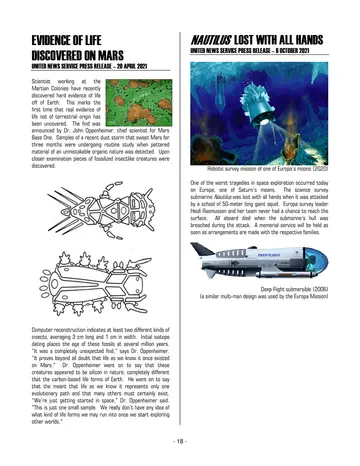
Scientist working at the Martian Colonies have recently discovered hard evidence of life off of Earth. This marks the first time that real evidence of life not of terrestrial origin has been uncovered. The find was announced by Dr. John Oppenheimer, chief scientist for Mars Base One. Samples of a recent dust storm that swept Mars for three months were undergoing routine study when pattered material of an unmistakable organic nature was detected. Upon closer examination pieces of fossilized insect-like creatures were discovered.
Computer reconstruction indicates at least two different kinds of insects, averaging 3 cm long and 1 cm in width. Initial isotope dating places the age of these fossils at several million years. “It was a completely unexpected find,” says Dr. Oppenheimer. “It proves beyond all doubt that life as we know it once existed on Mars.” Dr. Oppenheimer went on to say that these creatures appeared to be silicon in nature, completely different that the carbon-based life forms of Earth. He went on to say that the meant that life as we know it represents only one evolutionary path and that many others must certainly exist. “We’re just getting started in space,” Dr. Oppenheimer said. “This is just one small sample. We really don’t have any idea of what kind of life forms we may run into once we start exploring other worlds.”
Nautilus Lost With All Hands
United News Service press release – 6 October 2021
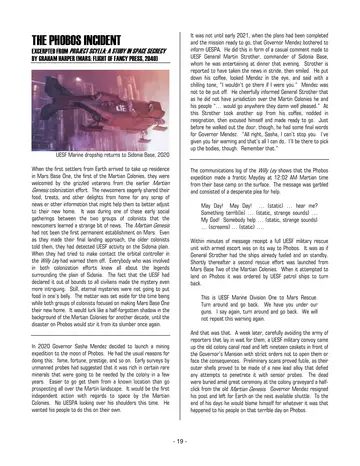
One of the worst tragedies in space exploration occurred today on Europa, one of Saturn’s moons. The science survey submarine Nautilus was lost with all hands when it was attacked by a school of 50-meter long giant squid. Europa survey leader Heidi Rasmussen and her team never had a chance to reach the surface. All aboard died when the submarine’s hull was breached during the attack. A memorial service will be held as soon as arrangements are made with the respective families.
The Phobos Incident
Excerpted from Project Scylla: A Study in Space Secrecy by Graham Harper (Mars: Flight of Fancy Press, 2040)
When the first settlers from Earth arrived to take up residence in Mars Base One, the first of the Martian Colonies, they were welcomed by the grizzled veterans from the earlier Martian Genesis colonization effort. The newcomers eagerly shared their food, treats, and other delights from home for any scrap of news or other information that might help them to better adjust to their new home. It was during one of these early social gatherings between the two groups of colonists that the newcomers learned a strange bit of news. The Martian Genesis had not been the first permanent establishment on Mars. Even as they made their final landing approach, the older colonists told them, they had detected UESF activity on the Sidonia plain. When they had tried to make contact the orbital controller in the Willy Ley had warned them off. Everybody who was involved in both colonization efforts knew all about the legends surrounding the plain of Sidonia. The fact that the UESF had declared it out of bounds to all civilians made the mystery even more intriguing. Still, eternal mysteries were not going to put food in one’s belly. The matter was set aside for the time being while both groups of colonists focused on making Mars Base One their new home. It would lurk like a half-forgotten shadow in the background of the Martian Colonies for another decade, until the disaster on Phobos would stir it from its slumber once again.
In 2020 Governor Sasha Mendez decided to launch a mining expedition to the moon of Phobos. He had the usual reasons for doing this: fame, fortune, prestige, and so on. Early surveys by unmanned probes had suggested that it was rich in certain rare minerals that were going to be needed by the colony in a few years. Easier to go get them from a known location than go prospecting all over the Martin landscape. It would be the first independent action with regards to space by the Martian Colonies. No UESPA looking over his shoulders this time. He wanted his people to do this on their own. It was not until early 2021, when the plans had been completed and the mission ready to go, that Governor Mendez bothered to inform UESPA. He did this in form of a casual comment made to UESF General Martin Strother, commander of Sidonia Base, whom he was entertaining at dinner that evening. Strother is reported to have taken the news in stride, then smiled. He put down his coffee, looked Mendez in the eye, and said with a chilling tone, “I wouldn’t go there if I were you.” Mendez was not to be put off. He cheerfully informed General Strother that as he did not have jurisdiction over the Martin Colonies he and his people “… would go anywhere they damn well pleased.” At this Strother took another sip from his coffee, nodded in resignation, then excused himself and made ready to go. Just before he walked out the door, though, he had some final words for Governor Mendez. “All right, Sasha, I can’t stop you. I’ve given you fair warning and that’s all I can do. I’ll be there to pick up the bodies, though. Remember that.”
The communications log of the Willy Ley shows that the Phobos expedition made a frantic Mayday at 12:02 AM Martian time from their base camp on the surface. The message was garbled and consisted of a desperate plea for help.
May Day! May Day! … (static) … hear me? Something terrib[le] … (static, strange sounds) … My God! Somebody help … (static, strange sounds) … (screams) … (static) ….
Within minutes of message receipt a full UESF military rescue unit with armed escort was on its way to Phobos. It was as if General Strother had the ships already fueled and on standby. Shortly thereafter a second rescue effort was launched from Mars Base Two of the Martian Colonies. When it attempted to land on Phobos it was ordered by UESF patrol ships to turn back.
This is UESF Marine Division One to Mars Rescue. Turn around and go back. We have you under our guns. I say again, turn around and go back. We will not repeat this warning again.
And that was that. A week later, carefully avoiding the army of reporters that lay in wait for them, a UESF military convoy came up the old colony canal road and left nineteen caskets in front of the Governor’s Mansion with strict orders not to open them or face the consequences. Preliminary scans proved futile, as their outer shells proved to be made of a new lead alloy that defied any attempts to penetrate it with sensor probes. The dead were buried amid great ceremony at the colony graveyard a half-click from the old Martian Genesis. Governor Mendez resigned his post and left for Earth on the next available shuttle. To the end of his days he would blame himself for whatever it was that happened to his people on that terrible day on Phobos.