6.0 The Rise of the Federation (2101–2200): Overview
An overview of the era explains how fate placed five advanced humanoid cultures of the Local Group close together, how the Vulcans patiently sponsored their union, and how the compromise allowing local defense fleets cleared the way for the Articles of Federation to be signed at Babel on May 8, 2127, founding the United Federation of Planets.
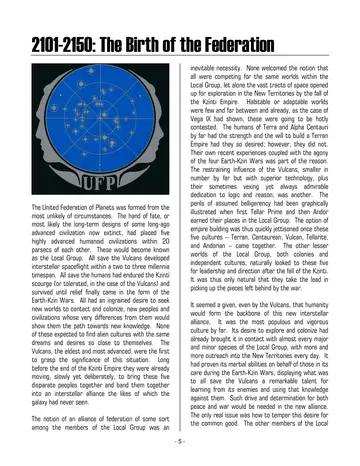
The United Federation of Planets was formed from the most unlikely of circumstances. The hand of fate, or most likely the long-term designs of some long-ago advanced civilization now extinct, had placed five highly advanced humanoid civilizations within 20 parsecs of each other. These would become known as the Local Group. All save the Vulcans developed interstellar spaceflight within a two to three millennia timespan. All save the humans had endured the Kzinti scourge (or tolerated, in the case of the Vulcans) and survived until relief finally came in the form of the Earth-Kzin Wars. All had an ingrained desire to seek new worlds to contact and colonize, new peoples and civilizations whose very differences from them would show them the path towards new knowledge. None of these expected to find alien cultures with the same dreams and desires so close to themselves. The Vulcans, the eldest and most advanced, were the first to grasp the significance of this situation. Long before the end of the Kzinti Empire they were already moving, slowly yet deliberately, to bring these five disparate peoples together and band them together into an interstellar alliance the likes of which the galaxy had never seen.
The notion of an alliance of federation of some sort among the members of the Local Group was an inevitable necessity. None welcomed the notion that all were competing for the same worlds within the Local Group, let alone the vast tracts of space opened up for exploration in the New Territories by the fall of the Kzinti Empire. Habitable or adaptable worlds were few and far between and already, as the case of Vega IX had shown, these were going to be hotly contested. The humans of Terra and Alpha Centauri by far had the strength and the will to build a Terran Empire had they so desired; however, they did not. Their own recent experiences coupled with the agony of the four Earth-Kzin Wars was part of the reason. The restraining influence of the Vulcans, smaller in number by far but with superior technology, plus their sometimes vexing yet always admirable dedication to logic and reason, was another. The perils of assumed belligerency had been graphically illustrated when first Tellar Prime and then Andor earned their places in the Local Group. The option of empire building was thus quickly jettisoned once these five cultures — Terran, Centaurean, Vulcan, Tellarite, and Andorian — came together. The other lesser worlds of the Local Group, both colonies and independent cultures, naturally looked to these five for leadership and direction after the fall of the Kzinti. It was thus only natural that they take the lead in picking up the pieces left behind by the war.
It seemed a given, even by the Vulcans, that humanity would form the backbone of this new interstellar alliance. It was the most populous and vigorous culture by far. Its desire to explore and colonize had already brought it in contact with almost every major and minor species of the Local Group, with more and more outreach into the New Territories every day. It had proven its martial abilities on behalf of those in its care during the Earth-Kzin Wars, displaying what was to all save the Vulcans a remarkable talent for learning from its enemies and using that knowledge against them. Such drive and determination for both peace and war would be needed in the new alliance. The only real issue was how to temper this desire for the common good. The other members of the Local Group were leery of the idea of a permanent alliance for this very reason until humanity could prove it could work for the common good. Even given the proofs of the Earth-Kzin War and the War with the Vegan Tyranny, it would take much diplomacy on the part of Vulcan before the interstellar alliance for which it had so long worked began to coalesce and form.
The brief war with what remained of the Vegans reminded the members of the Local Group that there were more foes other than the fallen Kzinti still lurking in the Sea of Stars. A common alliance would be necessary to deal with such a threat. Humanity might be able to do it alone again; however, the best interests of all would be served by working together for the common good. A common alliance would also benefit the peace that would come after such conflicts, peace like that which the Local Group now currently enjoyed. Common trade protocols, a universal system of exchange, compatible laws, joint projects and cultural exchanges, and so on. The differences that made each of them unique could unite to make them stronger and thus benefit the common good. So the Vulcans said, time and again in their own quiet way each time a conference on the subject of alliance was held. The first did not succeed, nor did the second. Gradually, though, over the years and with the patient sponsorship of the Vulcans, the notion of alliance finally took hold.
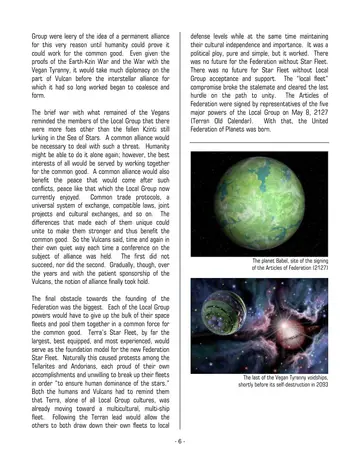
The final obstacle towards the founding of the Federation was the biggest. Each of the Local Group powers would have to give up the bulk of their space fleets and pool them together in a common force for the common good. Terra’s Star Fleet, by far the largest, best equipped, and most experienced, would serve as the foundation model for the new Federation Star Fleet. Naturally this caused protests among the Tellarites and Andorians, each proud of their own accomplishments and unwilling to break up their fleets in order “to ensure human dominance of the stars.” Both the humans and Vulcans had to remind them that Terra, alone of all Local Group cultures, was already moving toward a multicultural, multi-ship fleet. Following the Terran lead would allow the others to both draw down their own fleets to local defense levels while at the same time maintaining their cultural independence and importance. It was a political ploy, pure and simple, but it worked. There was no future for the Federation without Star Fleet. There was no future for Star Fleet without Local Group acceptance and support. The “local fleet” compromise broke the stalemate and cleared the last hurdle on the path to unity. The Articles of Federation were signed by representatives of the five major powers of the Local Group on May 8, 2127 (Terran Old Calendar). With that, the United Federation of Planets was born.