11.18 The Kzinti Strike Back (The Kzinti Incursion of 2272)
THE KZINTI STRIKE BACK AN ABRIDGED AND EDITED EXTRACT FROM THE KZINTI INCURSION OF 2272 BY HANSON BRIGGS (TERRA: CAMBRIDGE PRESS, 2292) Begi
THE KZINTI STRIKE BACK AN ABRIDGED AND EDITED EXTRACT FROM THE KZINTI INCURSION OF 2272 BY HANSON BRIGGS (TERRA: CAMBRIDGE PRESS, 2292)
Beginning in 2270 the Federation Starfleet began onducting a series of covert “hemming-in” operati ons against c e th Kzinti. These was in blatant violation of the terms of the Treaty of Sirius. Starfleet justified its actions on the grounds that the Kzinti were “up to something.” What it was they didn’t know and their best intelligence amounted to little more than educated guesses. There were certain indications, though, that something was stirring within the Patriarchy. Starfleet vessels began violating Kzinti space on a regular basis, searching with their long-range sensors, trying to find out what it was. The Kzinti, to Starfleet’s surprise, did nothing to stop them save verbal warnings. Not that the Kzinti could have resisted, anyway. Even in groups, antiquated Kzinti police cruisers (the largest ship class they were allowed under treaty terms) were no match for a single Federation starship. The suspicions of Starfleet Intelligence were in fact correct, but far beyond their worst nightmares.
The Kzinti had not been idle since their humiliation at S tarfleet’s hands in the Beta Lyrae Incident of 2264. The loss of the Trader’s Claw, a reportedly stolen Kzinti police vessel whose real mission was to steal a recently discovered Slaver stasis box, might not have been learned had not two of the ship’s crewmen survived. They had been on the far side of the ship when a Slaver weapon inside the box self-destructed to prevent capture, and thus escaped the instant death that was served to their fellows. The Kzinti Patriarch is said to have exploded in rage upon hearing the news of their failure and that of ChuftCaptain, their late commander. It is said that he swore war against the Federation on that day in payment for the constant humiliations his people had been made to suffer under the Treaty of Sirius. Whether his vow was justified or not is a question for the historians to argue. The fact remains that war was waged within the decade, and a very costly one at that. Ever since the late 2250s the Kzinti had been avy surreptitiously building a small but powerful modern space n right under the noses of Starfleet. The new ships were built in deep underground caverns on asteroids and small planets within the Patriarchy, well shielded and hidden from prying Federation eyes. In this they were helped by two of their former vassal states, the Mirak Star Empire and the M’dok. The Tzenkethi, who had once been servitors to the Kzinti, refused aid but allowed Mirak and Kzinti trading ships to pass through their territory unchallenged. This was of great help to the Patriarch’s war effort, for it gave him back-door contact with his third and most unlikely ally: the Klingon Empire, which provided considerable technical assistance. The Klingons and Kzinti had set aside the traditional bad blood between them for the chance to strike a blow at Starfleet from deep within the Federation itself. The alliance with the Mirak was just as important. The Mirak Star Empire was centered on the Omega Sagittarii star system and thus lay well out of the Federation Treaty Exploration Territory. Kzinti and Mirak agents used the circuitous Tzenkethiavel back and forth, as well as Klingon-Rigel trade corridor to tr s Orion trade cartels were to muggle arms and technology. The hip deep into this operation, as one might have expected, and did their part to aid the Mirak and Klingons in rearming the Kzinti with modern ships and weaponry – all the while making a handsome profit along the way. To the ruling Kzinti Patriarch, none of this mattered. He did not care how his prides rearmed for war, so long as it was accomplished. His gift to his people would be one last chance at glory in the warlike ways of the past before the old ways of Kzin died forever. Only a knowing few were aware of the real reasons behind his actions. No others would learn of the threat that was bringing Kzin to the brink of extinction until after the Heroes’-Last-Stand had gone down in history as the last great military campaign of the Kzinti.
On 07 August 2272 the frigate Norma Ra Den (NCC-2779) s wa on routine assignment patrolling the border sectors of the . Its Kzinti Patriarchy closest to the Local Group systems counterpart on the other side of the Patriarchy was the cruiser Encounter (NCC-2632), patrolling the coreward border sectors. t’s last “hemmingAll had been quiet on the border since Starflee ” a in ction only months before. Nothing unusual was expected to be fairly routine. and the day was expected The destroyer Hashishiyun (NCC-516) was enroute to the Patriarchy for its turn at border patrol when it received a badly could garbled distress signal from the Ra Den. What little that be discerned was the Ra Den was under attack by multiple Kzinti spacecraft. Captain Thomas Hooker immediately ordered the Kzinti space at warp 8 at red alert Hashishiyun to proceed to d an full battle readiness. He also sent a message to Starfleet situation and that the Kzinti Command apprising them of the appe ared to be “causing another incident.” It would be the last message ever received from the Hashishiyun. Approximately 13.4 hours after receiving Captain Hooker’s message from the Hashishiyun, Regional Space Station Omega12 was attacked and destroyed by “more than 30 starships of ng day, the Fomalhaut unknown configuration.” The followi
- 44 -
system fell to the enemy force, along with thre e more Starfleet combat vessels. By this time the identity of t he attackers was ec e, was is confirmed. known to Starfleet – or to be more pr S ars of almost tarfleet had pushed the Kzinti too far in three ye Kzinti were and now the constant “hemming-in” operations riking back. Two centuries of resentment against losing the st arth-Kzin Wars, losing their Empire, the Patriarch’s ancestor E made to grovel before the boots of Starfleet in order to save the prides, the ever-present and always-chafing restrictions of the Treaty of Sirius, and the “unceasing” poking and prodding by Starfleet patrol vessels had finally taken their toll. The new Kzinti space fleet, fitted with ships of Mirak design, weapons and engines of Klingon origin, and shielding technology stolen right out from under the very nose of Starfleet itself, cut a bloody swath of death and destruction through the Ophiucus sector that would have done their ancestors proud. Their goal was obvious to anyone who could read a star map: the Federation Local Group systems and Terra in particular.
What was not realized at the time was that not one but two Kzinti fleets had simultaneously burst out of the Patriarchy. The first, the larger of the two and the one bound for Local Group space, was the one that had destroyed the Ra Den and Hashishiyun. The second, smaller fleet had destroyed the Encounter. It was making a beeline for the border, where the freedom and protection of Mirak space awaited them. They pointedly avoided combat with the few Starfleet vessels they encountered. By the time Starfleet Command realized what was happening it was too late. A fleet of fourteen Starfleet vessels, hastily assembled to stop the Kzinti at the border, was mauled by a Mirak fleet that came over the border to assist the fleeing Kzinti. Five Starfleet vessels were destroyed and four more badly damaged before the battle was over. Thus did the mates and heirs of the Patriarch escape capture, and soon found new homes with the Mirak ruling prides. The Mirak, on the other hand, gained legitimacy as the “true heirs” of the Kzinti legacy. y had long sought and, to them, well worth It was a status the the price they paid for it.
The main Kzinti thrust made it as far as Tellar, conquering the planet for the second time in its history. This conquest cost them dearly, as did their occupations of Galen and Jourett. Starfleet and local forces put up stiff resistance, destroying a number of Kzinti starships and inflicting heavy casualties on Kzinti ground assault teams. In return the Kzinti killed all prisoners taken in combat and subjected the surviving population to torture, deprivation, starvation, and slavery. All Kzinti forces were under orders to impose the old ways on their new conquests, in order to remind the Federation of just how terrible the Kzinti scourge could be. Once again, the Sea of Stars served as the Kzinti dinner table … if only for a brief time. It was at the Battle of Tau Ceti that the tide finally turned in favor of Starfleet. The tactical importance of the system was not lost on the Patriarch. Capturing Tau Ceti would buy his fleet the time and resources it needed to counter the inevitable Starfleet response-in-force. To this end Kzinti forces launched a massed-wave attack on the Starfleet base at Tau Ceti IX with the intent of capturing it intact. It was here, though, that their luck ran out. Waiting for them in anticipation of such an attack was the heavy cruiser Xanthii (NCC-1743), along with two destroyers, three frigates, and a hastily assembled force of a dozen Kearsarge class light cruisers. The last had been quickly reactivated from a nearby Starfleet storage depot and sent into the fight. They were undermanned but crewed sufficiently for combat operations. What happened next was the fiercest battle within Federation space in living memory. Tau Ceti was saved from the Kzinti claw-swipe at the cost of three Starfleet vessels destroyed, seven crippled, three badly damaged, and a total of 1,762 Starfleet personnel dead and 4,657 injured. The three ships lost were the light cruisers Littorio (NCC-1513), Piorun (NCC-1547), and the destroyer Samson (NCC-543). These would be the last Starfleet vessels destroyed during the Kzinti Incursion. The heavy cruiser Xanthii was the most heavily damaged of the surviving Star Fleet vessels, with well over half of he r crew and Captain Julius Long killed in action. All but a dozen Kzinti vessels in the attacking force were destroyed, with the survivors fleeing back to Tellar as fast as they could. There were two things key to Starfleet’s victory at Tau Ceti. The first was the presence of the Kearsarges. These ships had been designed for close-in combat with Klingon vessels during the Four Years War. The fact that they were three decades old made little difference; their agility almost matched ti vessels and they had superior that of the more numerous Kzin repower. Second, and most important, was the quick thinking fi f a team of junior officers at the Starfleet base on Tau Ceti. o Duri ng the battle, as the Patriarch’s flagship made a strafing run at the Starfleet base, Lt. Trayce Donvoan used a subspace tachyon pulse to create a temporary hole in the attacking ship’s shields. It was small and lasted only for a few seconds, but was e nough for a squad of Starfleet Marines led by Lt. Allan “Custer” Donovan to beam aboard the Kzinti vessel. They attacked the ship’s C3 command center and destroyed it, then made their while fighting off escape in one of the ship’s own attack shuttles enra ged Kzinti warriors all the way to the hangar deck. Most of Donovan’s Marines were lost in the raid; however, the attack disrupted Kzinti fleet coordination activities, thus giving Starfleet its chance to turn and pounce on its prey.
Admiral James T. Kirk arrived at Tau Ceti shortly thereafter, having been delayed by Kzinti forces at Mimit. He took personal command of all Starfleet forces in the area. Under his leadership, Task Force Zulu was formed to drive the Kzinti from Federation space. Its success under his leadership is o evident by the shortness f his campaign, with the whole of the Kzinti Incursion lasting only six weeks (as opposed to six years).
- 45 -
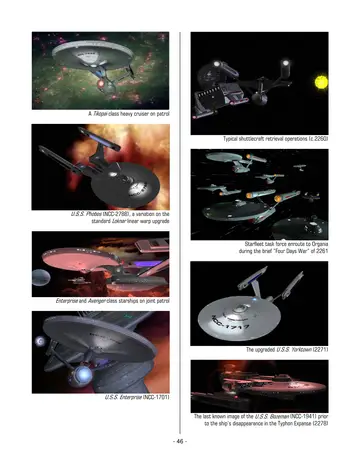
A Tikopai class heavy cruiser on patrol
U.S.S. Phobos (NCC-2788), a variation on the standard Loknar linear warp upgrade
Enterprise and Avenger class starships on joint patrol
U.S.S. Enterprise (NCC-1701) Typical shuttlecraft retrieval operations (c.2260)
Starfleet task force enroute to Organia during the brief “Four Days War” of 2261
The upgraded U.S.S. Yorktown (2271)
The last known image of the U.S.S. Bozeman (NCC-1941) prior to the ship’s disappearance in the Typhon Expanse (2278)
- 46 -