7.7 U.S.S. Bonaventure (Rebuild)
To mark both the new PB-6 "Quantum II" warp engine and the centennial of warp flight, the venerable Bonaventure was recalled from retirement and rewoven into an entirely new vessel realizing the Jeffries Project design — the first Star Fleet ship broken down and rebuilt into a new class and the first with a thin discoid primary hull — before being lost with all hands in the Delta Triangle in 2166.
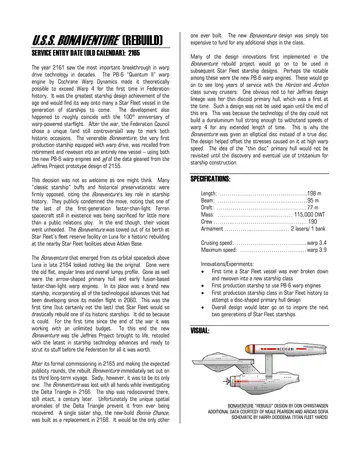
U.S.S. Bonaventure (Rebuild)
Service Entry Date (Old Calendar): 2165The year 2161 saw the most important breakthrough in warp drive technology in decades. The PB-6 "Quantum II" warp engine by Cochrane Warp Dynamics made it theoretically possible to exceed Warp 4 for the first time in Federation history. It was the greatest starship design achievement of the age and would find its way onto many a Star Fleet vessel in the generation of starships to come. The development also happened to roughly coincide with the 100th anniversary of warp-powered starflight. After the war, the Federation Council chose a unique (and still controversial) way to mark both historic occasions. The venerable Bonaventure, the very first production starship equipped with warp drive, was recalled from retirement and rewoven into an entirely new vessel — using both the new PB-6 warp engines and all of the data gleaned from the Jeffries Project prototype design of 2155.
This decision was not as welcome as one might think. Many "classic starship" buffs and historical preservationists were firmly opposed, citing the Bonaventure's key role in starship history. They publicly condemned the move, noting that one of the last of the first-generation faster-than-light Terran spacecraft still in existence was being sacrificed for little more than a public relations ploy. In the end though, their voices went unheeded. The Bonaventure was towed out of its berth at Star Fleet's fleet reserve facility on Luna for a historic rebuilding at the nearby Star Fleet facilities above Aitken Base.
The Bonaventure that emerged from its orbital spacedock above Luna in late 2164 looked nothing like the original. Gone were the old flat, angular lines and overall lumpy profile. Gone as well were the arrow-shaped primary hull and early fusion-based faster-than-light warp engines. In its place was a brand new starship, incorporating all of the technological advances that had been developing since its maiden flight in 2060. This was the first time (but certainly not the last) that Star Fleet would so drastically rebuild one of its historic starships. It did so because it could. For the first time since the end of the war it was working with an unlimited budget. To this end the new Bonaventure was the Jeffries Project brought to life, retooled with the latest in starship technology advances and ready to strut its stuff before the Federation for all it was worth.
After its formal commissioning in 2165 and making the expected publicity rounds, the rebuilt Bonaventure immediately set out on its third long-term voyage. Sadly, however, it was to be its only one. The Bonaventure was lost with all hands while investigating the Delta Triangle in 2166. The ship was rediscovered there, still intact, a century later. Unfortunately the unique spatial anomalies of the Delta Triangle prevent it from ever being recovered. A single sister ship, the new-build Bonnie Chance, was built as a replacement in 2168. It would be the only other one ever built. The new Bonaventure design was simply too expensive to fund for any additional ships in the class.
Many of the design innovations first implemented in the Bonaventure rebuild project would go on to be used in subsequent Star Fleet starship designs. Perhaps the notable among these were the new PB-6 warp engines. These would go on to see long years of service with the Horizon and Archon class survey cruisers. One obvious nod to her Jeffries design lineage was her thin discoid primary hull, which was a first at the time. Such a design was not be used again until the end of this era. This was because the technology of the day could not build a duraluminum hull strong enough to withstand speeds of warp 4 for any extended length of time. This is why the Bonaventure was given an elliptical disc instead of a true disc. The design helped offset the stresses caused on it at high warp speed. The idea of the "thin disc" primary hull would not be revisited until the discovery and eventual use of trititanium for starship construction.
Specifications
Length: 198 m. Beam: 95 m. Draft: 77 m. Mass: 115,000 DWT. Crew: 190. Armament: 2 lasers / 1 bank. Cruising speed: warp 3.4. Maximum speed: warp 3.9.Innovations/Experiments
- First time a Star Fleet vessel was ever broken down and rewoven into a new starship class.
- First production starship to use PB-6 warp engines.
- First production starship class in Star Fleet history to attempt a disc-shaped primary hull design.
- Overall design would later go on to inspire the next two generations of Star Fleet starships.