8.0 The Difficult Days: Overview
An overview of Star Fleet's post-Romulan War decline under a slashed budget and a forced shift to peaceful exploration, the political obstruction that culminated in the Tritium Debacle, the technological breakthroughs (trititanium, the Jeffries hull concept, and new warp engines) that prepared the next generation of starships, and the simultaneous boom in the civilian starship industry.
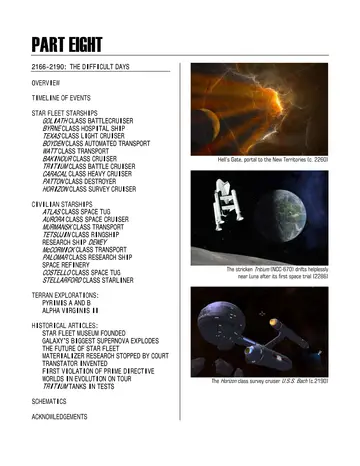
Those were difficult days. I remember as a junior officer getting bumped from one kind of ship to another. Never the same class twice. I was posted to six different starships in six different classes within ten years … I was green then, mind you, and I’ve learned a lot about what was happening since then. It was as hard on the senior officers as it was for us. If only the damn politicians had left Star Fleet alone, then maybe we wouldn’t have gotten in the mess we did. Then again, maybe we would have anyway.
— William van Anling, Admiral, Star Fleet (ret.) (2147-2251)
The period of time from the end of the Romulan War until just before the turn of the 22nd century is known in Star Fleet lore as “the Difficult Days.” It was during these years that Star Fleet seemed to lose its way. The reasons are obvious: hamstrung by a sharply reduced budget, forcibly re-tracked from a purely military organization into a “peaceful exploration force,” and constantly criticized for every misstep no matter how large or small. It was as if the rug of Federation faith upon which Star Fleet had once stood was suddenly yanked from beneath its feet. It stumbled, and continued to stumble for the next few decades, trying to regain a sense of purpose and dedication while fighting off the meddling of Federation politicians all the way.
The end of the Romulan War had brought the first major peace dividend to the Federation. Aside from the brief police action of fighting the M’dok and the occasional terrorist threat, there would be no major conflicts in Federation space for decades. It is understandable what happened next. History repeated itself, regardless of culture or species or world. The citizens of the Federation grew content and even self-indulgent, quickly forgetting the horrors of the Romulan War in order to resume sedately peaceful lives. The politicians and bureaucrats within the newly re-organized Federation government greedily eyed the large outlays for Star Fleet spending and snatched all that they could. After all, who needed a large military during a time of peace? There was plenty of leftover hardware from the war. Why buy more? So, the funding that would have gone to keep Star Fleet in its prime went instead for public projects such as the Galactic Cultural Exchange, for Federation interstellar fairs, and so on. Only a fraction of its former budget now went to maintain the organization that had fought so hard to bring this peace dividend to life. Only a handful of supporters rose up to defend Star Fleet’s development budget in the Federation Council. They were lone voices in the wilderness. Only the renewed possibility of war with the Romulans would finally bring the Council back to its senses. By that time, however, it was too late and the damage had already been done. Star Fleet would have to develop a whole new generation of starships from scratch before it could regain something of its former strength and glory of old.
The drastic reductions in Star Fleet spending in the late 2160s meant that it could no longer order production blocks of 30, 40, or an “unreasonable” 50 starships at a time. Even an order for as few as 10 was often deemed “a needless waste of public funds.” Star Fleet had to limit its new military starship orders to three, four, maybe as many as a half-dozen vessels in a given class if they were lucky — but only if they were warships. Science vessels and transports were seemingly immune to the budgetary axe because they could be used “… for peaceful purposes, which is what the new Star Fleet is supposed to be all about.” So the pundits of the day said, and so the politicians believed. Star Fleet Command had no choice but to grit its teeth and humbly accept the new role that was being defined for it: a semi-military enforcer of the peace for who violence was used only as a weapon of last resort. It hid what new builds it could under the guise of “research cruisers” and “science ships” while doing its best to maintain its rapidly aging fleet. Many veterans of the Romulan War could not accept this situation and left the service as quickly as possible, crippling Star Fleet even more. The Federation Council refused to stop this bleeding of talent because former Star Fleet veterans were proving themselves useful in the rapidly growing civilian shipping sector. This loss of a valuable talent and experience pool would hurt Star Fleet tremendously in the years to come.
Councilor T’Mek of Vulcan was typical of the political thinking of the time. She was the ranking member of the Procurement Sub-Committee, and it was she who repeatedly block additional funding for new Star Fleet starship classes.
I fail to see the logic in the outlay of funds for a class of starships with definite military connotations when there exists no clear need for such vessels. There are at present no pressing dangers from species beyond Federation space. What dangers that exist within our borders, such as the occasional terrorist act, have proven to be well within the current operational capacities of Star Fleet. Additional funding for a series of starships intended for wartime activities, which would be operating within a time of peace such as ours, is most illogical.
How far Vulcan had fallen from the days of the Earth-Kzin Wars, when the ability of Star Fleet’s Terran ancestor to make war was a subject of praise on Vulcan, not scorn! It proved that even the Vulcans were not immune to the perils of peaceful times. It is small wonder, then, that the quality of new Star Fleet vessels began to slip as the years rolled by. Despite the best efforts of some within the Starship Design Bureau, the rather unorthodox methods used by some to escape Council limitations coupled with fanaticism towards design preferences of the past would push Star Fleet to the brink of collapse. The highly publicized mess that was the Tritium Debacle involved failure at almost every level of the starship design and procurement process. It involved under-the-table deals on a hereforeto unprecedented scale in order to build a class of starships that would obviously never work as designed to anyone with decent engineering sense. The end result was a starship that went out of control on its first major space trial, almost killing its crew and coming close to destroying several nearby space stations in the process before its wild tumbling could be stopped. The ensuing scandal would eventually break Cosmodyne Corporation, the main contractor for the Tritium program, as evidence of its kickbacks and bribes to cover shoddy contractor work came to light. Most of its senior executive officers would be imprisoned for crimes against the Federation by the mid-2190s, with many a former Star Fleet officer from the Starship Design Bureau sharing their cells with them. With the dissolution of Cosmodyne also came the death of the old Terran “slab hull” starship design philosophy. The Tritium Debacle had, more or less, put the final nail in the coffin of a design philosophy that should have been abandoned decades before.
With Star Fleet caught at the literal crossroads by forces without and within, it fell to its remaining civilian allies to take up the slack. Their names are familiar to students of Federation starship history. Cochrane Warp Dynamics of Alpha Centauri, the leader in the field of starship warp engines, along with their “friendly” new rival Kloratis Drive Systems of Tellar — Chiokis Starship Design of Andor, staunch champions of the old Jeffries Project proposal, who were ready to take it to new and dizzying heights — Vickers Shipbuilding of Terra, one of its oldest firms and subcontractor of many a Star Fleet design — the new Deneva Research Station, whose research into microelectronics and materializer theory were about to bear fruit — and more. Parallel breakthrough developments in many fields were unflinchingly pointing towards a whole new generation of Federation starships the likes of which even the legendary W. M. Jeffries had never dreamed. Only three things were missing from this slow-cooking stew that would make it ready: a new construction material capable of withstanding Warp 4 stress loads, a new starship design that could handle Warp 4 without tearing itself apart, and a new series of starship engines that could push a starship’s cruising speed past Warp 4 and beyond.
The first issue, a new construction material for starship hulls, unexpectedly proved to be the quickest to resolve. Trititanium (also known as tritanium) was discovered on the mining planet Motherlode in 2184. Once its elemental properties were determined and analyzed, it soon became clear that it was a natural for use in starship construction. It was as malleable as duraluminium but 21.4 times stronger than diamond. Laboratory tests indicated that a starship built with a trititanium hull could withstand theoretical stresses of Warp 20, five times more than the so-called “Warp 4 barrier” limiting duraluminum hulls. That was the nasty secret behind this legendary speed barrier. It was not that the warp engines of the day were not capable of exceeding Warp 4. It was that the starship frames being built couldn’t stand the stress. There was no Warp 4 barrier, given the right building materials. Building a starship out of trititanium was an obvious solution to this problem. Its subsequent use on the base frame for the Horizon, Archon, and later Mann classes would prove once and for all that the Warp 4 barrier was nothing more than the myth it had always been.
The second issue, a new starship design, had already been addressed. The pre-war Jeffries Project prototype had clearly shown the direction that future Star Fleet starships needed to take. The rebuilt Bonaventure (now lost) and its lone sister ship, the Bonnie Chance, were visible proof of the concept. Only the aftereffects of the Romulan War, the technology of the day, the construction limitations of the time, and the severe budget limitations imposed on Star Fleet by the Federation Council had prevented the Jeffries Project from yielding more fruit than it should have. The Federation Council couldn’t see this, though, caught up in post-war politics and more concerned with maintaining the present peace than planning for a future war. They took the excellent performance of the Daedalus class cruisers for granted without really knowing, or for that matter caring, what had enabled that excellence in the first place. They repeatedly denied Star Fleet’s requests for more starships of the rebuilt Bonaventure configuration until, as they had hoped, Star Fleet finally quit asking.
Fortunately for Star Fleet, its civilian contractors did not have to worry about interference from the Federation Council. They pressed ahead with refining the concepts embodied in the work of Jeffries and bringing them into the present. Chief among these was Chiokis Starship Design of Andor, one of the strongest backers of Star Fleet in the Federation starship industry. It was they who had helped Star Fleet sneak the Balkinour class cruisers past Federation Council limitations, not revealing their military nature until the nearly complete hulls were ready for weapons fitting. In return, a grateful Star Fleet “loaned” the advanced starship Bonnie Chance to Chiokis for what they claimed was “routine in-service maintenance.” It was nothing of the sort. Chiokis engineers were allowed to put the Bonnie Chance through every space test they could devise, evaluating its performance under every conceivable condition as only trained starship engineers could do. The results further augmented the data Star Fleet had already made available to Chiokis from the trial runs of both the rebuilt Bonaventure and the original Jeffries Prototype. Chiokis now had all the data it needed to design new types of primary and secondary hulls for the next generation of Star Fleet vessels. The discovery of trititanium shortly thereafter was a literal godsend for this effort. While they waited for enough of this new material to begin construction on a new prototype, Chiokis senior engineer Mark Chausser and his assistant Franz Joseph IV began to work on a new design for a Star Fleet starship. That effort, with additional modifications, would forever revolutionize the Federation starship industry.
Meanwhile, two of Star Fleet’s other primary civilian contractors were hard at work resolving the third issue that blocked development of the next generation of Star Fleet vessels. Cochrane Warp Dynamics had already seen the first production versions of its “Perth” PB-series circumferential warp engines, the PB-2, enjoy great success during the Romulan War. Their design was proven and reliable, easy to service and maintain, and open to quick upgrade due to the use of boom mounts as opposed to in-hull mounting. Cochrane was as ready as Chiokis and other Star Fleet contractors for the next generation of starships, and was as equally frustrated when the Federation Council repeatedly refused to grant the necessary funding. Nevertheless, it soldiered on with its own research and development, doing its best to improve upon the promise shown by its postwar PB-6 “Quantum II” warp engine.
The PB-6 was the first Federation warp engine ever designed that could exceed Warp 4. It had proven itself with its exceptional performance on the rebuilt Bonaventure and the Bonnie Chance. It would have replaced the venerable war-era PB-2 “Quantum I” as Star Fleet’s standard warp engine had not budget cuts imposed by the Federation Council dictated otherwise. Cochrane almost lost its monopoly on Star Fleet warp engine contracts for the simple reason that the PB-6 was, to quote the Council, “too expensive.” Its next engine would somehow have to be both inexpensive and an excellent performer.
The PB-8 “Quantum III” was little more than a retooled and simplified PB-7, with every possible corner cut that would both reduce cost and maintain operational safety. Its main claim to fame was its use on the failed Goliath battlecruiser project of 2165. All involved were quick to point out that the engines themselves were not the reason for the Goliath’s failure. The engines themselves had performed admirably. The main problem was that they had been attached to a starship that was simply too big and had too many systems for them to handle. Star Fleet was able to salvage Cochrane’s reputation despite the failure by backing them before a hearing of an investigatory subcommittee of the Federation Council. The low-cost PB-8 would become Star Fleet’s favorite “second-tier” engine in subsequent years, often finding its way into fleet upgrade programs, with the last such being the Marshall-C refits of the late 2180s.
It was fortunate that newer warp engines from Cochrane were not used on the ill-fated Tritium. Cosmandyne had cut costs by electing to go with modified PB-8s, which was already available in quantity from Star Fleet stores. It was not allowed to cut corners this way with the Caracal contract, however. New Cochrane-type circumferential warp engines were mandated (and, surprisingly, approved by the Council) as part of the design. Cochrane was already waiting in the wings with its PB-14 “Pollux.” This design had tested at Warp 6 in simulation, although the limitations of the Caracal frame would not allow such high speeds. Unofficially, however, one Caracal class captain reported making an emergency burst of Warp 5.2 while battling Orion pirates in the Rigel sector. This validated Cochrane’s development efforts within the limits of the Caracal design, further fueling efforts at developing a more powerful successor. There was no question now that Cochrane Warp Dynamics would have a new generation of warp engines ready for Star Fleet’s newest starship — provided, of course, that the ever-present design and funding obstacles were overcome first.
While Cochrane was absolved of its involvement in the failure of the Goliath Program, the fact that the program was a failure gave elements within the Council all the ammunition they needed to open Star Fleet’s previously closed procurement process. Star Fleet now had to accept competing bids for its starship systems, with the low bidder (not necessarily the best design) getting the contract. This was the break for which the newly founded Kloratis Drive Systems was looking. It had been continually stymied in its efforts to win a prestigious military contract and boost the new company’s reputation. The Council-mandated changes in the Star Fleet procurement process gave it its chance. Its first successful contract was to provide the warp engines for the Bakinour sub-class of survey cruisers — or so Star Fleet said. What Kloratis did not know was that it would be providing the engines for Star Fleet’s first military cruiser class since the end of the Romulan War. Truth be told, Cochrane was glad to let them have it — just in case they were caught in yet another procurement debacle. The VX-10 “Harpie” was introduced in 2183 as part of the Bakinour program. The Kloratis design represented quite a different approach to warp power than the Cochrane norm. For the first time since the war, part of the engine converter assembly was deliberately exposed to open space. Kowloon-Andjong, the precursor to Kloratis, had done the same thing with the war-era Claudius Ptolemaeus class starships. This accounted for the VX-10’s unusual “crunched cowl” aft section. Improvements in warp engine technology over the past two decades had practically eliminated the high maintenance issues associated with such a design. In operation, the Bakinour enjoyed almost the same maneuverability as had the Claudius Ptolemaeus without the worry of its engines breaking down at any time without notice. This arrangement gave the Bakinour’s VX-10 engines what appeared to be an unearthly glow around their exposed back halves when at warp speed. What mattered more, though, was the savings in power consumption by using the relative vacuum of space for matter/antimatter conversion rather than maintaining a self-contained artificial vacuum. This largely successful experiment would gain Kloratis its second major contract to procure new engines for the Tritium class, resulting in the improved VX-12. It would also be followed upon in other subsequent designs by Kloratis, Cochrane, and other warp engine manufacturers of the era.
The initial startup of a Kloratis VX-10 warp engine was always accompanied by a peculiar “screaming” sound as the matter/antimatter containment field was engaged. This was what earned the design its nickname of “Harpie,” evoking the Terro-Centaurean myth of old. The reason for this sound remains a mystery to this day and it gradually went away with more refined Kloratis successor designs.
While these years were a difficult time for the advancement of Star Fleet, they were boom years as far as the civilian starship industry was concerned. Freed from wartime restraints, armed with the latest technological advances, and enjoying a boom in surplus hulls and parts, civilian starship development in the Federation underwent a virtual explosion following the Romulan War. No less than ten different major civilian starship classes were introduced to Federation service between 2166 and 2190 — all of which were civilian craft. Those were just the significant ones. There were at least twice as many lesser designs, as well as almost a hundred different type of the new “personal starships.” These were small, family-sized craft, akin to Terran automobiles of the 20th century or what had been intended with the Cochrane Interstellar Express in 2074. The CIE-07 had been a century too early, however. The post-war boom in the Federation economy, coupled with the relative low cost of late 22nd century starships, finally made personal starflight within the financial reach of all but the poorest Federation citizen. It was a new market waiting to be tapped and Federation businessmen would tap it with a vengeance. The personal starship market would prove so successful that by the end of the century over 20% of Federation families would own their own starship — and more than one enterprising businessman would make multimillion credit fortunes in the process.
Civilian starship designers of the late 22nd century soon learned that their new customers expected no less of their craft than had Star Fleet or the interstellar trading conglomerates. Most wanted top performance at affordable cost, with travel in relative comfort and provisions for all of the normal amenities of life while enroute. Others wanted vessels tailored to their particular needs or tastes. A dedicated few, the “classic starship” pioneers of this new market, wanted easier access to surplus or decommissioned Star Fleet hulls for restoration or customization. Many companies soon emerged that could address the needs of all of these. The “classic starship” market had always been there, and always would be, but enjoyed a newfound popularity as the UESPA Foundation (and later the Star Fleet Association) gave their backing to the business. The “personal luxury” and “high-performance” civilian markets came into being around this time, with each catering to a specific niche of the market. Finally, there was enough business in the Warp 2 “family” market for anyone who could maintain their profit margins without going broke in the process. One of the most surprising players of all in this “new” arena was the mighty Cochrane Warp Dynamics, which could no longer ignore the very industry it had helped to create and subsequently abandoned almost a century before.
Thus it was that while Star Fleet languished and the Federation Council fought over every last credit that it would be appropriated for new builds, the space lanes were teeming with thousands civilian starships of every shape, size, and description. All too soon, civilian designs would be competing with the best of Star Fleet in advancing the future of the Federation starship industry.