5.2 Keldysh Class Survey Cruiser
A profile of Cochrane’s first peacetime survey cruiser, the Keldysh class with its boom-mounted warp engines—including the famously lost Valiant—paired with the sublight Terra series space arks, repurposed industrial refineries adapted for multigenerational colonization voyages.
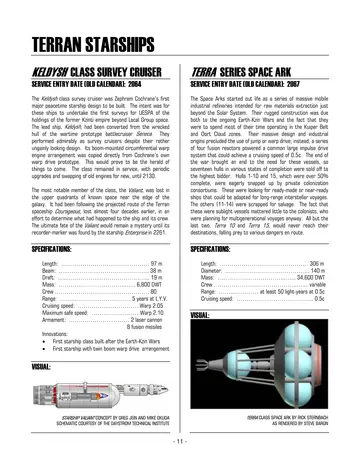
The Keldysh class survey cruiser was Zephram Cochrane’s first major peacetime starship design to be built. The intent was for these ships to undertake the first surveys for UESPA of the holdings of the former Kzinti empire beyond Local Group space. The lead ship, Keldysh, had been converted from the wrecked hull of the wartime prototype battlecruiser Seneca. They performed admirably as survey cruisers despite their rather ungainly looking design. Its boom-mounted circumferential warp engine arrangement was copied directly from Cochrane’s own warp drive prototype. This would prove to be the herald of things to come. The class remained in service, with periodic upgrades and swapping of old engines for new, until 2130.
The most notable member of the class, the Valiant, was lost in the upper quadrants of known space near the edge of the galaxy. It had been following the projected route of the Terran spaceship Courageous, lost almost four decades earlier, in an effort to determine what had happened to the ship and its crew. The ultimate fate of the Valiant would remain a mystery until its recorder-marker was found by the starship Enterprise in 2261.
Service entry date (old calendar): 2064.
Specifications
- Length: 97 m
- Beam: 38 m
- Draft: 19 m
- Mass: 6,800 DWT
- Crew: 80
- Range: 5 years at L.Y.V.
- Cruising speed: Warp 2.05
- Maximum safe speed: Warp 2.10
- Armament: 2 laser cannon, 8 fusion missiles
Innovations
- First starship class built after the Earth-Kzin Wars
- First starship with twin boom warp drive arrangement
Terra Series Space Ark
The Space Arks started out life as a series of massive mobile industrial refineries intended for raw materials extraction just beyond the Solar System. Their rugged construction was due both to the ongoing Earth-Kzin Wars and the fact that they were to spend most of their time operating in the Kuiper Belt and Oort Cloud zones. Their massive design and industrial origins precluded the use of jump or warp drive; instead, a series of four fusion reactors powered a common large impulse drive system that could achieve a cruising speed of 0.5c. The end of the war brought an end to the need for these vessels, so seventeen hulls in various states of completion were sold off to the highest bidder. Hulls 1-10 and 15, which were over 50% complete, were eagerly snapped up by private colonization consortiums. These were looking for ready-made or near-ready ships that could be adapted for long-range interstellar voyages. The others (11-14) were scrapped for salvage. The fact that these were sublight vessels mattered little to the colonists, who were planning for multigenerational voyages anyway. All but the last two, Terra 10 and Terra 15, would never reach their destinations, falling prey to various dangers en route.
Service entry date (old calendar): 2067.
Specifications
- Length: 306 m
- Diameter: 140 m
- Mass: 34,600 DWT
- Crew: variable
- Range: at least 50 light-years at 0.5c
- Cruising speed: 0.5c