8.11 Horizon Class Heavy Cruiser
The Horizon class was an upsized Daedalus, sold to a reluctant Council as a "proven design" but secretly built around a modern trititanium frame, that ended the old slab-hull era and signaled the close of the Difficult Days.
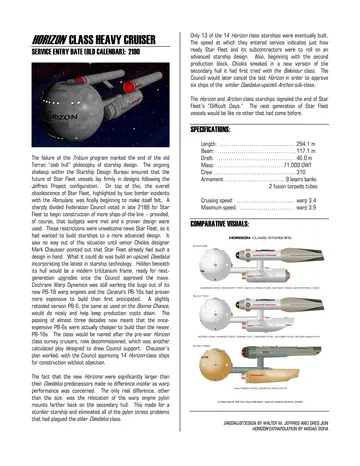
Service Entry Date (Old Calendar): 2190
The failure of the Tritium program marked the end of the old Terran “slab hull” philosophy of starship design. The ongoing shakeup within the Starship Design Bureau ensured that the future of Star Fleet vessels lay firmly in designs following the Jeffries Project configuration. On top of this, the overall obsolescence of Star Fleet, highlighted by two border incidents with the Romulans, was finally beginning to make itself felt. A sharply divided Federation Council voted in late 2188 for Star Fleet to begin construction of more ships-of-the-line — provided, of course, that budgets were met and a proven design were used. These restrictions were unwelcome news Star Fleet, as it had wanted to build starships to a more advanced design. It saw no way out of this situation until senior Chiokis designer Mark Chausser pointed out that Star Fleet already had such a design in hand. What it could do was build an upsized Daedalus incorporating the latest in starship technology. Hidden beneath its hull would be a modern trititanium frame, ready for next-generation upgrades once the Council approved the move. Cochrane Warp Dynamics was still working the bugs out of its new PB-18 warp engines and the Caracal’s PB-16s had proven more expensive to build than first anticipated. A slightly retooled version PB-6, the same as used on the Bonnie Chance, would do nicely and help keep production costs down. The passing of almost three decades now meant that the once-expensive PB-6s were actually cheaper to build than the newer PB-16s. The class would be named after the pre-war Horizon class survey cruisers, now decommissioned, which was another calculated ploy designed to draw Council support. Chausser’s plan worked, with the Council approving 14 Horizon-class ships for construction without objection.
The fact that the new Horizons were significantly larger than their Daedalus predecessors made no difference insofar as warp performance was concerned. The only real difference, other than the size, was the relocation of the warp engine pylon mounts farther back on the secondary hull. This made for a sturdier starship and eliminated all of the pylon stress problems that had plagued the older Daedalus class. Only 13 of the 14 Horizon class starships were eventually built. The speed at which they entered service indicates just how ready Star Fleet and its subcontractors were to roll on an advanced starship design. Also, beginning with the second production block, Chiokis sneaked in a new version of the secondary hull it had first tried with the Bakinour class. The Council would later cancel the last Horizon in order to approve six ships of the similar Daedalus-upsized Archon sub-class.
The Horizon and Archon class starships signaled the end of Star Fleet’s “Difficult Days.” The next generation of Star Fleet vessels would be like no other that had come before.
Specifications
- Length: 294.1 m
- Beam: 117.1 m
- Draft: 46.0 m
- Mass: 71,000 DWT
- Crew: 310
- Armament: 9 lasers banks, 2 fusion torpedo tubes
- Cruising speed: warp 3.4
- Maximum speed: warp 3.9