9.2 Star Fleet Starships
Detailed class entries cover the Star Fleet vessels of the Baton Rouge generation, including the Mann, Rickenbacker, the USS Sigma prototype battlecruiser, the Illustrious shuttlecarrier, the Lowell, the CR594 mobile construction rig, the Cahuya, the Bering automated tanker, the Baton Rouge heavy cruiser and its Ranger, Constant Warwick, Hale, Anton, Bode, Detroyat, Nordenskjold, Drake, and Cook derivatives, and the unbuilt Invincible class dreadnought.
Mann Class Survey Cruiser
Service entry date (old calendar): 2192
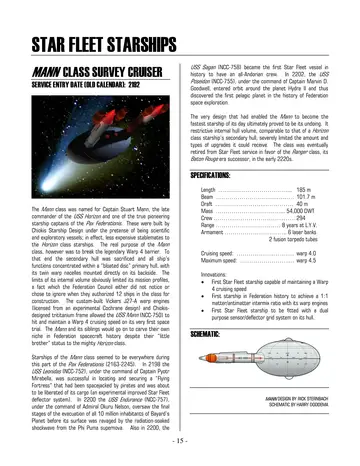
The Mann class was named for Captain Stuart Mann, the late commander of the USS Horizon and one of the true pioneering captains of the Pax Federationis. These were built by Chiokis Starship Design under the pretense of being scientific and exploratory vessels; in effect, less expensive stablemates to the Horizon class starships. The real purpose of the Mann class, however, was to break the legendary Warp 4 barrier. To that end the secondary hull was sacrificed and all ship's functions concentrated within a "bloated disc" primary hull, with its twin warp nacelles mounted directly on its backside. The limits of its internal volume obviously limited its mission profiles, a fact which the Federation Council either did not notice or chose to ignore when they authorized 12 ships in the class for construction. The custom-built Vickers J27-A warp engines (licensed from an experimental Cochrane design) and Chiokis-designed trititanium frame allowed the USS Mann (NCC-750) to hit and maintain a Warp 4 cruising speed on its first space trials. The Mann and its siblings would go on to carve their own niche in Federation spacecraft history despite their "little brother" status to the mighty Horizon class.
Starships of the Mann class seemed to be everywhere during this part of the Pax Federationis (2163-2245). In 2198 the USS Leonidas (NCC-752), under the command of Captain Pyotr Mirabell, was successful in locating and securing a "Flying Fortress" that had been spacejacked by pirates and was about to be liberated of its cargo (an experimental improved Star Fleet deflector system). In 2200 the USS Endurance (NCC-757), under the command of Admiral Okuru Nelson, oversaw the final stages of the evacuation of all 10 million inhabitants of Bayard's Planet before its surface was ravaged by the radiation-soaked shockwave from the Phi Puma supernova. Also in 2200, the USS Sagan (NCC-758) became the first Star Fleet vessel in history to have an all-Andorian crew. In 2202, the USS Poseidon (NCC-755), under the command of Captain Marvin D. Goodwell, entered orbit around the planet Hydra II and thus discovered the first pelagic planet in the history of Federation space exploration.
The very design that had enabled the Mann to become the fastest starship of its day ultimately proved to be its undoing. Its restrictive internal hull volume, comparable to that of a Horizon class starship's secondary hull, severely limited the amount and types of upgrades it could receive. The class was eventually retired from Star Fleet service in favor of the Ranger class, its Baton Rouge era successor, in the early 2220s.
Specifications:
- Length: 185 m
- Beam: 101.7 m
- Draft: 40 m
- Mass: 54,000 DWT
- Crew: 294
- Range: 8 years at L.Y.V.
- Armament: 6 laser banks, 2 fusion torpedo tubes
- Cruising speed: warp 4.0
- Maximum speed: warp 4.5
Innovations:
- First Star Fleet starship capable of maintaining a Warp 4 cruising speed
- First starship in Federation history to achieve a 1:1 matter/antimatter intermix ratio with its warp engines
- First Star Fleet starship to be fitted with a dual purpose sensor/deflector grid system on its hull.
Rickenbacker Class "Flying Fortress" Transport
Service entry date (old calendar): 2194
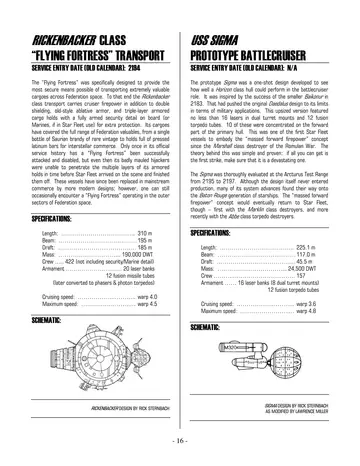
The "Flying Fortress" was specifically designed to provide the most secure means possible of transporting extremely valuable cargoes across Federation space. To that end the Rickenbacker class transport carries cruiser firepower in addition to double shielding, old-style ablative armor, and triple-layer armored cargo holds with a fully armed security detail on board (or Marines, if in Star Fleet use) for extra protection. Its cargoes have covered the full range of Federation valuables, from a single bottle of Saurian brandy of rare vintage to holds full of pressed latinum bars for interstellar commerce. Only once in its official service history has a "Flying Fortress" been successfully attacked and disabled, but even then its badly mauled hijackers were unable to penetrate the multiple layers of its armored holds in time before Star Fleet arrived on the scene and finished them off. These vessels have since been replaced in mainstream commerce by more modern designs; however, one can still occasionally encounter a "Flying Fortress" operating in the outer sectors of Federation space.
Specifications:
- Length: 310 m
- Beam: 195 m
- Draft: 185 m
- Mass: 190,000 DWT
- Crew: 422 (not including security/Marine detail)
- Armament: 20 laser banks, 12 fusion missile tubes (later converted to phasers & photon torpedos)
- Cruising speed: warp 4.0
- Maximum speed: warp 4.5
USS Sigma Prototype Battlecruiser
Service entry date (old calendar): N/A
The prototype Sigma was a one-shot design developed to see how well a Horizon class hull could perform in the battlecruiser role. It was inspired by the success of the smaller Baikonur in 2183. That had pushed the original Daedalus design to its limits in terms of military applications. This upsized version featured no less than 16 lasers in dual turret mounts and 12 fusion torpedo tubes. 10 of these were concentrated on the forward part of the primary hull. This was one of the first Star Fleet vessels to embody the "massed forward firepower" concept since the Marshall class destroyer of the Romulan War. The theory behind this was simple and proven: if all you can get is the first strike, make sure that it is a devastating one.
The Sigma was thoroughly evaluated at the Arcturus Test Range from 2195 to 2197. Although the design itself never entered production, many of its system advances found their way onto the Baton Rouge generation of starships. The "massed forward firepower" concept would eventually return to Star Fleet, though – first with the Marklin class destroyers, and more recently with the Abbe class torpedo destroyers.
Specifications:
- Length: 225.1 m
- Beam: 117.0 m
- Draft: 45.5 m
- Mass: 24,500 DWT
- Crew: 157
- Armament: 16 laser banks (8 dual turret mounts), 12 fusion torpedo tubes
- Cruising speed: warp 3.6
- Maximum speed: warp 4.8
Illustrious Class Shuttlecarrier
Service entry date (old calendar): 2198
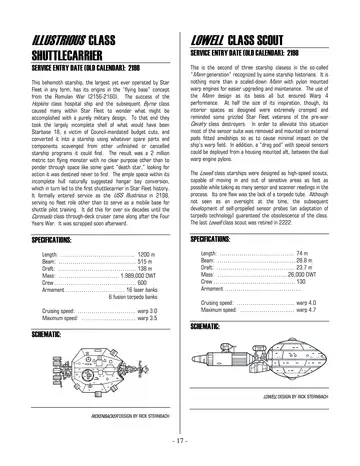
This behemoth starship, the largest yet ever operated by Star Fleet in any form, has its origins in the "flying base" concept from the Romulan War (2156-2160). The success of the Hopkins class hospital ship and the subsequent Byrne class caused many within Star Fleet to wonder what might be accomplished with a purely military design. To that end they took the largely incomplete shell of what would have been Starbase 18, a victim of Council-mandated budget cuts, and converted it into a starship using whatever spare parts and components scavenged from other unfinished or cancelled starship programs it could find. The result was a 2 million metric ton flying monster with no clear purpose other than to ponder through space like some giant "death star," looking for action it was destined never to find. The ample space within its incomplete hull naturally suggested hangar bay conversion, which in turn led to the first shuttlecarrier in Star Fleet history. It formally entered service as the USS Illustrious in 2198, serving no fleet role other than to serve as a mobile base for shuttle pilot training. It did this for over six decades until the Coronado class through-deck cruiser came along after the Four Year War. It was scrapped soon afterward.
Specifications:
- Length: 1200 m
- Beam: 515 m
- Draft: 138 m
- Mass: 1,989,000 DWT
- Crew: 600
- Armament: 16 laser banks, 6 fusion torpedo banks
- Cruising speed: warp 3.0
- Maximum speed: warp 3.5
Lowell Class Scout
Service entry date (old calendar): 2198
This is the second of three starship clasess in the so-called "Mann generation" recognized by some starship historians. It is nothing more than a scaled-down Mann with pylon mounted warp engines for easier upgrading and maintenance. The use of the Mann design as its basis all but ensured Warp 4 performance. At half the size of its inspiration, though, its interior spaces as designed were extremely cramped and reminded some grizzled Star Fleet veterans of the pre-war Cavalry class destroyers. In order to alleviate this situation most of the sensor suite was removed and mounted on external pods fitted amidships so as to cause minimal impact on the ship's warp field. In addition, a "drag pod" with special sensors could be deployed from a housing mounted aft, between the dual warp engine pylons.
The Lowell class starships were designed as high-speed scouts, capable of moving in and out of sensitive areas as fast as possible while taking as many sensor and scanner readings in the process. Its one flaw was the lack of a torpedo tube. Although not seen as an oversight at the time, the subsequent development of self-propelled sensor probes (an adaptation of torpedo technology) guaranteed the obsolescence of the class. The last Lowell class scout was retired in 2222.
Specifications:
- Length: 74 m
- Beam: 28.8 m
- Draft: 23.7 m
- Mass: 26,000 DWT
- Crew: 130
- Cruising speed: warp 4.0
- Maximum speed: warp 4.7
CR594 Mobile Construction Rig
Service entry date (old calendar): 2203
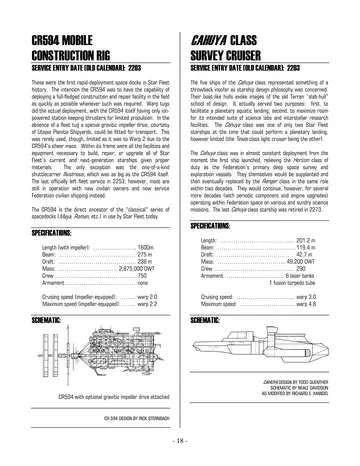
These were the first rapid-deployment space docks in Star Fleet history. The intention the CR594 was to have the capability of deploying a full-fledged construction and repair facility in the field as quickly as possible whenever such was required. Warp tugs did the actual deployment, with the CR594 itself having only ion-powered station keeping thrusters for limited propulsion. In the absence of a fleet tug a special gravitic impeller drive, courtesy of Utopia Planitia Shipyards, could be fitted for transport. This was rarely used, though, limited as it was to Warp 2 due to the CR594's sheer mass. Within its frame were all the facilities and equipment necessary to build, repair, or upgrade all of Star Fleet's current and next-generation starships given proper materials. The only exception was the one-of-a-kind shuttlecarrier Illustrious, which was as big as the CR594 itself. The last officially left fleet service in 2253; however, most are still in operation with new civilian owners and now service Federation civilian shipping instead.
The CR594 is the direct ancestor of the "classical" series of spacedocks (Maya, Roman, etc.) in use by Star Fleet today.
Specifications:
- Length (with impeller): 1600 m
- Beam: 275 m
- Draft: 238 m
- Mass: 2,875,000 DWT
- Crew: 750
- Armament: none
- Cruising speed (impeller-equipped): warp 2.0
- Maximum speed (impeller-equipped): warp 2.2
Cahuya Class Survey Cruiser
Service entry date (old calendar): 2203
The five ships of the Cahuya class represented something of a throwback insofar as starship design philosophy was concerned. Their boat-like hulls evoke images of the old Terran "slab-hull" school of design. It actually served two purposes: first, to facilitate a planetary aquatic landing; second, to maximize room for its intended suite of science labs and interstellar research facilities. The Cahuya class was one of only two Star Fleet starships at the time that could perform a planetary landing, however limited (the Texas class light cruiser being the other).
The Cahuya class was in almost constant deployment from the moment the first ship launched, relieving the Horizon class of duty as the Federation's primary deep space survey and exploration vessels. They themselves would be supplanted and then eventually replaced by the Ranger class in the same role within two decades. They would continue, however, for several more decades (with periodic component and engine upgrades) operating within Federation space on various and sundry science missions. The last Cahuya class starship was retired in 2273.
Specifications:
- Length: 201.2 m
- Beam: 119.4 m
- Draft: 42.7 m
- Mass: 49,200 DWT
- Crew: 290
- Armament: 6 laser banks, 1 fusion torpedo tube
- Cruising speed: warp 3.0
- Maximum speed: warp 4.8
Bering Class Automated Tanker
Service entry date (old calendar): 2204
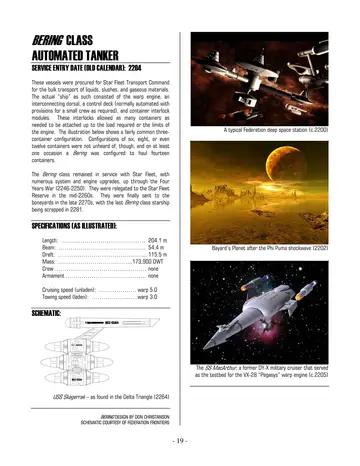
These vessels were procured for Star Fleet Transport Command for the bulk transport of liquids, slushes, and gaseous materials. The actual "ship" as such consisted of the warp engine, an interconnecting dorsal, a control deck (normally automated with provisions for a small crew as required), and container interlock modules. These interlocks allowed as many containers as needed to be attached up to the load required or the limits of the engine. The illustration below shows a fairly common three-container configuration. Configurations of six, eight, or even twelve containers were not unheard of, though, and on at least one occasion a Bering was configured to haul fourteen containers.
The Bering class remained in service with Star Fleet, with numerous system and engine upgrades, up through the Four Years War (2246-2250). They were relegated to the Star Fleet Reserve in the mid-2260s. They were finally sent to the boneyards in the late 2270s, with the last Bering class starship being scrapped in 2281.
Specifications (as illustrated):
- Length: 204.1 m
- Beam: 54.4 m
- Draft: 115.5 m
- Mass: 173,900 DWT
- Crew: none
- Armament: none
- Cruising speed (unladen): warp 5.0
- Towing speed (laden): warp 3.0
Baton Rouge Class Heavy Cruiser
Service entry date (old calendar): 2205
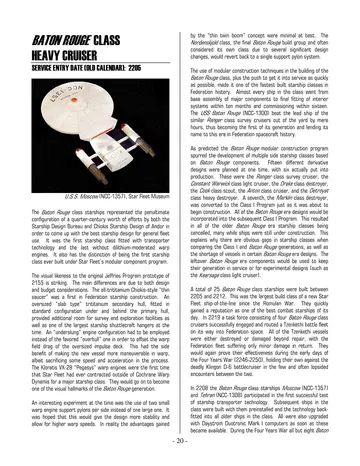
The Baton Rouge class starships represented the penultimate configuration of a quarter-century worth of efforts by both the Starship Design Bureau of Andor and Chiokis Starship Design in order to come up with the best starship design for general fleet use. It was the first starship class fitted with transporter technology and the last without dilithium-moderated warp engines. It also has the distinction of being the first starship class ever built under Star Fleet's modular component program.
The visual likeness to the original Jeffries Program prototype of 2155 is striking. The main differences are due to both design and budget considerations. The all-trititanium Chiokis-style "thin saucer" was a first in Federation starship construction. An oversized "slab type" trititanium secondary hull, fitted in standard configuration under and behind the primary hull, provided additional room for survey and exploration facilities as well as one of the largest starship shuttlecraft hangers at the time. An "underslung" engine configuration had to be employed instead of the favored "overhull" one in order to offset the warp field drag of the oversized impulse deck. This had the side benefit of making the new vessel more maneuverable in warp, albeit sacrificing some speed and acceleration in the process. The Kloratis VX-28 "Pegasys" warp engines were the first time that Star Fleet had ever contracted outside of Cochrane Warp Dynamis for a major starship class. They would go on to become one of the visual hallmarks of the Baton Rouge generation.
An interesting experiment at the time was the use of two small warp engine support pylons per side instead of one large one. It was hoped that this would give the design more stability and allow for higher warp speeds. In reality the advantages gained by the "thin twin boom" concept were minimal at best. The Nordenskjold class, the final Baton Rouge build group and often considered its own class due to several significant design changes, would revert back to a single support pylon system.
The use of modular construction techniques in the building of the Baton Rouge class, plus the push to get it into service as quickly as possible, made it one of the fastest built starship classes in Federation history. Almost every ship in the class went from base assembly of major components to final fitting of interior systems within ten months and commissioning within sixteen. The USS Baton Rouge (NCC-1300) beat the lead ship of the similar Ranger class survey cruisers out of the yard by mere hours, thus becoming the first of its generation and lending its name to this era in Federation spacecraft history.
As predicted the Baton Rouge modular construction program spurred the development of multiple side starship classes based on Baton Rouge components. Fifteen different derivative designs were planned at one time, with six actually put into production. These were the Ranger class survey cruiser, the Constant Warwick class light cruiser, the Drake class destroyer, the Cook class scout, the Anton class cruiser, and the Detroyat class heavy destroyer. A seventh, the Marklin class destroyer, was converted to the Class I Program just as it was about to begin construction. All of the Baton Rouge era designs would be incorporated into the subsequent Class I Program. This resulted in all of the older Baton Rouge era starship classes being cancelled, many while ships were still under construction. This explains why there are obvious gaps in starship classes when comparing the Class I and Baton Rouge generations, as well as the shortage of vessels in certain Baton Rouge era designs. The leftover Baton Rouge era components would be used to keep their generation in service or for experimental designs (such as the Kearsage class light cruiser).
A total of 25 Baton Rouge class starships were built between 2205 and 2212. This was the largest build class of a new Star Fleet ship-of-the-line since the Romulan War. They quickly gained a reputation as one of the best combat starships of its day. In 2219 a task force consisting of four Baton Rouge class cruisers successfully engaged and routed a Tzenkethi battle fleet on its way into Federation space. All of the Tzenkethi vessels were either destroyed or damaged beyond repair, with the Federation fleet suffering only minor damage in return. They would again prove their effectiveness during the early days of the Four Years War (2246-2250), holding their own against the deadly Klingon D-6 battlecruiser in the few and often lopsided encounters between the two.
In 2208 the Baton Rouge class starships Moscow (NCC-1357) and Tehran (NCC-1308) participated in the first successful test of starship transporter technology. Subsequent ships in the class were built with them preinstalled and the technology backfitted into all older ships in the class. All were also upgraded with Daystrom Duotronic Mark I computers as soon as these became available. During the Four Years War all but eight Baton Rouge class cruisers had their original Pegasys VX-28 warp engines replaced with the more powerful Cochrane Dynamics PB-32 "Titiac." All received phaser upgrades, with some having two additional single phaser banks mounted to the rear of their secondary hulls (one to each side of the hangar bay) per the Nordenskjold configuration. These wartime refits were not continued once the war was over given the age of the class and how expensive they were, leaving eight unmodified Baton Rouge cruisers in their original configuration. These were retired as soon as postwar build strength permitted, while the remaining upgraded vessels continued to serve Star Fleet well into the Class I era.
All remaining active duty Baton Rouge class cruisers were decommissioned in 2263, although several still remain in the Star Fleet Reserve. The U.S.S. Moscow (NCC-1357), one of the two that was part of the first successful starship transporter test, and one of the few that still retains its original Pegasys VX-28 warp engines, was donated to the Star Fleet Museum at Memory Alpha and restored for public display. The U.S.S. San Diego (NCC-1438) is preserved as a museum ship at the Star Fleet Division Orbital Shipyards at Luna by the Starfleet Association.
The Baton Rouge's success as Star Fleet's premiere starship of the day is without question. Even so, certain aspects of the design continued to vex Star Fleet. The oversized impulse deck and slab-like secondary hull were design concerns that had been "allowed" to happen. This was for the simple reason that Star Fleet needed the Baton Rouge immediately to replace its rapidly aging Romulan War era capital ships. Both of these had also necessitated the move of the warp engines to their "underslung" arrangement, something that Star Fleet designers knew full well was not the best configuration for an optimum starship warp field. That is why, when the next generation of Star Fleet vessels went to the drawing boards, they would go back to the Jeffries Prototype one last time before deciding the future of Star Fleet starship design.
Specifications:
- Length: 245 m
- Beam: 153 m
- Draft: 64.6 m
- Mass: 92,500 DWT
- Crew: 344
- Armament: 4 phaser banks (6 in 4YW refit), 2 photon torpedo tubes
- Cruising speed: warp 4.5
- Maximum speed: warp 5.2 (warp 6 after PB-32 upgrade)
Innovations:
- First large Star Fleet starship program in over two decades (31 vessels in 3 build groups, counting the Nordenskjold sub-class)
- First Star Fleet starship class since the Bonnie Chance to have a "thin disc" primary hull
- First Star Fleet starship class with an all-trititanium hull and frame
- First Star Fleet starship class built using the modular component construction system
- First Star Fleet starship class with transporter technology and duotronic computer systems
Ranger Class Survey Cruiser
Service entry date (old calendar): 2205
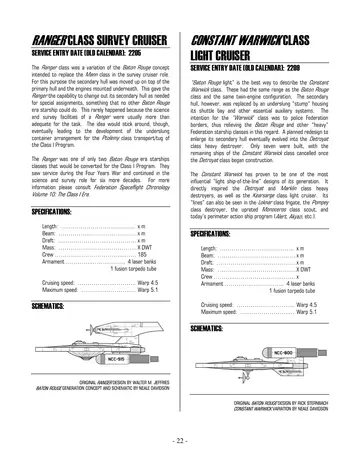
The Ranger class was a variation of the Baton Rouge concept intended to replace the Mann class in the survey cruiser role. For this purpose the secondary hull was moved up on top of the primary hull and the engines mounted underneath. This gave the Ranger the capability to change out its secondary hull as needed for special assignments, something that no other Baton Rouge era starship could do. This rarely happened because the science and survey facilities of a Ranger were usually more than adequate for the task. The idea would stick around, though, eventually leading to the development of the underslung container arrangement for the Ptolemy class transport/tug of the Class I Program.
The Ranger was one of only two Baton Rouge era starships classes that would be converted for the Class I Program. They saw service during the Four Years War and continued in the science and survey role for six more decades. For more information please consult Federation Spaceflight Chronology Volume 10: The Class I Era.
Specifications:
- Crew: 185
- Armament: 4 laser banks, 1 fusion torpedo tube
- Cruising speed: Warp 4.5
- Maximum speed: Warp 5.1
Constant Warwick Class Light Cruiser
Service entry date (old calendar): 2209
"Baton Rouge light" is the best way to describe the Constant Warwick class. These had the same range as the Baton Rouge class and the same twin-engine configuration. The secondary hull, however, was replaced by an underslung "stump" housing its shuttle bay and other essential auxiliary systems. The intention for the "Warwick" class was to police Federation borders, thus relieving the Baton Rouge and other "heavy" Federation starship classes in this regard. A planned redesign to enlarge its secondary hull eventually evolved into the Detroyat class heavy destroyer. Only seven were built, with the remaining ships of the Constant Warwick class cancelled once the Detroyat class began construction.
The Constant Warwick has proven to be one of the most influential "light ship-of-the-line" designs of its generation. It directly inspired the Detroyat and Marklin class heavy destroyers, as well as the Kearsarge class light cruiser. Its "lines" can also be seen in the Loknar class frigate, the Pompey class destroyer, the uprated Monoceros class scout, and today's perimeter action ship program (Alert, Akyazi, etc.).
Specifications:
- Armament: 4 laser banks, 1 fusion torpedo tube
- Cruising speed: Warp 4.5
- Maximum speed: Warp 5.1
Hale Class Scout
Service entry date (old calendar): 2210
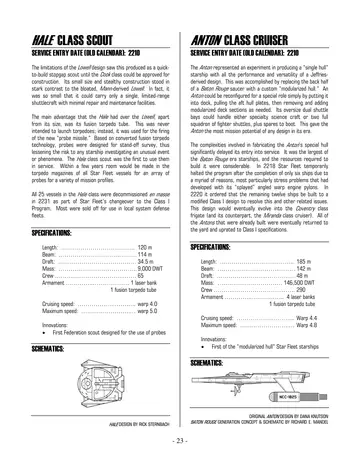
The limitations of the Lowell design saw this produced as a quick-to-build stopgap scout until the Cook class could be approved for construction. Its small size and stealthy construction stood in stark contrast to the bloated, Mann-derived Lowell. In fact, it was so small that it could carry only a single, limited-range shuttlecraft with minimal repair and maintenance facilities.
The main advantage that the Hale had over the Lowell, apart from its size, was its fusion torpedo tube. This was never intended to launch torpedoes; instead, it was used for the firing of the new "probe missile." Based on converted fusion torpedo technology, probes were designed for stand-off survey, thus lessening the risk to any starship investigating an unusual event or phenomena. The Hale class scout was the first to use them in service. Within a few years room would be made in the torpedo magazines of all Star Fleet vessels for an array of probes for a variety of mission profiles.
All 25 vessels in the Hale class were decommissioned en masse in 2231 as part of Star Fleet's changeover to the Class I Program. Most were sold off for use in local system defense fleets.
Specifications:
- Length: 120 m
- Beam: 114 m
- Draft: 34.5 m
- Mass: 9,000 DWT
- Crew: 65
- Armament: 1 laser bank, 1 fusion torpedo tube
- Cruising speed: warp 4.0
- Maximum speed: warp 5.0
Innovations:
- First Federation scout designed for the use of probes
Anton Class Cruiser
Service entry date (old calendar): 2210
The Anton represented an experiment in producing a "single hull" starship with all the performance and versatility of a Jeffries-derived design. This was accomplished by replacing the back half of a Baton Rouge saucer with a custom "modularized hull." An Anton could be reconfigured for a special role simply by putting it into dock, pulling the aft hull plates, then removing and adding modularized deck sections as needed. Its oversize dual shuttle bays could handle either specialty science craft or two full squadron of fighter shuttles, plus spares to boot. This gave the Anton the most mission potential of any design in its era.
The complexities involved in fabricating the Anton's special hull significantly delayed its entry into service. It was the largest of the Baton Rouge era starships, and the resources required to build it were considerable. In 2218 Star Fleet temporarily halted the program after the completion of only six ships due to a myriad of reasons, most particularly stress problems that had developed with its "splayed" angled warp engine pylons. In 2220 it ordered that the remaining twelve ships be built to a modified Class I design to resolve this and other related issues. This design would eventually evolve into the Coventry class frigate (and its counterpart, the Miranda class cruiser). All of the Antons that were already built were eventually returned to the yard and uprated to Class I specifications.
Specifications:
- Length: 185 m
- Beam: 142 m
- Draft: 48 m
- Mass: 146,500 DWT
- Crew: 290
- Armament: 4 laser banks, 1 fusion torpedo tube
- Cruising speed: Warp 4.4
- Maximum speed: Warp 4.8
Innovations:
- First of the "modularized hull" Star Fleet starships
Bode Class Scout
Service entry date (old calendar): 2213
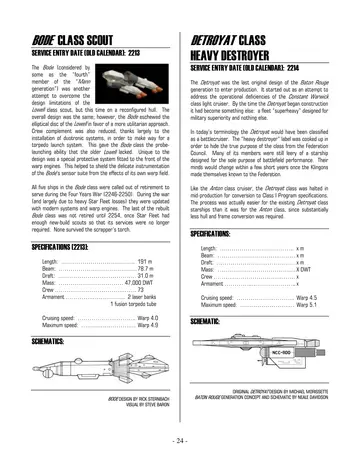
The Bode (considered by some as the "fourth" member of the "Mann generation") was another attempt to overcome the design limitations of the Lowell class scout, but this time on a reconfigured hull. The overall design was the same; however, the Bode eschewed the elliptical disc of the Lowell in favor of a more utilitarian approach. Crew complement was also reduced, thanks largely to the installation of duotronic systems, in order to make way for a torpedo launch system. This gave the Bode class the probe-launching ability that the older Lowell lacked. Unique to the design was a special protective system fitted to the front of the warp engines. This helped to shield the delicate instrumentation of the Bode's sensor suite from the effects of its own warp field.
All five ships in the Bode class were called out of retirement to serve during the Four Years War (2246-2250). During the war (and largely due to heavy Star Fleet losses) they were updated with modern systems and warp engines. The last of the rebuilt Bode class was not retired until 2254, once Star Fleet had enough new-build scouts so that its services were no longer required. None survived the scrapper's torch.
Specifications (2213):
- Length: 191 m
- Beam: 78.7 m
- Draft: 31.0 m
- Mass: 47,000 DWT
- Crew: 73
- Armament: 2 laser banks, 1 fusion torpedo tube
- Cruising speed: Warp 4.0
- Maximum speed: Warp 4.9
Detroyat Class Heavy Destroyer
Service entry date (old calendar): 2214
The Detroyat was the last original design of the Baton Rouge generation to enter production. It started out as an attempt to address the operational deficiencies of the Constant Warwick class light cruiser. By the time the Detroyat began construction it had become something else: a fleet "superheavy" designed for military superiority and nothing else.
In today's terminology the Detroyat would have been classified as a battlecruiser. The "heavy destroyer" label was cooked up in order to hide the true purpose of the class from the Federation Council. Many of its members were still leery of a starship designed for the sole purpose of battlefield performance. Their minds would change within a few short years once the Klingons made themselves known to the Federation.
Like the Anton class cruiser, the Detroyat class was halted in mid-production for conversion to Class I Program specifications. The process was actually easier for the existing Detroyat class starships than it was for the Anton class, since substantially less hull and frame conversion was required.
Specifications:
- Cruising speed: Warp 4.5
- Maximum speed: Warp 5.1
Nordenskjold Class Exploratory Cruiser
Service entry date (old calendar): 2218
The "Old Norge," as her crews came to know her, was the first starship in the last and final build group of the original Baton Rouge class cruiser program. She and her five sister ships have a somewhat different configuration than do the earlier ships in the Baton Rouge class. Nevertheless, the six ships of the Nordenskjold class are often lumped in together with the Baton Rouge class in most fleet and historical discussions.
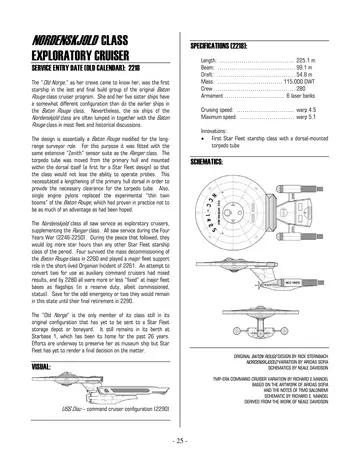
The design is essentially a Baton Rouge modified for the long-range surveyor role. For this purpose it was fitted with the same extensive "Zenith" sensor suite as the Ranger class. The torpedo tube was moved from the primary hull and mounted within the dorsal itself (a first for a Star Fleet design) so that the class would not lose the ability to operate probes. This necessitated a lengthening of the primary hull dorsal in order to provide the necessary clearance for the torpedo tube. Also, single engine pylons replaced the experimental "thin twin booms" of the Baton Rouge, which had proven in practice not to be as much of an advantage as had been hoped.
The Nordenskjold class all saw service as exploratory cruisers, supplementing the Ranger class. All saw service during the Four Years War (2246-2250). During the peace that followed, they would log more star hours than any other Star Fleet starship class of the period. Four survived the mass decommissioning of the Baton Rouge class in 2260 and played a major fleet support role in the short-lived Organian Incident of 2261. An attempt to convert two for use as auxiliary command cruisers had mixed results, and by 2280 all were more or less "fixed" at major fleet bases as flagships (in a reserve duty, albeit commissioned, status). Save for the odd emergency or two they would remain in this state until their final retirement in 2290.
The "Old Norge" is the only member of its class still in its original configuration that has yet to be sent to a Star Fleet storage depot or boneyard. It still remains in its berth at Starbase 1, which has been its home for the past 26 years. Efforts are underway to preserve her as museum ship but Star Fleet has yet to render a final decision on the matter.
Specifications (2218):
- Length: 225.1 m
- Beam: 99.1 m
- Draft: 54.8 m
- Mass: 115,000 DWT
- Crew: 280
- Armament: 6 laser banks
- Cruising speed: warp 4.5
- Maximum speed: warp 5.1
Innovations:
- First Star Fleet starship class with a dorsal-mounted torpedo tube
Drake Class Destroyer & Cook Class Scout
Service entry date (old calendar): 2218
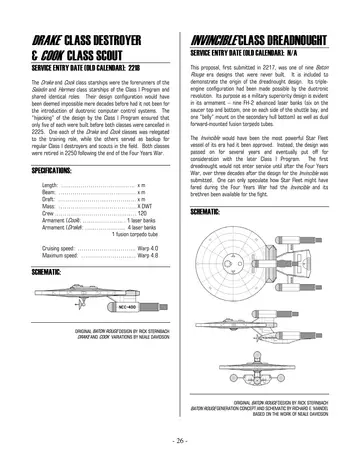
The Drake and Cook class starships were the forerunners of the Saladin and Hermes class starships of the Class I Program and shared identical roles. Their design configuration would have been deemed impossible mere decades before had it not been for the introduction of duotronic computer control systems. The "hijacking" of the design by the Class I Program ensured that only five of each were built before both classes were cancelled in 2225. One each of the Drake and Cook classes was relegated to the training role, while the others served as backup for regular Class I destroyers and scouts in the field. Both classes were retired in 2250 following the end of the Four Years War.
Specifications:
- Crew: 120
- Armament (Cook): 1 laser banks
- Armament (Drake): 4 laser banks, 1 fusion torpedo tube
- Cruising speed: Warp 4.0
- Maximum speed: Warp 4.8
Invincible Class Dreadnought
Service entry date (old calendar): N/A
This proposal, first submitted in 2217, was one of nine Baton Rouge era designs that were never built. It is included to demonstrate the origin of the dreadnought design. Its triple-engine configuration had been made possible by the duotronic revolution. Its purpose as a military superiority design is evident in its armament – nine FH-2 advanced laser banks (six on the saucer top and bottom, one on each side of the shuttle bay, and one dual "belly" mount on the secondary hull bottom) as well as dual forward-mounted fusion torpedo tubes.
The Invincible would have been the most powerful Star Fleet vessel of its era had it been approved. Instead, the design was passed on for several years and eventually put off for consideration with the later Class I Program. The first dreadnought would not enter service until after the Four Years War, over three decades after the design for the Invincible was submitted. One can only speculate how Star Fleet might have fared during the Four Years War had the Invincible and its brethren been available for the fight.