1.5 X-20 DynoSoar & X-27 Raven
Profiles of the United States military's reusable spaceplane projects, the cancelled X-20 DynoSoar and its covert successor the X-27 Raven with its SR-3 Condor carrier.
X-20 DynoSoar
Service entry date (Old Calendar): 1963
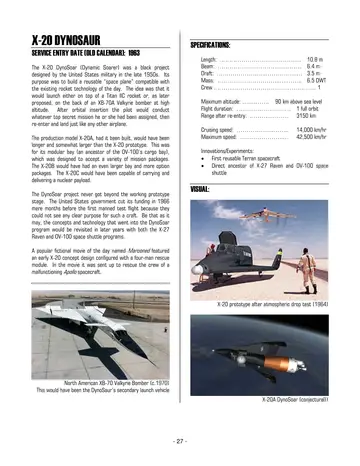
The X-20 DynoSoar (Dynamic Soarer) was a black project designed by the United States military in the late 1950s. Its purpose was to build a reusable “space plane” compatible with the existing rocket technology of the day. The idea was that it would launch either on top of a Titan IIIC rocket or, as later proposed, on the back of an XB-70A Valkyrie bomber at high altitude. After orbital insertion the pilot would conduct whatever top secret mission he or she had been assigned, then re-enter and land just like any other airplane.
The production model X-20A, had it been built, would have been longer and somewhat larger than the X-20 prototype. This was for its modular bay (an ancestor of the OV-100's cargo bay), which was designed to accept a variety of mission packages. The X-20B would have had an even larger bay and more option packages. The X-20C would have been capable of carrying and delivering a nuclear payload.
The DynoSoar project never got beyond the working prototype stage. The United States government cut its funding in 1966 mere months before the first manned test flight because they could not see any clear purpose for such a craft. Be that as it may, the concepts and technology that went into the DynoSoar program would be revisited in later years with both the X-27 Raven and OV-100 space shuttle programs.
A popular fictional movie of the day named Marooned featured an early X-20 concept design configured with a four-man rescue module. In the movie it was sent up to rescue the crew of a malfunctioning Apollo spacecraft.
Specifications: Length 10.8 m; Beam 6.4 m; Draft 3.5 m; Mass 6.5 DWT; Crew 1; Maximum altitude 90 km above sea level; Flight duration 1 full orbit; Range after re-entry 3150 km; Cruising speed 14,000 km/hr; Maximum speed 42,500 km/hr.
Innovations/Experiments:
- First reusable Terran spacecraft
- Direct ancestor of X-27 Raven and OV-100 space shuttle
X-27 Raven
Service entry date (Old Calendar): 1986
The X-27 Raven was the United States military's counterpart to the civilian OV-100 space shuttle program. It was for the most part an updated version of the X-20 DynoSoar program but with a more clearly defined mission in mind. After the loss of the space shuttle Challenger in 1984 the United States military wanted its own reusable space vehicle. Their reasoning was that since one shuttle had failed others might. They did not want, to borrow a Terran phrase, “to put all of their eggs in one basket” when it came to launching military satellites. Since the DynoSoar had already proven itself in prototype all that was needed was to update the design and avionics for its new mission: that of a reusable military launch vehicle for covert satellite launches. The United States approved this crash black project this time around under the code name Raven, provided that it had to be built entirely out of proven, off-the-shelf (and therefore cheap) technology.
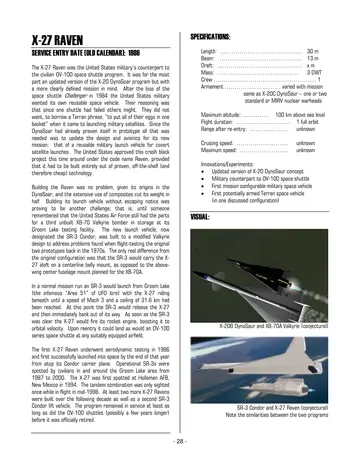
Building the Raven was no problem, given its origins in the DynoSoar, and the extensive use of composites cut its weight in half. Building its launch vehicle without escaping notice was proving to be another challenge; that is, until someone remembered that the United States Air Force still had the parts for a third unbuilt XB-70 Valkyrie bomber in storage at its Groom Lake testing facility. The new launch vehicle, now designated the SR-3 Condor, was built to a modified Valkyrie design to address problems found when flight-testing the original two prototypes back in the 1970s. The only real difference from the original configuration was that the SR-3 would carry the X-27 aloft on a centerline belly mount, as opposed to the above-wing center fuselage mount planned for the XB-70A.
In a normal mission run an SR-3 would launch from Groom Lake (the infamous “Area 51” of UFO lore) with the X-27 riding beneath until a speed of Mach 3 and a ceiling of 31.6 km had been reached. At this point the SR-3 would release the X-27 and then immediately bank out of its way. As soon as the SR-3 was clear the X-27 would fire its rocket engine, boosting it to orbital velocity. Upon re-entry it could land as would an OV-100 series space shuttle at any suitably equipped airfield.
The first X-27 Raven underwent aerodynamic testing in 1986 and first successfully launched into space by the end of that year from atop its Condor carrier plane. Operational SR-3s were spotted by civilians in and around the Groom Lake area from 1987 to 2000. The X-27 was first spotted at Holloman AFB, New Mexico in 1994. The tandem combination was only sighted once while in flight in mid-1998. At least two more X-27 Ravens were built over the following decade as well as a second SR-3 Condor lift vehicle. The program remained in service at least as long as did the OV-100 shuttles (possibly a few years longer) before it was officially retired.
Specifications: Length 30 m; Beam 13 m; Draft unknown; Mass 3 DWT; Crew 1; Armament varied with mission, same as X-20C DynoSoar – one or two standard or MIRV nuclear warheads; Maximum altitude 100 km above sea level; Flight duration 1 full orbit; Range after re-entry unknown; Cruising speed unknown; Maximum speed unknown.
Innovations/Experiments:
- Updated version of X-20 DynoSoar concept
- Military counterpart to OV-100 space shuttle
- First mission configurable military space vehicle
- First potentially armed Terran space vehicle (in one discussed configuration)