4.4 DY-550 Series Transport
DY-550 SERIES TRANSPORT SERVICE ENTRY DATE (OLD CALENDAR): 2055 “economy model” of The DY-550 was an attempt to market an cing its expensive
DY-550 SERIES TRANSPORT SERVICE ENTRY DATE (OLD CALENDAR): 2055
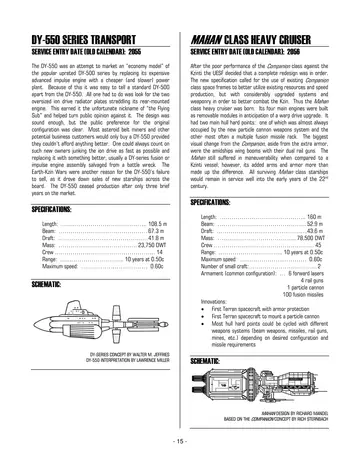
“economy model” of The DY-550 was an attempt to market an cing its expensive the popular uprated DY-500 series by repla (and slower) power advanced impulse engine with a cheaper l a standard DY-500 plant. Because of this it was easy to tel apart from the DY-550. All one had to do was look for the two oversized ion drive radiator plates straddling its rear-mounted engine. This earned it the unfortunate nickname of “the Flying Sub” and helped turn public opinion against it. The design was sound enough, but the public preference for the original configuration was clear. Most asteroid belt miners and other potential business customers would only buy a DY-550 provided they couldn’t afford anything better. One could always count on such new owners junking the ion drive as fast as possible and replacing it with something better, usually a DY-series fusion or impulse engine assembly salvaged from a battle wreck. The Earth-Kzin Wars were another reason for the DY-550’s failure to sell, as it drove down sales of new starships across the board. The DY-550 ceased production after only three brief years on the market.
SPECIFICATIONS:
Length: …………………………………….. 108.5 m Beam: ……………………………………… 67.3 m Draft: …………………….………………… 41.8 m Mass: …………………………………. 23,750 DWT Crew …………………………………………… 14 Range: …………………………... 10 years at 0.50c Maximum speed: ………………….………… 0.60c
SCH EMATIC:
DY-SERIES CONCEPT BY WALTER M. JEFFRIES DY-550 INTERPRETATION BY LAWRENCE MILLER MAHAN CLASS HEAVY CRUISER SERVICE ENTRY DATE (OLD CALENDAR): 2056
Companion class against the After the poor performance of the plete redesign was in order. Kzinti the UESF decided that a com f existing Companion The new specification called for the use o resources and speed class space frames to better utilize existing production, but with considerably upgraded systems and weaponry in order to better combat the Kzin. Thus the Mahan class heavy cruiser was born. Its four main engines were built as removable modules in anticipation of a warp drive upgrade. It had two main hull hard points: one of which was almost always occupied by the new particle cannon weapons system and the other most often a multiple fusion missile rack. The biggest visual change from the Companion, aside from the extra armor, were the amidships wing booms with their dual rail guns. The Mahan still suffered in maneuverability when compared to a Kzinti vessel; however, its added arms and armor more than made up the difference. All surviving Mahan class starships would remain in service well into the early years of the 22nd century.
SPECIFICATIONS:
Length: …………………………………….. 160 m Beam: ……………………………………… 52.9 m Draft: …………………….………………… 43.6 m Mass: …………………………………. 78,500 DWT Crew …………………………………………… 45 …………………... 10 years at 0.50c Range: ……… d: ………………….………… 0.60c Maximum spee Number of small craft:…………………………….. 2 Armament (common configuration): … 6 forward lasers 4 rail guns 1 particle cannon 100 fusion missiles Innovations: • First Terran spacecraft with armor protection • First Terran spacecraft to mount a particle cannon • os hul ar poi M t l h d nts could be cycled with different ea ns ste s ( w po sy m beam weapons, missiles, rail guns, mines, etc.) depending on desired configuration and e requirements missil
SCHEMATIC:
MAHAN DESIGN BY RICHARD MANDE L BASED ON THE COMPANION CONCEPT BY RICH STERNBACH
- 15 -