1.6 OV-100 Space Shuttle
A detailed profile of NASA's reusable OV-100 series space shuttle, covering its system design, payload bay and manipulator arm, livery, and the Challenger disaster, with specifications and innovations.
Service entry date (Old Calendar): 1980
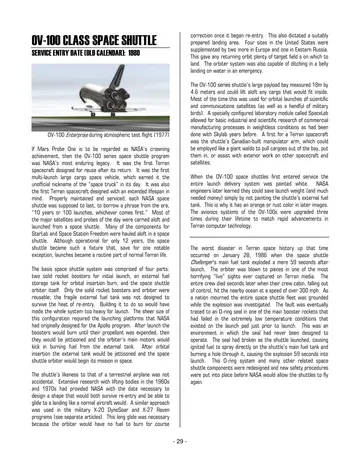
If Mars Probe One is to be regarded as NASA's crowning achievement, then the OV-100 series space shuttle program was NASA's most enduring legacy. It was the first Terran spacecraft designed for reuse after its return. It was the first multi-launch large cargo space vehicle, which earned it the unofficial nickname of the “space truck” in its day. It was also the first Terran spacecraft designed with an extended lifespan in mind. Properly maintained and serviced, each NASA space shuttle was supposed to last, to borrow a phrase from the era, “10 years or 100 launches, whichever comes first.” Most of the major satellites and probes of the day were carried aloft and launched from a space shuttle. Many of the components for StarLab and Space Station Freedom were hauled aloft in a space shuttle. Although operational for only 12 years, the space shuttle became such a fixture that, save for one notable exception, launches became a routine part of normal Terran life.
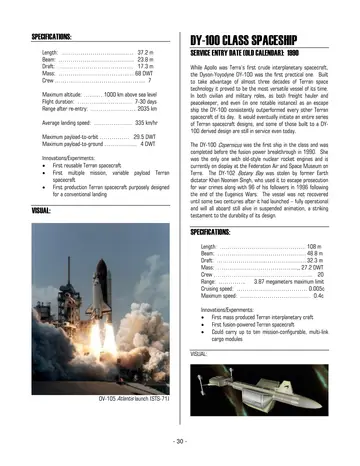
The basic space shuttle system was comprised of four parts: two solid rocket boosters for initial launch, an external fuel storage tank for orbital insertion burn, and the space shuttle orbiter itself. Only the solid rocket boosters and orbiter were reusable; the fragile external fuel tank was not designed to survive the heat of re-entry. Building it to do so would have made the whole system too heavy for launch. The sheer size of this configuration required the launching platforms that NASA had originally designed for the Apollo program. After launch the boosters would burn until their propellant was expended, then they would be jettisoned and the orbiter's main motors would kick in burning fuel from the external tank. After orbital insertion the external tank would be jettisoned and the space shuttle orbiter would begin its mission in space.
The shuttle's likeness to that of a terrestrial airplane was not accidental. Extensive research with lifting bodies in the 1960s and 1970s had provided NASA with the data necessary to design a shape that would both survive re-entry and be able to glide to a landing like a normal aircraft would. A similar approach was used in the military X-20 DynoSoar and X-27 Raven programs (see separate articles). This long glide was necessary because the orbiter would have no fuel to burn for course correction once it began re-entry. This also dictated a suitably prepared landing area. Four sites in the United States were supplemented by two more in Europe and one in Eastern Russia. This gave any returning orbiter plenty of target fields on which to land. The orbiter system was also capable of ditching in a belly landing on water in an emergency.
The OV-100 series shuttle's large payload bay measured 18m by 4.6 meters and could lift aloft any cargo that would fit inside. Most of the time this was used for orbital launches of scientific and communications satellites (as well as a handful of military birds). A specially configured laboratory module called SpaceLab allowed for basic industrial and scientific research of commercial manufacturing processes in weightless conditions as had been done with Skylab years before. A first for a Terran spacecraft was the shuttle's Canadian-built manipulator arm, which could be employed like a giant waldo to pull cargoes out of the bay, put them in, or assist with exterior work on other spacecraft and satellites.
When the OV-100 space shuttles first entered service the entire launch delivery system was painted white. NASA engineers later learned they could save launch weight (and much needed money) simply by not painting the shuttle's external fuel tank. This is why it has an orange or rust color in later images. The avionics systems of the OV-100s were upgraded three times during their lifetime to match rapid advancements in Terran computer technology.
The worst disaster in Terran space history up to that time occurred on January 28, 1986 when the space shuttle Challenger's main fuel tank exploded a mere 59 seconds after launch. The orbiter was blown to pieces in one of the most horrifying “live” sights ever captured on Terran media. The entire crew died seconds later when their crew cabin, falling out of control, hit the nearby ocean at a speed of over 300 mph. As a nation mourned the entire space shuttle fleet was grounded while the explosion was investigated. The fault was eventually traced to an O-ring seal in one of the main booster rockets that had failed in the extremely low temperature conditions that existed on the launch pad just prior to launch. This was an environment in which the seal had never been designed to operate. The seal had broken as the shuttle launched, causing ignited fuel to spray directly on the shuttle's main fuel tank and burning a hole through it, causing the explosion 59 seconds into launch. This O-ring system and many other related space shuttle components were redesigned and new safety procedures were put into place before NASA would allow the shuttles to fly again.
Specifications: Length 37.2 m; Beam 23.8 m; Draft 17.3 m; Mass 68 DWT; Crew 7; Maximum altitude 1000 km above sea level; Flight duration 7-30 days; Range after re-entry 2035 km; Average landing speed 335 km/hr; Maximum payload-to-orbit 29.5 DWT; Maximum payload-to-ground 4 DWT.
Innovations/Experiments:
- First reusable Terran spacecraft
- First multiple mission, variable payload Terran spacecraft
- First production Terran spacecraft purposely designed for a conventional landing