8.1 Timeline of Events
A year-by-year chronology from 2160 to 2190 recording the major Federation political, scientific, exploratory, and starship milestones of the Difficult Days, including the Romulan War's end, the founding of the Deneva Research Station, the discovery of trititanium, the invention of the transtator and replicator, the first Klingon and Tholian contacts, and the Tritium Debacle.
2160 — Sarek of Vulcan, son of Skon, the most influential Vulcan of his generation, is born in the city of ShiKahr. — T'Rea, first wife of Sarek, is born.
2162 — The Romulan War ends with a decisive victory for Federation forces at the Battle of Cheron. — Galactic peace brings the beginnings of tremendous growth in industry and trade.
2163 — The Federation Galactic Outreach Program resumes, having been suspended during the Romulan War. — The Atlas class space tugs enter service. Their first job is to tow the new Neutral Zone outpost stations to their final locations on the Federation side of the Zone. — A new program of space buoy deployment begins to replace many that were damaged or destroyed during the Romulan War.
2164 — The number of systems that are members of or affiliated with the Federation reaches 100. — The Goliath class battlecruiser prototype is completed and begins its acceptance tests with Star Fleet. — A new Star Fleet Academy campus begins construction near Star Fleet Headquarters at San Francisco, Terra.
2165 — The Goliath class battlecruiser fails its acceptance tests and is rejected for Star Fleet service. More ships of the proven Marshall-B class are authorized to fill in the resulting “starship gap.” — Starbase 10 is rebuilt. — A binary planetary pair in the Pyrimis star system is discovered by the survey cruiser USS Gemini. Both worlds have unstable orbits and will eventually collide with each other. The inhabitants of both worlds refuse Federation help for religious reasons. Star Fleet is powerless to intervene and forcibly evacuate the Pyrimians due to the direct orders of the Federation Council.
2166 — All of the worlds of the Rigel star system save for Orion and its colonies join the Federation. This causes the Federation to redefine its borders outward, now encompassing a sphere some 480 parsecs in diameter. Most of this newly acquired territory has yet to be properly explored at the time. — Based on the success of the Pacer class scout, a new prototype “spy ship” is developed for Star Fleet. It will never enter service due to lack of need. It will, however, achieve a sustained cruising speed of Warp 3.96 during its space trials. This will remain the sustained warp speed record for a Federation starship for decades. — The starbase program, interrupted by the Romulan War, resumes as construction begins on Starbase 12.
2167 — “First Five Years of the New Federation” news conference admits to a chaotic start; however, all member and affiliated systems express confidence in the new government. — A renewed Galactic Cultural Exchange program is sponsored by the Federation. Its goal is to share the cultures of all of its member and affiliated worlds as it travels Federation space. — The Broadway class transports enter service. They prove so popular that the design and its derivatives will remain in production, with minor modifications and occasional system and engine updates, up to the present day. — The USS Hurok, a brand-new Broadway class transport, takes part in the Galactic Cultural Exchange program by ferrying a human traveling circus to various Federation worlds. — The USS Essex, a Daedalus class cruiser, is lost at the moon of Mab-Bu VI. — The USS Horizon visits Sigma Iotia II, shortly after which it is lost. The later Daedalus-derived Horizon class will be named in its honor.
2168 — The new prototype “spy ship” is ultimately rejected for service with Star Fleet — not for any faults, but due to lack of funding. The Federation Council sees no need for such a craft during a time of peace. — The Bonnie Chance, replacement for the ill-fated Bonaventure, is built. — Founding of the Deneva Research Station. It will ultimately make a name for itself for its pioneering research in two areas: the development of the transtator and perfection of early transporter (“materializer”) systems. — Founding of the “genetically perfect” human colony on Moab VI. — The new Star Fleet Academy campus on Terra is completed and begins accepting students. The old campus becomes home of the Academy's Command School.
2169 — The Aurora class civilian space cruisers enter service. This is the first starship class available to private citizens, albeit at a steep price.
2170 — The Star Fleet Museum is founded on Memory Alpha. — Utopia Planitia launches the Tetsujin class ringships now that peace has returned to Federation space. This will be the last major ringship class ever to see service in Federation spacecraft history. — Orion closes its ports to Federation shipping. This is an attempt to keep the Federation from discovering its clandestine trading with the Klingon Empire. — The Venus drug is invented. — The Eta Serpentis system is colonized by the survivors of the Terra Five space ark. — A new and more powerful form of subspace radio is introduced. It allows for signals to travel at the previously unheard-of speed of Warp 30. This allows for near-instant contact with all but the far border regions of Federation space. The development has immediate, far-reaching impact on interstellar security, trade, and travel. — The inhabitants of Gamma Spica are saved from destruction thanks to the welcome intervention of the Star Fleet vessel USS Bellweather. This is the first major event in which the new version of subspace radio plays a key role.
2171 — Scientists at the Deneva Research Station, under the direction of William E. Abramson, begin a research program that will eventually lead to the invention of the transtator. — The invention of the replicator all but eliminates famine within the Federation and completely transforms its economy within the quarter-century.
2172 — The massive Centauri Spaceworks opens for business. This is the newest and most modern civilian space construction facility of its day. Star Fleet will eventually take advantage of this facility in the near future by setting up the nearby Proxima Shipyard. The Alpha and Proxima Centauri systems will eventually become major Federation centers of starship construction, repair, and maintenance. — The well-preserved remains of the galaxy's oldest civilization, the ones who originally sent the signals first detected by Farside Moonbase in the early 21st century, are found on planet UFC 522-IV.
2173 — End of the Vulcan Outreach period (2065-2173). — The Byrne class hospital ships enter service, allowing the aging Hopkins class to be retired. — A major study shows that interstellar tourism may become the biggest industry in the Federation in the years to come.
2174 — The Resolution of Non-Interference is approved by all members of the Federation Council. Its principles will form the basis for Star Fleet's own Prime Directive (General Order #1). — The explosion of the Phi Puma supernova is the biggest such event in recorded Federation history. The nearby research vessel USS Kepler is vaporized in the blast. — The credit has replaced all local system and planetary currencies as the unit of exchange for goods and services within the Federation by this date.
2175 — The Bradley class space tanks are withdrawn from service. — The Texas class light cruiser enters service. — The twin worlds of Pyrimis collide, killing all life on both planets. — “Small” personal starships for civilian use (smaller than a cruiser) become affordable for the average citizen around this time.
2176 — The Delta Research Station begins construction. — The first evidence of extragalactic life is found when an unknown probe resembling an elongated cylinder is recovered from sector 24 of the New Territories. It will not be learned until over 150 years later that it was the first of two Whalesong Probes. — Former Star Fleet Captain James Smithson is dishonorably discharged for the first recorded violation of the Prime Directive. — The Orions, under increasing diplomatic pressure from the Federation, agree to reopen their ports on a limited basis.
2177 — The hedonistic lifestyle of the natives of Argelius II quickly make the planet one of the most popular “party hot spots” in the Federation. — The Dewey class “university ship” enters service. — The Boyden class starships are the first unmanned, warp-driven transport craft in the Federation to enter service. — The Delta Research Station is completed and enters service, drawing in scientists from all worlds and sectors of Federation space.
2178 — The traveling Worlds in Evolution program enables university students across the Federation to witness firsthand various eras in the life cycles of developing planets. The vessel hosting the students in this program is the newly commissioned Dewey. — A “fault” is discovered in the Omega section of the Orion arm of the Milky Way galaxy. This “fault” is discovered to be the cause of a ring of novas throughout Federation history, including the recent Phi Puma explosion.
2179 — The McCormick class factory ships enter service. — Grahd of Tellar develops the transporter matrix at the Deneva Research Station. This device finally permits the lossless transmission of organic matter through a “materializer” while retaining life. “Materializers” will eventually be renamed “transporters” due to the significance of Grahd’s breakthrough.
2180 — Star Fleet issues its famed White Paper report of this year: The Future Fleet - A Blueprint for the 23rd Century. It correctly predicts the need for a greatly enlarged Star Fleet by the year 2200. — The Federation Council refuses requests by Star Fleet for additional funding for new warship classes in order to update its fleet. The aging Marshall class destroyers must remain the backbone of the fleet for the time being. The completion of Starbase 12 also will be delayed for decades due to lack of sufficient funds. — On Terra, the New World Economy begins to take shape. All forms of money are eventually abandoned as the Federation credit becomes the preferred unit of exchange for goods and services. — The Watt class cargo ships enter service. — A lawsuit is filed against the Deneva Research Station in order to prevent the testing of “materializers” on living organic lifeforms. The contention is that a being dies once it is dematerialized and reduced to a matrix-stored data pattern. Any rematerialized life form is not the living original, which makes the materializer “a murder machine.” The case has enough legal merit to put a stop to continued materializer research and will remain tied up in Federation courts for years.
2181 — An “incident” occurs involving the illegal colonization of the planet Charlemange within the Neutral Zone. This causes the Federation Council to reverse its decision and release funds to Star Fleet for new starship construction. This will result in the Patton, Tritium, and Caracal starship programs. — The Mercury class scouts are retired.
2182 — After 20 years, the new Federation has matured into a stable, ever-growing alliance of star systems. — The Palomar class research ships enter service. — The Powers class scouts are withdrawn from service.
2183 — The first mobile space refineries enter service. These mobile refining platforms, equipped with warp drive, are designed to travel to remote areas and provide industrial capabilities until the local infrastructure has built up enough to take over for itself. While their main job is to process antimatter for starship engines, they are large and versatile enough to take on refining of raw planetary materials as well. Due to their unique nature this “class” is never retired, remaining in service with constant upgrades to this day. — The first intelligent avian humanoids are discovered on Alpha Virginis II, a planet located in Sector 14C. — The Atlas class space tugs are withdrawn from service. — The Bakinour class cruiser enters service. — Star Fleet is reorganized under the terms of the new Star Fleet Charter.
2184 — Federation research into weather control systems, a necessary part of advanced terraforming techniques, begins paying big dividends. Planets that were once unproductive worlds can now be transformed into worlds with viable ecosystems. — Trititanium (aka tritanium) is discovered on the mining planet of Motherlode. Its use in future starship construction will revolutionize the industry.
NOTE: The discovery of trititanium (tritanium) removes the key impediment limiting starship design: the ability to build a space frame that can withstand speeds of Warp 4 or greater.
— Standardized Federation police craft enter service, replacing the ships of “local fleets” for routine tariff and customs duties. — The last of the Federation’s individual member “local fleets” are dissolved; however, many Federation affiliates choose to retain their own for various reasons.
2185 — The Stellarford class spaceliners enter service. These opulent vessels, which evoke the old Terran Magellan class, have double the passenger capacity and the longest range of any commercial starship in Federation space. — Part of the Stellarford program includes an impulse-driven “space plane” capable of carrying small to mid-sized cargoes or 65 passengers. The design proves so popular that a warp-capable version is soon sold as a starship in its own right. The Stellarford Shuttleplane soon becomes the most recognizable civilian spacecraft in known space. — William E. Abramson of the Deneva Research Station, working in conjunction with Daniela Vukovic and Mareechi Govindarajan of the University of Mumbai on Terra, jointly develop the transtator. This important breakthrough in microelectronics will become the foundation for all modern Federation electronics. Abramson will insist that Vukovic and Govindarajan take full credit for the actual invention of the device and leaves the Deneva Research Station shortly thereafter, never to be seen again. Vukovic and Govindarajan will later credit Abramson as the true genius behind the basic theory of their invention.
NOTE: The development of the transtator is as important to the Federation-wide “electronics revolution” at the turn of the 22nd century as the discovery of trititanium was for the starship industry. The subsequent duotronics computer systems breakthrough, spearheaded by Dr. Richard Daystrom, would not have been possible without the development of transtator-based technology. Duotronic computers were necessary to provide “spot-on” adjustment to a starship’s warp field, thus making possible non-conventional starships such as single-engine and tri-engine designs.
— A Federation merchant captain named E. A. Jacoby encounters a previously unknown humanoid species in a bar on one of the Orion colonies. They pump him for information while keeping him in the dark as to their origins and homeworld. Jacoby later passes on a routine first contact report to the local Federation representative but it gets lost in bureaucratic red tape. This incident marks the first-ever known encounter with the Klingons.
2186 — Chiokis Starship Design of Andor begins researching the possibilities of using trititanium for starship hulls. Their lead engineers have realized that trititanium will finally make possible the “thin disc” primary hull first attempted with the Bonaventure in 2165. It will also give a starship the ability to withstand frame stresses well above the legendary Warp 4 limit for current starship designs.
2187 — Star Fleet's first mobile drydock, the DD495, enters service. — First recorded sighting of a Tholian ship. — The Patton class destroyers enter service. This is nothing more than a modernized version of the old Marshall design with new weapons, engines, and onboard systems. Most of the older Marshall class starships still in service will receive a Patton-style “Marshall-C” upgrade to keep them current with their newer siblings. The subsequent success of the stopgap Patton class will eventually free up additional funds for other, newer designs. — The USS Tritium goes out of control during its first major space trial due to severe warp field imbalances inherent in its triple engine design. Fortunately, the stricken ship is brought to a stop without any harm to life or property. This design error is but one of many flaws discovered after the failed test, further compounded by the fact that the class had already began construction before the prototype had been evaluated. All ships under construction have to be modified while still in drydock to address all the flaws found during the Tritium’s first space test. The “Tritium Debacle,” as it will become known, costs Star Fleet billions in credits. Many Star Fleet officers and civilian personnel associated with the Tritium will lose their jobs. It also results in Cosmodyne Corporation, the prime contractor for the program, going into receivership within the decade. The affair will cause the name Tritium to be associated with any costly starship design that appears to be a failure (“… we’ve got another Tritium on our hands”).
2188 — The revised production model of the Tritium class starships enters service. They will never perform up to spec due to the flaws that still remain in their design. No additional hulls will be ordered beyond the six that were already under construction at the time of the Tritium debacle. — A new personnel shuttle is introduced along with the Tritium class starships. These shuttles will outlive their inglorious contemporary in service with Star Fleet by fifteen years. — The tricorder makes its debut in Star Fleet service when its use helps to stop a major plague outbreak on Rigel II.
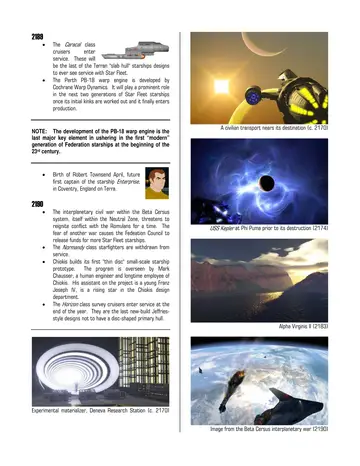
2189 — The Caracal class cruisers enter service. These will be the last of the Terran “slab hull” starships designs to ever see service with Star Fleet. — The Perth PB-18 warp engine is developed by Cochrane Warp Dynamics. It will play a prominent role in the next two generations of Star Fleet starships once its initial kinks are worked out and it finally enters production.
NOTE: The development of the PB-18 warp engine is the last major key element in ushering in the first “modern” generation of Federation starships at the beginning of the 23rd century.
— Birth of Robert Townsend April, future first captain of the starship Enterprise, in Coventry, England on Terra.
2190 — The interplanetary civil war within the Beta Cersus system, itself within the Neutral Zone, threatens to reignite conflict with the Romulans for a time. The fear of another war causes the Federation Council to release funds for more Star Fleet starships. — The Normandy class starfighters are withdrawn from service. — Chiokis builds its first “thin disc” small-scale starship prototype. The program is overseen by Mark Chausser, a human engineer and longtime employee of Chiokis. His assistant on the project is a young Franz Joseph IV, a rising star in the Chiokis design department. — The Horizon class survey cruisers enter service at the end of the year. They are the last new-build Jeffries-style designs not to have a disc-shaped primary hull.