7.4 Marshall Class Destroyer
The Marshall class "hammerhead" destroyer was Star Fleet's heavily armed, force-field-screened mainstay throughout the Romulan War, of which only 36 of an intended 260 were built, with its uprated Marshall-B, Marshall-C/Patton, and later derivatives keeping the class as the backbone of the fleet for nearly six decades.
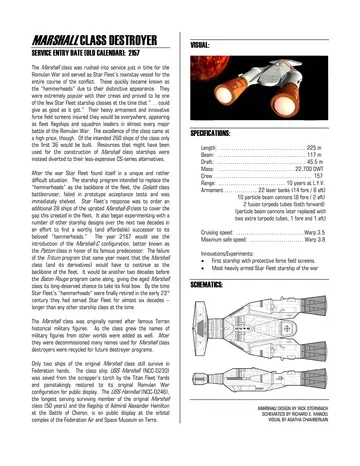
Marshall Class Destroyer
Service Entry Date (Old Calendar): 2157The Marshall class was rushed into service just in time for the Romulan War and served as Star Fleet's mainstay vessel for the entire course of the conflict. These quickly became known as the "hammerheads" due to their distinctive appearance. They were extremely popular with their crews and proved to be one of the few Star Fleet starship classes at the time that "... could give as good as it got." Their heavy armament and innovative force field screens insured they would be everywhere, appearing as fleet flagships and squadron leaders in almost every major battle of the Romulan War. The excellence of the class came at a high price, though. Of the intended 260 ships of the class only the first 36 would be built. Resources that might have been used for the construction of Marshall class starships were instead diverted to their less-expensive CS-series alternatives.
After the war Star Fleet found itself in a unique and rather difficult situation. The starship program intended to replace the "hammerheads" as the backbone of the fleet, the Goliath class battlecruiser, failed in prototype acceptance tests and was immediately shelved. Star Fleet's response was to order an additional 28 ships of the uprated Marshall-B class to cover the gap this created in the fleet. It also began experimenting with a number of other starship designs over the next two decades in an effort to find a worthy (and affordable) successor to its beloved "hammerheads." The year 2187 would see the introduction of the Marshall-C configuration, better known as the Patton class in honor of its famous predecessor. The failure of the Tritum program that same year meant that the Marshall class (and its derivatives) would have to continue as the backbone of the fleet. It would be another two decades before the Baton Rouge program came along, giving the aged Marshall class its long-deserved chance to take its final bow. By the time Star Fleet's "hammerheads" were finally retired in the early 23rd century they had served Star Fleet for almost six decades — longer than any other starship class at the time.
The Marshall class was originally named after famous Terran historical military figures. As the class grew the names of military figures from other worlds were added as well. After they were decommissioned many names used for Marshall class destroyers were recycled for future destroyer programs.
Only two ships of the original Marshall class still survive in Federation hands. The class ship USS Marshall (NCC-D230) was saved from the scrapper's torch by the Titan Fleet Yards and painstakingly restored to its original Romulan War configuration for public display. The USS Hannibal (NCC-D246), the longest serving surviving member of the original Marshall class (50 years) and the flagship of Admiral Alexander Hamilton at the Battle of Cheron, is on public display at the orbital complex of the Federation Air and Space Museum on Terra.
Specifications
Length: 225 m. Beam: 117 m. Draft: 45.5 m. Mass: 22,700 DWT. Crew: 157. Range: 10 years at L.Y.V. Armament: 22 laser banks (14 fore / 8 aft), 10 particle beam cannons (8 fore / 2 aft), 2 fusion torpedo tubes (both forward) (particle beam cannons later replaced with two extra torpedo tubes, 1 fore and 1 aft). Cruising speed: Warp 3.5. Maximum safe speed: Warp 3.8.Innovations/Experiments
- First starship with protective force field screens.
- Most heavily armed Star Fleet starship of the war.