10.0 2221–2250: The Class I Era
An overview of the Class I Program traces its origins in the Jeffries Project and the Baton Rouge generation, the modular component construction that produced fourteen distinct Class I designs alongside a parallel Class II Program, the economic boom and political backlash that culminated in the Scandal of Archimedes and the strife-ridden Babel Conference of 2230, and the coming of the Four Years War in which the new Class I fleet held the line against the Klingon Empire.
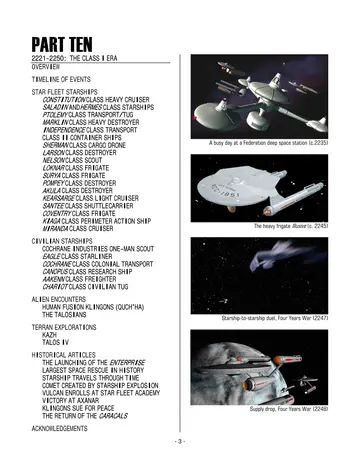
Magnificent, isn’t it? The soundness of Franz Joseph’s original design holds up well. You know, there was a time when people thought he designed these ships only for amusement — that they’d never have any practical application.
— William van Anling, Admiral, Star Fleet (ret.) (2147–2251)
No major starship program has had as great an impact on Star Fleet and the future of the Federation as has the Class I Program. Its origins were seven decades old with their roots in the Jeffries Project, a starship design far ahead of its time. It had been delayed decade after decade due to Federation Council politics and lack of direction within Star Fleet over the future of the fleet. It had taken a visionary, W. M. Jeffries, to conceive the program. It took another, the late Mark Chausser, to convince Star Fleet that the technology was ready and the time was right. It took a third, Franz Joseph IV, to take both of their visions and turn them into reality. When he did, he would forever change the very concept of the word starship. It would be as if the past 150 years of Terran and Federation spaceflight advances were but blips on the screen, necessary landmarks to hurriedly pass by on the way to the prize. The Class I Program that Joseph helped bring about did that. It changed everything about starships and the way they were conceived. It built upon the pioneering work of Chausser’s Baton Rouge generation to set the standard by which all future Federation starships would be measured. From there it would spread out into the science, merchant, and civilian starship sectors and even make a lasting impression on the Federation’s future foes.
In a very real sense, we are still living in the Class I Era. Almost every aspect of modern Federation starship design, from component configuration to ship’s interior layouts, from warp engine philosophies to starship procedures and protocols, can be directly traced back to the 2222 launch of the U.S.S. Constitution. The Class I Program did more than just define a new generation of starships. It also defined the future of Star Fleet, and with it the Federation. Had not the Class I fleet been available when it was, then the Four Years War with the Klingon Empire would have been a very different affair. It might have easily devolved into the desperate struggle that was the Romulan War, with countless casualties and atrocities. The Class I Program made sure that such a thing never happened. That alone was justification enough to silence even its harshest critics.
Modular component construction techniques that had been pioneered with the Baton Rouge generation of starships were taken to new heights with the Class I Program. As originally conceived there were only three basic component configurations: a twin nacelled (heavy) cruiser, a single nacelled destroyer/scout, and a twin-nacelled saucer fitted with a tractor grapple for use as a transport/tug. By the end of the Four Years War there were a total of fourteen distinct Class I starship designs under construction, with multiple build classes authorized for almost all of them and more designs pending approval. This did not include the long-delayed dreadnought, which would not be built until just after the Four Years War, nor did it include the effort to convert five Baton Rouge era starship classes to Class I specifications. Proceeding in parallel was the Class II Program, a joint Star Fleet / Merchant Marine effort, with six distinct starship designs (each with multiple build groups) based on Class I components. The immediate effect was to produce the first modern Star Fleet in decades. There were important side effects as well. All of this construction effort resulted in boom years for starship yards across the Federation, with everyone involved contributing to the Class I program to some degree. Component modularization meant that work could proceed in parallel on the hulls of multiple starship classes, so long as the other main components (warp engines, secondary hulls, specialized attachments, etc.) were ready and delivered on time. The starship boom also brought about a parallel boom in the Federation economy, lifting its gross economic product to previously unseen heights. Times were good and jobs were available for all who desired them, thanks to Star Fleet’s Class I and Class II Program.
There were, unfortunately, a number of beings that did not appreciate these good times. Instead, they saw an increasingly militaristic and totalitarian Federation government arming for war. They wanted freedom from bureaucracy and government regulations. They wanted things as they had been before the Federation Charter was enacted: a weak, decentralized Federation banding together only in times of great interstellar crisis, with all its members and associated free to conduct their own intersystem affairs. Some of the more militant groups, such as the increasingly popular Terra Return League, advocated the dissolution of the Federation. Beyond these were others, who idolized the likes of Terra’s notorious Colonel Green and were not above violence in achieving their aims.
In 2224, a group of Tellarite merchant ships were fired upon by Star Fleet forces under the command of Admiral Hathari of Andor while his fleet was ostensibly conducting war games exercises near the planet Th’allt. It was actually a deliberate act to cover up what became known as the Scandal of Archimedes. This sordid affair played right into the hands of Federation dissidents, who up until this point had been repressed by Council decree. Many of those who had imposed those decrees were deposed themselves in the wake of hearings and arrests that followed. This freed the Terra Return League and its allies of the restrictions that had all but silenced them during the terror-laden days at the end of the 22nd century. They were quick to resume their clarion calls for the dissolution of the Federation. The Scandal of Archimedes added weight to their words, much to the dismay of the new Federation Council. Eventually the clamor became so great that a special Babel Conference was called in 2230 to resolve the matter. A special guest of honor at this conference would be Captain Krenn, the new ambassador from the Klingon Empire. This was intended to show him how the Federation could peacefully resolve major problems without antagonism and violence. Unfortunately, the Babel Conference of 2230 would be one of the most strife-ridden in Federation history and leave Captain Krenn with much food for thought in his report back to his Klingon superiors.
Even before the conference convened it was struck by violence. Vice Admiral Andreas Mitskoval, Star Fleet chief of staff, was assassinated along with his adjutant and several of his entourage by a bomb planted in his airtram at Star Fleet Headquarters. He had just left his office and was on his way to Babel to represent Star Fleet interests at the conference. This unprecedented act of terrorism, which was never solved, set the tone for the rest of the Babel Conference. Star Fleet Marines stood guard everywhere as conference security was tripled. As for himself, Captain Krenn seemed to be enjoying the charges, counter-charges, accusations, threats, and such that flew back and forth in the conference chambers in the first few days. “It is as if we never left home,” he was heard to say to one of his aides.
As might be expected, the loudest and most strident voices at the Babel Conference of 2230 were those of the Terra Return League and its allies. They called for a halt to Federation expansion and abolition of the “discredited” Federation Charter. The latter found considerable support among other Federation opposition groups, such as the Symmetrists, the Free Space League, and (to no one’s surprise) the Orion trade cartels. At the other end of the spectrum were the Border Worlds Association and the League of Federation Affiliated Systems, who clamored for more Federation assistance and a continued Star Fleet presence in their systems. The Border Worlds delegates were especially upset by Captain Krenn’s presence, calling him a spy and not a diplomant. Krenn is reported to have smiled and replied, “I am neither. I am a soldier in service to the Empire. I am not here to fight nor to spy. My current assignment is to sit here and watch you Federation fools destroy each other.”
The Babel Conference of 2230 might very well have ended in the dissolution of the Federation were it not for the intervention of two humans. Commodore Douglas Shepherd was in command of the cruiser Savannah (NCC-1307). He had been originally detailed to escort Captain Krenn’s unarmed D-5 cruiser Serpant to the Babel Conference. Due to the assassination of Admiral Mitskoval he was immediately promoted to rear admiral and named acting Star Fleet chief of staff. It was Admiral Shepherd who would speak for Star Fleet at the Babel Conference, and that he did with surprising eloquence.
Star Fleet is not an unresponsive monolith, callously disregarding the needs and wishes of the Federation and its allies. We have always been there for them. Despite the desires of some we will always be there for as long as Star Fleet lasts. I need only to point out that the alternative to peace is war. That is a solution that none of us desire.
There are few beings in this room that were alive at the time of the Romulan War. Those of you who were remember those perilous times. My grandfather and my father often told me about them and how close the Federation came to falling. Were it not for the courage and dedication of the men and women, the humans and beings and other species that serve in Star Fleet and defend the Federation, we would not be here today. All of you know this, even if you do not share the living memories of the others in this room. The freedom you have to argue today was bought with the blood of Star Fleet. We demand nothing in return save the privilege of continuing to serve the Federation and its affiliated worlds. If there is no Federation, if you go through with this vote to dissolve it, then there will be no Star Fleet. That would be welcome news to some of you here today. I for one never want that day to come.
Gentlebeings, the Federation is not perfect. That is why we have conferences such as these, to peacefully resolve our disputes. Let me remind you, however, that without the Federation there is no Star Fleet, nor is there any alternative to Star Fleet. The Federation will fall, a house divided, and your worlds and systems will be left open to any foe with the might and will to conquer them. It is my duty to see to it that such a thing never happens. I ask you, delegates — please allow me to continue to perform that duty. Please do not dissolve the Federation. Without it, all of us will surely fall.
The silence that followed Admiral Shepherd’s words was broken by another human clearing his throat. He asked permission to speak and it was granted. His name was Carter Winston, a wealthy Federation entrepreneur known for his benevolence and charity, a man who gave away fortunes as fast as he made them to help other beings less fortunate than he. It was Carter Winston who had the last word before the vote was taken on dissolution.
I feel a little out of place here. I am a businessman, not an ambassador. As a civilian I have no special standing among you other than an invited guest. So why have I asked to speak? Well, it’s all this talk about limits, and tariffs, and sanctions, and restrictive regulations, and suffocating bureaucracy, and the need to “return to our roots” and such. To be honest, none of this sounds like the Federation that I know. I think, to borrow one of my grandfather’s favorite expressions, we “can’t see the forest for the trees.” Perhaps it’s time to step back, look around, and truly realize what is about to happen here.
I’m a human. My great-grandparents were born on Earth, and I’ll be the first to admit to a fondness for the place. It isn’t home to me, though, any more than my childhood home on Deneva. My home is the stars, and I won my success there with hard, hard work and very little of this so-called “Federation interference” I’ve been hearing about. The Sea of Stars is too wide and rich for any one political body to effectively control with such restrictive authority. I don’t mean to demean any of you here, but I have great difficulty in believing the tales I’ve heard about a Federation dictatorship imposed over the space I’ve traveled. I’ve been to every major world in the Federation and I’ve seen no such thing.
You should not be talking about limits and restrictions. Instead, you should be talking about freedoms and opportunities, because they’re out there. They’re beckoning to anyone who will heed their call. It’s always good to have some roots, and a place to go back to when you need it, but you shouldn’t become so narrow-minded as to restrict yourself there. So, put down your roots where you will and make that place yours, but remember: the Federation is what we make of it. It is ours to fashion after our own image. Any complaints we have about the Federation are complaints about ourselves, and in ourselves the solution lies. If we give up this dream of a United Federation of Planets, we are giving up on ourselves as well.
As I see it, the future is neither bleak nor constrained. It is full of promise and mystery and is ours for the choosing. I know what my choice would be if I could vote today. I would vote for the future. I can but hope that you would do the same.
The motion to dissolve the Federation failed by a single vote. The rest of the Conference passed rather uneventfully, with the delegates drafting resolutions to deal with various minor concerns. The Terra Return League and several other dissident parties soon dissolved, never to be heard from again. The Federation’s greatest peacetime crisis had passed. Once again it could look towards the future.
The Babel Conference of 2230 was not the end of the Federation’s troubles. Captain Krenn had learned much from his visit and shared his information in many reports back to his Klingon superiors. The Klingon Empire itself had just emerged from a bloody civil war, with a newly installed, strong central government under the iron fist of Chancellor Kar’harmmer. He despised everything about the Federation and for what it stood because it was so unlike the Klingon way. He also resented “constant Federation encroachment” on their shared border, although in truth it was the local Klingon commanders who were doing most of the “encroaching.” Almost as soon as he entered office Chancellor Kar’harmmer resolved to destroy the Federation once and for all. To that end he began preparing the Klingon Empire for an all-out war with the United Federation of Planets — winner take all.
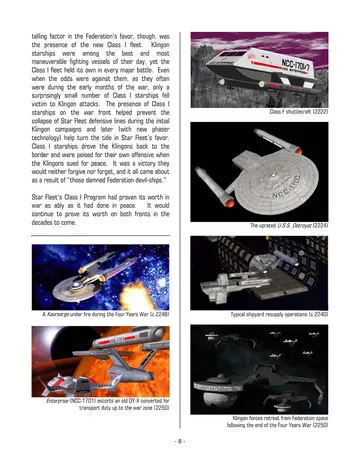
The Four Years War was destined to become the only major interstellar war ever fought between the Klingons and the Federation. Klingon numbers and tenacity were thrown by the bucketful at Federation technological might — and essentially washed off. Large portions of border space were lost to the Klingons in the first year of the war; however, there were no Klingon deep-penetration offensives (as had been hoped) like there had been during the Romulan War a century before. This time, Star Fleet knew that the Klingons were coming and had almost two decades to prepare for such an event. The most telling factor in the Federation’s favor, though, was the presence of the new Class I fleet. Klingon starships were among the best and most maneuverable fighting vessels of their day, yet the Class I fleet held its own in every major battle. Even when the odds were against them, as they often were during the early months of the war, only a surprisingly small number of Class I starships fell victim to Klingon attacks. The presence of Class I starships on the war front helped prevent the collapse of Star Fleet defensive lines during the initial Klingon campaigns and later (with new phaser technology) help turn the tide in Star Fleet’s favor. Class I starships drove the Klingons back to the border and were poised for their own offensive when the Klingons sued for peace. It was a victory they would neither forgive nor forget, and it all came about as a result of “those damned Federation devil-ships.”
Star Fleet’s Class I Program had proven its worth in war as ably as it had done in peace. It would continue to prove its worth on both fronts in the decades to come.