7.3 Galactic Survey Cruiser Proposal & Prototype
The Galactic Survey Cruiser was W. M. Jeffries' radical 2153 design proposal, built as a one-fourth-scale prototype named Bonaventure in 2155 that combined ideas borrowed from Terra, Alpha Centauri, Andor, Tellar Prime, and Vulcan, hit a record Warp 3.8, and established the "lines" of its legendary descendant, the Constitution class heavy cruiser.
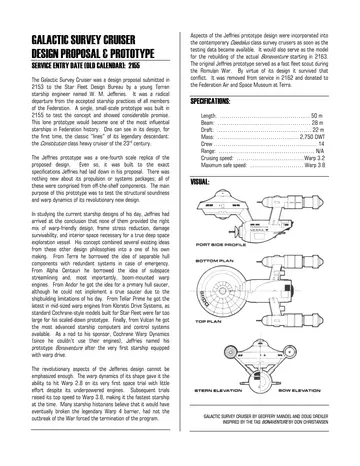
Galactic Survey Cruiser Design Proposal & Prototype
Service Entry Date (Old Calendar): 2155The Galactic Survey Cruiser was a design proposal submitted in 2153 to the Star Fleet Design Bureau by a young Terran starship engineer named W. M. Jefferies. It was a radical departure from the accepted starship practices of all members of the Federation. A single, small-scale prototype was built in 2155 to test the concept and showed considerable promise. This lone prototype would become one of the most influential starships in Federation history. One can see in its design, for the first time, the classic "lines" of its legendary descendant: the Constitution class heavy cruiser of the 23rd century.
The Jeffries prototype was a one-fourth scale replica of the proposed design. Even so, it was built to the exact specifications Jeffries had laid down in his proposal. There was nothing new about its propulsion or systems packages; all of these were comprised from off-the-shelf components. The main purpose of this prototype was to test the structural soundness and warp dynamics of its revolutionary new design.
In studying the current starship designs of his day, Jeffries had arrived at the conclusion that none of them provided the right mix of warp-friendly design, frame stress reduction, damage survivability, and interior space necessary for a true deep space exploration vessel. His concept combined several existing ideas from these other design philosophies into a one of his own making. From Terra he borrowed the idea of separable hull components with redundant systems in case of emergency. From Alpha Centauri he borrowed the idea of subspace streamlining and, most importantly, boom-mounted warp engines. From Andor he got the idea for a primary hull saucer, although he could not implement a true saucer due to the shipbuilding limitations of his day. From Tellar Prime he got the latest in mid-sized warp engines from Kloratis Drive Systems, as standard Cochrane-style models built for Star Fleet were far too large for his scaled-down prototype. Finally, from Vulcan he got the most advanced starship computers and control systems available. As a nod to his sponsor, Cochrane Warp Dynamics (since he couldn't use their engines), Jeffries named his prototype Bonaventure after the very first starship equipped with warp drive.
The revolutionary aspects of the Jefferies design cannot be emphasized enough. The warp dynamics of its shape gave it the ability to hit Warp 2.8 on its very first space trial with little effort despite its underpowered engines. Subsequent trials raised its top speed to Warp 3.8, making it the fastest starship at the time. Many starship historians believe that it would have eventually broken the legendary Warp 4 barrier, had not the outbreak of the War forced the termination of the program. Aspects of the Jeffries prototype design were incorporated into the contemporary Daedalus class survey cruisers as soon as the testing data became available. It would also serve as the model for the rebuilding of the actual Bonaventure starting in 2163. The original Jeffries prototype served as a fast fleet scout during the Romulan War. By virtue of its design it survived that conflict. It was removed from service in 2162 and donated to the Federation Air and Space Museum at Terra.