3.8 Alien Encounters: The Watchers from Vulcan & Ambush in the Stars
Two excerpted accounts present the era’s alien encounters: “The Watchers from Vulcan,” a vignette of two Vulcan observers watching the Day of Fire from orbit, and “Ambush in the Stars,” the harrowing story of the scout Sakharov’s catastrophic first contact with the Kzinti and the three technicians who saved its crew.
The Watchers from Vulcan
Excerpted from Secret Watchers: The Visitors from Vulcan by Norris Whittaker (Terra: New Chicago Press, 2200).
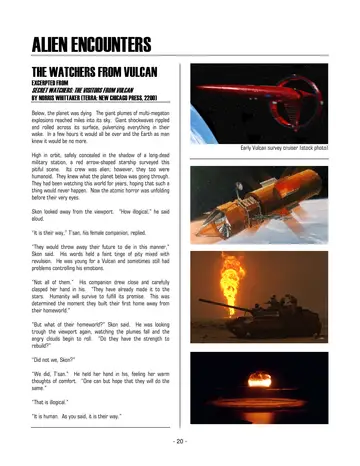
Below, the planet was dying. The giant plumes of multi-megaton explosions reached miles into its sky. Giant shockwaves rippled and rolled across its surface, pulverizing everything in their wake. In a few hours it would all be over and the Earth as man knew it would be no more.
High in orbit, safely concealed in the shadow of a long-dead military station, a red arrow-shaped starship surveyed this pitiful scene. Its crew was alien; however, they too were humanoid. They knew what the planet below was going through. They had been watching this world for years, hoping that such a thing would never happen. Now the atomic horror was unfolding before their very eyes.
Skon looked away from the viewport. “How illogical,” he said aloud.
“It is their way,” T’san, his female companion, replied.
“They would throw away their future to die in this manner,” Skon said. His words held a faint tinge of pity mixed with revulsion. He was young for a Vulcan and sometimes still had problems controlling his emotions.
“Not all of them.” His companion drew close and carefully clasped her hand in his. “They have already made it to the stars. Humanity will survive to fulfill its promise. This was determined the moment they built their first home away from their homeworld.”
“But what of their homeworld?” Skon said. He was looking trough the viewport again, watching the plumes fall and the angry clouds begin to roll. “Do they have the strength to rebuild?”
“Did not we, Skon?”
“We did, T’san.” He held her hand in his, feeling her warm thoughts of comfort. “One can but hope that they will do the same.”
“That is illogical.”
“It is human. As you said, it is their way.”
Ambush in the Stars: The First Earth-Kzin Contact
Excerpted from The Rise and Fall of the Kzinti Empire by Miklos Sofia (Al Rijil: Centaur Press, 2175).
Kzinti. The very name strikes fear in the heart of any sane being. The Tellarites will shudder, praying to their gods that their world will never again fall victim to the great Claw-Swipe. The Andorians will instinctively steel themselves, racial memories of hard fought and desperate battles suddenly revived. The Klingons will nod their head in knowing understanding. The Vulcans will say nothing, bowing their heads as if that alone could wipe the thought from their mind. As for the humans of Terran and Alpha Centauri, we who were the last to bear the brunt of Kzinti fury, we who alone of all the beings of the Local Group were willing to do more than just defend ourselves, we who took the fight to the Kzinti and in four bloody wars managed to rip the heart out of their depraved empire once and for all … we remember. We look to our monuments, our markers of glory, our reminders of our many dead. We look at the thousands of shattered ships and marker stones on a thousand blood-soaked worlds. We look at our prizes of war, study them, learn from them, and yet to this day cannot rid them of the terrible memories and emotions affiliated with them. We must not. We must never forget them no matter how terrible they may be. We must remember so the Kzinti scourge will remain penned and muzzled for the rest of time.
It was in the days immediately following the conclusion of Terra’s Third World War that humanity first learned of the Kzinti. The war had not stopped Terra’s colonies from continuing their space exploration efforts. My homeworld of Alpha Centauri was about to be contacted by two ships from Terra, the Icarus and the Enterprise. Other ships were heading outward from the Solar System in all directions, seeing new worlds to colonize and that elusive first contact with a truly alien race that would escape them with my people. That contact would not be long in coming. Unfortunately it would be far from the pleasant experience for which the humans of Terra had for so long hoped. Its living nightmare would go on to haunt them for years to come.
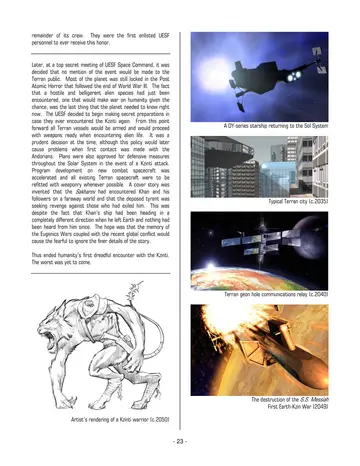
The Andrei Sakharov was a Searcher class scout vessel, smaller than the Terran Declaration class but of the same general design and purpose. It had been part of a small fleet of Terran ships sent out in the late 2030 and early 2040s to look for other inhabited planets. Travel times were on the magnitude of years back then since warp drive had not yet been invented. The Sakharov was typical of a Terran vessel of the day: advanced fusion drive, steering rockets, and limited defensive armament. The weapons were there for other Terrans; humanity as yet had not met any hostile beings in space. That was about to change.
The Sakharov was some five years out from Pluto when it encountered what was unmistakably an alien starship. Commander Piotr Velikiy ordered the Sakharov to slow and begin broadcasting friendly messages on all channels. He also ordered his crew to refrain from loading and aiming his ship’s weapons. He wanted mankind’s first true “first contact” experience to be a positive one. His naïve optimism lasted for all of three seconds. Without warning the alien vessel opened fire, damaging the Sakharov’s auxiliary engines and bringing the ship to a dead stop. The ship’s bridge then took a direct hit, killing Velikiy and all of his command staff. Within minutes the alien ship had pulled alongside the crippled Sakharov, grappled it, and then began a boarding action. The dazed and stunned crew of the Sakharov had little chance without weapons against the alien invaders, who were twice their size and three times as strong. The few who did manage to get to their guns and tried to resist were killed on the spot. The survivors were then dragged into the ship’s cargo hold as prisoners. Only after the fighting stopped and the last of the Sakharov’s crew rounded up did their captors reveal themselves. They were felinoid: red-coated tigers walking on two legs with tempers to match. They called themselves the Kzinti, lords of the universe, and demanded to know why the “softskins,” as they called the humans, had violated the borders of the mighty Kzinti Empire. When Lieutenant Georgi Radestki, the senior surviving officer, protested, his Kzinti interrogator ripped open his throat in front of everyone. To their horror the other Kzinti who were not guarding them began to feed on the dying man even as he slumped to the deck. They were then threatened with a similar fate unless they answered every question put to them.
It was by the luckiest of chances that three technicians had been at work inside one of the Sakharov’s interior access shafts when the Kzinti boarded the ship. They were thus the only three to escape capture, and the many unfamiliar scents aboard the human vessel helped to hide them. Technician First Class Josef Latski, along with Technicians Second Class Marta Donets and Andrei Shkvarzev were the only hope for the doomed crew of the Sakharov. They were but three techs against an army of rabid Kzinti; however, they knew the ship and the Kzinti did not. That fact would prove to be their salvation.
Latski’s situation and that of his comrades was precarious at best. It was only a matter of time before their presence was discovered by the Kzinti. To make matters worse, they overheard the Kzinti order a telepath to be brought on board for interrogation. This left them little time to act. The telepath could almost certainly detect their absence in the minds of their captured crewman and possibly pick up their own thoughts as well. They had to act before the telepath could be ferried over.
Fortunately, Technician Shkvarzev had the interesting hobby of big game hunting back home. He had hunted a number of large cats in game preserves and was thus best qualified among them to devise a situation to their dilemma. They were without weapons or access to them, but they might still be able to get to the ship’s workshop. Shkvarzev’s idea was to quick-build a sonic disruptor tuned to the range of feline hearing. An amplified signal from the disruptor would throw the Kzinti into confusion, provided their hearing was the same as terrestrial cats. Shkvarzev wasn’t sure it would work but to Latski it was a good a plan as any.
The three made their way back to the workshop as quickly and quietly as they could. Two surprises awaited them. The place was unguarded, being deemed of little worth by the Kzinti. Furthermore, the Kzinti had taken the weapons of the disarmed humans and simply dumped them on the floor of the workshop. There was no way the captured crew of the Sakharov could reach the workshop from where they were being held. This fortunate turn of events played right into Latski’s hands. He and Donets quickly began arming themselves, as quietly as possible, while Shkvarzev whipped up his homebrew disruptor. Donets and Shkvarzev would rescue the crew while Latski made his way back to the engine room. If their plan failed, well … he knew what he would do. If the opportunity presented itself to regain control of the ship, however, they would need someone to seize and barricade the engine room until reinforcements arrived. They had no idea if their plan would work and little chance of it succeeding, yet they pressed ahead anyway. Slim hope was better than none at all.
Even as the Kzinti telepath was making his way through the ship’s airlock, Donets and Shkvarzev were already hiding in a service crawlways next to the hold where the rest of the crew were being held prisoner. Donets managed to attract the attention of one of the captured crew and held her hands up to her ears. The crewman nodded and the whispered word quickly passed. The service access panel to the compartment was suddenly kicked open. As the startled Kzinti reacted to the noise, the Sakharov survivors hit the floor and covered their ears. Shkvarzev powered up his disruptor full force and aimed it at the Kzinti, even as he and Donets burst inside. What happened next took him by complete surprise.
By the time the sonic blast ended two of the Kzinti were already unconscious on the floor with blood running from their ears. The other three were still staggering but were soon put down with repeated machine gun fire from Donets and Shkvarzev. Donets would later report that she had to empty a full clip and part of another into one of the Kzinti warriors before he finally fell to his knees and bit the deck.
In the meantime Latski had slowly made his way through the ship’s interior to the engine core. The Sakharov wasn’t going anywhere without guidance control; however, that was not Latski’s intent. The Kzinti ship had changed its position relative to the Sakharov and its crew was in the process of attaching magnetic grapples for towing. By another lucky chance it was sitting directly in the path of the Sakharov’s main engine nozzle. They had been cruising on auxiliaries when the Kzinti attacked so perhaps the aliens had not recognized the imminent danger they had put themselves in. Latski wormed his way to the backside of the engine control panel, completely avoiding the Kzinti guards stationed in the area. The shaft grease he had doused himself with back in the workship was also masking his scent from their noses. Gritting his teeth and praying that Donets and Shkvarzev were succeeding, Latski fired the engine. As the fusion plant’s rumble increased dramatically Latski was gratified to see the Kzinti vessel torn away from the Sakharov by the blast, subsequently imploding seconds later from a ruptured hull. Almost immediately, as the Sakharov rocketed wildly away from the scene, the sounds of gunfire and Kzinti energy weapons could be heard down the corridor. Latski and his comrades had tried to time their actions so that the destruction of the Kzinti vessel and the Sakharov crew’s counterattack on the Kzinti still remaining would happen at the same time. The two Kzinti guards loped from the engine room at full speed, giving Latski his chance to barricade the engine room and stop the ship without fear of being surprised. He would later rejoin the others and help them in finishing off the last of the Kzinti on board and still clinging to the outside of the ship.
It took two days for the surviving crewmembers of the Sakharov to jerry-rig a crude guidance control and turn their crippled ship back towards Earth. Fortunately their distress signal was picked up by a passing colony ship, who relayed it back to the nearest UESF base. Two months after they began the return trip they were intercepted by a UESF fleet under the command of Captain Walter Endemann. The Sakharov survivors were taken back to Titan Base for debriefing and recovery. The bodies of the fallen Kzinti warriors and the surviving records from ship’s data banks were sent straight to UESPA Headquarters for study. Latski, Donets, and Shkvarzev would later be awarded the Solar Medal of Honor for their daring actions in saving the Sakharov and the remainder of its crew. They were the first enlisted UESF personnel to ever receive this honor.
Later, at a top secret meeting of UESF Space Command, it was decided that no mention of the event would be made to the Terran public. Most of the planet was still locked in the Post Atomic Horror that followed the end of World War III. The fact that a hostile and belligerent alien species had just been encountered, one that would make war on humanity given the chance, was the last thing that the planet needed to know right now. The UESF decided to begin making secret preparations in case they ever encountered the Kzinti again. From this point forward all Terran vessels would be armed and would proceed with weapons ready when encountering alien life. It was a prudent decision at the time, although this policy would later cause problems when first contact was made with the Andorians. Plans were also approved for defensive measures throughout the Solar System in the event of a Kzinti attack. Program development on new combat spacecraft was accelerated and all existing Terran spacecraft were to be refitted with weaponry whenever possible. A cover story was invented that the Sakharov had encountered Khan and his followers on a faraway world and that the deposed tyrant was seeking revenge against those who had exiled him. This was despite the fact that Khan’s ship had been heading in a completely different direction when he left Earth and nothing had been heard from him since. The hope was that the memory of the Eugenics Wars coupled with the recent global conflict would cause the fearful to ignore the finer details of the story.
Thus ended humanity’s first dreadful encounter with the Kzinti. The worst was yet to come.