3.1 Major Events
A year-by-year timeline of the 2026-2050 era covers the Third World War, asteroid mining and colony expansion, the failures of NASA’s TAU Program starships, the rise of Colonel Green, the Venus terraforming milestones, first contact with Alpha Centauri and the Kzinti, Zefram Cochrane’s warp drive, and the two great battles of the First Earth-Kzin War.
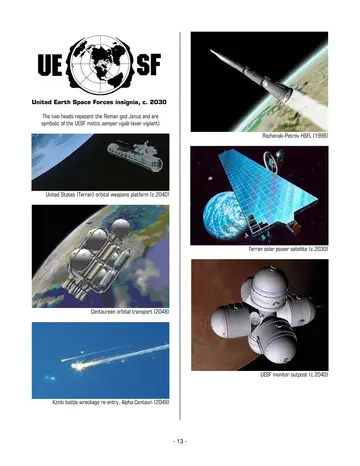
2026-2047 • Terra’s Third World War
2026 • The city of Asterpolis opens as a central hub for all of the mining and homesteading activity in the Sol System’s inner asteroid belt. • The 15-man Asteroid Rover, built “entirely by the locals,” enters service in the asteroid belt. • The Martian fossil fields at Ma’adim Vallis are discovered.
2027 • The UES Tiller, a DY-500 class vessel, stops at the Venus space station to observe the progress of the Venus Terraforming Project. • The first two-man work pods enter service. • The Ganymede Research Station begins a new project aimed at unlocking more of the mysteries of Jupiter.
2028 • The Galileo class transports enter service. • Claim jumpers begin the practice of jettisoning the cargo pods of their spaceships onto the settlements of unwary homesteaders to either knock them down or off the homestead and into space. • The UESF will eventually be forced to clamp down on the practice of asteroid claim jumping by the end of the year before anyone is seriously injured or killed.
2029 • Project SETI’s Farside Moonbase division detects the first true intelligent extraterrestrial communications to be received by Terrans listening for them.
2030 • The first successful matter-antimatter engine is tested under laboratory conditions. • The Aventeur class explorers are retired from service.
2031 • By this date the Ganymede Research Station has been turned into a permanent facility. • The UESF begins the construction of permanent military bases on Ganymede, Titan, and Pluto. • UESPA assists the Asteroid Colonies in moving a number of large asteroids whose orbits cross those of Earth. These will be parked in safer orbits at the Asteroid Belt and, in time, be settled by homesteaders. • The Asteroid Rovers are withdrawn from service as replacement vehicles become available.
2032 • The Ares IV is close to completing its survey mission of Mars when it is swept out of the Sol System by a spatial anomaly. Its ground survey team is left stranded on the surface with nothing but their base camp supplies. It takes an expedition from the Martian Colonies two weeks rescue them due to bad weather caused by the passing of the anomaly. • The Drake series of interstellar probes is launched. • An attempt to rescind the popular Space Homestead Act is defeated. The real reason for the move is to keep more people on Terra in order to fight the war.
2033 • All major Terran spacefaring nations that do not already have weapons platforms in orbit begin to launch them. Nations that already do augment their older weapons with newer delivery systems. These consist primarily of old-fashioned missile platforms, “rod drop” cylinders, and orbital laser satellites. • An ISA survey mission makes a 40 million km “close pass” of the surface of Sol. • The Companion class cruiser enters service. It is the USEF’s first dedicated warship class. • NASA’s second attempt at building an interplanetary starship for UESPA is foiled when the derelict Cerebus is found adrift in the vicinity of Neptune, its engines wrecked and its crew dead. • The New United Nations gives NASA one more chance to build a working interplanetary starship under the auspices of the TAU Program. Work begins almost immediately on the Charybdis.
2034 • UESF’s Titan Base is completed and begins operations. • An “accident” with an orbital laser satellite results in the complete destruction of Petrograd.
2035 • AFP-1, Terra’s first major attempt at building a faster-than-light spaceship, mysteriously explodes during space trials with all hands lost. Responsibility is claimed by William F. Green, a former ESA army colonel who rose to infamy for his genocidal policies during the war. • “Colonel” Green seizes control of UESF Aitken Base. He is eventually driven out and escapes back to Earth, but not before launching two thermonuclear missiles at the “impure” peoples of Southeast Asia. They detonate as programmed, killing millions and destroying two major cities. Green and his followers will continue to elude capture for the next year while pursuing their own private race war. • The first of Utopia Planitia’s Declaration class starliners, their answer to NASA’s TAU Program, completes its field trials for UESPA and officially enters service. This first ship, the Declaration, is a systems demonstrator and will never leave the Sol System. The others will be built to a slightly modified design.
2036 • Colonel Green and his followers are tracked to a base outside Singapore. The UESF orders it destroyed via orbital laser bombardment. Green manages to escape, continuing to plague humanity well into the Post Atomic Horror before he is finally killed. • “Geon holes” are discovered in the natural fabric of space. These permit faster-than-light communications on a limited basis so long as the points of contact are within range of a geon hole. This discovery helps solve a major problem with mankind’s early space exploration efforts. • The Declaration class starliner Enterprise is launched towards Alpha Centauri. It will take 11 years for the ship to get there and it will be passed en route by a newer, faster vessel (Icarus). • The Searcher class scout enters service. • The Saratoga class cargo carrier enters service.
2037 • The DY-400, informally dubbed the Helsinki class after its lead ship, enters service at this time. • The Searcher class scout Sakharov is but one of many in its class launched on long-term extra solar survey missions. • The completed Charybdis is successfully launched on 23 July 2037. It will be the final starship in NASA’s TAU Program and the last Terran vessel ever fitted with “spinner” drive.
2038 • All telemetry from the Charybdis is lost on 7 January. A search and rescue effort is attempted by the closest ship, the Jacob, but it finds neither ship nor debris. The TAU Program is officially abandoned. Its successor, a starship design with more conventional means of propulsion, is already under construction by ESA. • The uprated DY-500 class enters service. Save for their uprated engines they are not that different from their predecessors. The three under construction at the time have their new “spinner” drives yanked out at the yard due to the loss of the Charybdis. The rest of the class is built with conventional impulse engines.
2039 • Work on UESF’s Pluto Base is completed. • The Enterprise detects radio signals coming from the direction of Alpha Centauri. • The first major industrial plants begin construction at Terra’s space colonies. They will specialize in low-gravity refining and manufacturing techniques.
2040 • The Columbus class explorer enters service. Within three years it will replace the Declaration class as UESPA’s major interplanetary survey vessel of choice. • UESPA decides to go ahead and complete all but the UES Ghandi, the least finished Declaration class starliner building, in order to augment the UESF fleet. The Ghandi is cannibalized and scrapped in its slip for parts to finish the other vessels in the class. • The Magellan class spaceliners enter service. • The last surviving member of the original DY-500 Wheeler class is uprated. All new builds of this group will be of the uprated DY-500 design.
2041 • The Columbus class starship Adam & Eve is launched towards Barnard’s Star in a journey that is expected to last nine years.
2042 • The Columbus class starship Icarus is launched towards Alpha Centauri on 23 June 2042. It will pass the starliner Enterprise twice: once on the way and once again on the return trip as the Enterprise nears its destination.
2043 • UESPA begins a system-wide recruiting drive for a new series of interstellar colonization flights. The publicity campaign does not go as planned. Harsh criticism is leveled for the “wasted effort” of the Declaration class starliners. Nevertheless, UESPA finds plenty of volunteers from the war-ravaged Earth. • The Searcher class starship Andrei Sakharov launches from Earth. Its goal is the Procyon system.
2044 • The new Interplanetary Communications Network, based on geon hole technology, now allows near-instanteous transmissions from anywhere within the Sol System. • Geon hole transmitters are now installed (and backfitted) onto all UESPA spacecraft. These will permit limited interstellar transmission (on the order of days and months, not months and years) provided the ship is within range of a suitable geon hole.
2045 • A Vulcan scout ship crashes on Terra. This marks humanity’s first unofficial contact with the Vulcans. • The retired DY-106 Half Moon is stolen from its storage facility on Luna by persons unknown and successfully escapes the Sol System. • The DY-350 military cruiser program begins development.
2046 • The Belmont class interplanetary tugs enter service. • The Venus Flyer passes acceptance tests and is taken to Venus in order to assist in the Venus Terraforming Project.
2047 • After twenty-two years of hard work the Venus Terraforming Project has progressed to the point where a manned base can be established at the planet’s North Pole. • Two-man work pods are retired from service. • The Day of Fire ends World War III. Many, but not all, of Terra’s major nation-states perish. Over 600 million people die within twenty minutes. Beginning of the Post Atomic Horror. (NOTE: Some historians include the Post-Atomic Horror as part of World War III due to Colonel Green’s War, pushing the end date out to 2063)
2048 • First contact with the Kzinti in the notorious Sakharov Incident. The entire affair is concealed by UESPA in order not to aggravate an already bad situation on Terra. Only Terra’s space colonies and a select few on the planet know the real truth. The UESF begins to quietly arm itself for what will prove to be its first interstellar war. • UESPA plants a cover story that the Sakharov was attacked by Khan and new allies from the stars, who are now preparing to make war on the devastated Terra. This is believed by most people despite obvious inconsistencies. The cover story allows UESF forces on Terra to more openly prepare for war with the Kzinti than would have otherwise been the case. • The Icarus arrives at Alpha Centauri. What would have been the positive first contact mankind wanted turns out to be an encounter with itself. • One of the first visitors with the newly arrived humans from the Sol System is Centaurean scientist Zefram Cochrane. He shares with their scientists his theories on faster-than-light travel. They in turn share with him Alcubierre’s “warp drive” theory along with the latest discoveries into making it a reality. Cochrane realizes that he now has the pieces he was missing to complete his own research. For the sake of data sharing with his new Terran friends he refers to his research under the Terran term “warp drive.” His first goal will be to build an unmanned demonstration vehicle. • The DY-430 class enters service.
2049-2050 • The First Earth-Kzin War
2049 • The colony ship Hawking launches from Terra. • The Adam & Eve is destroyed by the Kzinti just short of its goal of reaching Barnard’s Star. • The First Battle of Alpha Centauri. • Alpha Centauri is attacked by a Kzinti battle fleet looking for the homeworld of the Sakharov. A combined Terran-Centaurean effort is able to drive them away through the use of portable mass drivers converted into giant “space shotguns.” This marks the first time that the humans of Terra and Alpha Centauri have worked together on a joint enterprise. • The Terran vessel Icarus takes heavy damage during the Battle of Alpha Centauri. It is forced to lay over for several months longer than planned in order to effect repairs. • The inventiveness and vigorous tenacity of the humans surprises the Kzinti. They had no idea that the “softskins” would prove to be such formidable opponents. • One small boon gained by the Kzinti during the Battle of Alpha Centauri is that they learn the location of Terra. A second battle fleet already enroute to Alpha Centauri is rerouted towards the Sol System. • Upon hearing the news of the Kzinti attack the New United Nations declares martial law in those sectors of Terra it still controls. All civilian craft are appropriated by the UESF, armed, and pressed into emergency service. What remains of Terra’s orbital weapons network is redeployed outward. Work begins on converting the Sol System’s interplanetary “beam rider” laser network into a defensive weapon. Mass drivers are deployed across the Sol System at all key points in anticipation of the impending attack. • Zefram Cochrane’s efforts into turning his warp drive theory into a practical reality are given a sudden boost by both the Terran and Centaurean governments. He doesn’t care about the new Earth-Kzin war; however, he gladly welcomes the new funding and resources without question. • Sol System activity in the Terran space colonies continues to boom via new industrial methods, boosting the Gross Solar Product yet again. • The Monticello class military transport enters service.
2050 • The Battle of the Sol System. • A Kzinti battle fleet arrives at the Sol System and begins to systematically attack its outer outposts and UESF bases. Humanity is ready for them, however, having been in preparations for almost a full year. A week of savage fighting will take place throughout the outer Sol System before the Kzinti are stopped at the Asteroid Belt. Most of the Kzinti ships are destroyed by a combination of asteroid based lasers and mass driver fire. A surprising number are also caught when the Sol System “beam rider” system is activated, catching and destroying them as if they were flies in a web. A fleet of UESF vessels led by a number of armed DY-500s, which had been laying in wait behind the asteroids, destroys most of the survivors. Only a handful of Kzinti ships escape the battle. • The starliner Enterprise finally arrives at Alpha Centauri. By some miracle it has managed to avoid the Kzinti. The common answer given as to how is, “Space is a big place.” • The Terran gravitic distortion engine, better known as the “Firecracker drive,” is first tested. It proves unworkable and is shelved. A positive side benefit of the program is the development of the inertial dampening system, which will become standard on all Terran (and Federation) vessels once it enters service. • Zefram Cochrane’s unmanned test drone exceeds the speed of light for 1.004 seconds by use of subspace field technology. His efforts represent mankind’s first working warp drive. For this he will be honored on his homeworld and receive the Nobel Prize on Terra. Cochrane will be the first non-Terran ever to receive the honor. Despite the accolades he knows that the test did not go as planned and major problems still remain with warp drive. More work is needed in order to make it a practical reality. • Unknown to all concerned, a Vulcan survey ship has quietly observed Cochrane’s first successful warp drive demonstration. They are the only species in the Local Group that currently posses the secret of faster-than-light drive. Logic dictates to the Vulcans that they should initiate contact with humanity once a stable human-built warp drive is achieved. • Cochrane is offered the chance to go to the Sol System aboard the returning Icarus to continue his warp drive research.
NOTE: It is at this point, per Section 31, that the Prime One and Prime Two timelines begin to significantly diverge based on Cochrane’s choice. His decision to stay on Alpha Centauri will maintain the timestream in the Prime One timeline. His decision to go to Terra will permanently divert the timestream onto the Prime Two timeline.