12.10 Starfleet's New Perimeter Action Ship Program
IANAR CLASS FAST FRIGATE SERVICE ENTRY DATE (OLD CALENDAR): 2285 Conceived in the 2270s, the Ianar was Starfleet’s first attempt at coming u
IANAR CLASS FAST FRIGATE SERVICE ENTRY DATE (OLD CALENDAR): 2285
Conceived in the 2270s, the Ianar was Starfleet’s first attempt at coming up with a modern frigate design to replace its aging fleet of Surya, Coventry, and Loknar class starships. It was one of many starship classes put on hold by the Cammell IV revelations of 2274. Council authorization for construction was not granted until 2283 because of this, allowing the Daran family of new-build frigates to enter service first.
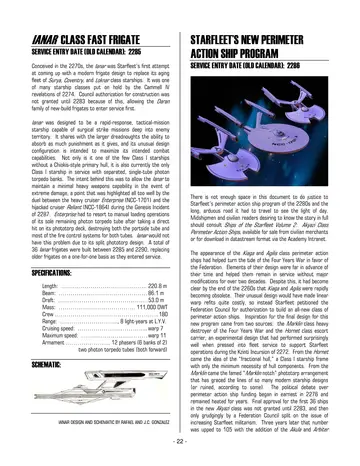
Ianar was designed to be a rapid-response, tactical-mission starship capable of surgical strike missions deep into enemy territory. It shares with the larger dreadnoughts the ability to absorb as much punishment as it gives, and its unusual design configuration is intended to maximize its intended combat capabilities. Not only is it one of the few Class I starships without a Chiokis-style primary hull, it is also currently the only Class I starship in service with separated, single-tube photon torpedo banks. The intent behind this was to allow the Ianar to maintain a minimal heavy weapons capability in the event of extreme damage, a point that was highlighted all too well by the duel between the heavy cruiser Enterprise (NCC-1701) and the hijacked cruiser Reliant (NCC-1864) during the Genesis Incident of 2287. Enterprise had to resort to manual loading operations of its sole remaining photon torpedo tube after taking a direct hit on its phototorp deck, destroying both the portside tube and most of the fire control systems for both tubes. Ianar would not have this problem due to its split phototorp design. A total of 36 Ianar frigates were built between 2285 and 2290, replacing older frigates on a one-for-one basis as they entered service.
SPECIFICATIONS:
Length: …………………………………….. 220.8 m Beam: ……………………………………… 86.1 m Draft: …………………….………………… 53.0 m Mass: ………………………………… 111,000 DWT Crew …………………………………………….. 180 Range: ………………………..., 8 light-years at L.Y.V. Cruising speed: ………………….………….. warp 7 Maximum speed: ………………….………… warp 11 Armament ………………….. 12 phasers (6 banks of 2) two photon torpedo tubes (both forward)
SCHEMATIC:
IANAR DESIGN AND SCHEMATIC BY RAFAEL AND J.C. GONZALEZ STARFLEET’S NEW PERIMETER ACTION SHIP PROGRAM SERVICE ENTRY DATE (OLD CALENDAR): 2286
There is not enough space in this document to do justice to Starfleet’s perimeter action ship program of the 2280s and the long, arduous road it had to travel to see the light of day. Midshipmen and civilian readers desiring to know the story in full should consult Ships of he Starfleet Volume 2: Akyazi Class t Perimeter Action Ships, available for sale from civilian merchants or for download in datastream format via the Academy Intranet.
The appearance of the Kiaga and Agilis class perimeter action ships had helped turn the tide of the Four Years War in favor of the Federation. Elements of their design were far in advance of their time and helped them remain in service without major modifications for over two decades. Despite this, it had become clear by the end of the 2260s that Kiaga and Agilis were rapidly becoming obsolete. Their unusual design would have made linear warp refits quite costly, so instead Starfleet petitioned the Federation Council for authorization to build an all-new class of perimeter action ships. Inspiration for the final design for this new program came from two sources: the Marklin class heavy destroyer of the Four Years War and the Hornet class escort carrier, an experimental design that had performed surprisingly well when pressed into fleet service to support Starfleet operations during the Kzinti Incursion of 2272. From the Hornet came the idea of the “fractional hull,” a Class I starship frame with only the minimum necessity of hull components. From the Marklin came the famed “Marklin notch” phototorp arrangement that has graced the lines of so many modern starship designs (or ruined, according to some). The political debate over perimeter action ship funding began in earnest in 2276 and remained heated for years. Final approval for the first 36 ships in the new Akyazi class was not granted until 2283, and then only grudgingly by a Federation Council split on the issue of increasing Starfleet militarism. Three years later that number was upped to 105 with the addition of the Akula and Arbiter
- 22 -
sub-classes, both quickly authorized in light of the Genesis Incident and increasing Klingon aggression.
To the casual observer a modern perimeter action ship resembles the mere skeleton of a Class I starship. Entire sections of its primary hull and engineering support frame are missing, and its design-specific LN-90 linear warp engines add to the ship’s decided “chop shop” look. Therein lies the design’s success. Perimeter action ships are not built for long-duration voyages, so they do not need large interior spaces devoted to cargo, provisions, large-scale fabricators and replicators, recycling facilities, and all of the other spaces and support systems essential to normal starship operations. They are designed exclusively for combat patrols within contested regions of space, operating either in conjunction with regular Starfleet units or from a nearby base. It is from these that perimeter action ships are maintained and provisioned, usually with only enough stores and supplies for the mission at hand. The rest of the ship, save for necessary crew and command spaces, is all weapons, power, and control systems. Lightening the load by eliminating non-critical systems and spaces also has the direct effect of considerably reducing a perimeter action ship’s mass. A typical modern-day Class I starship has an average mass in the 150,000 to 200,000 DWT range. A typical Class I perimeter action ship, on the other hand, has on the average only onethird the mass of a typical Class I starship. This directly translates into increased speed and maneuverability, far more than would a Class I starship of comparable size. In fact the Arbiter class perimeter action ships currently hold the Federation warp speed record, recording a sustained “burst” velocity of warp 21.5 for one full hour before mounting frame stresses mandated a reduction in speed.
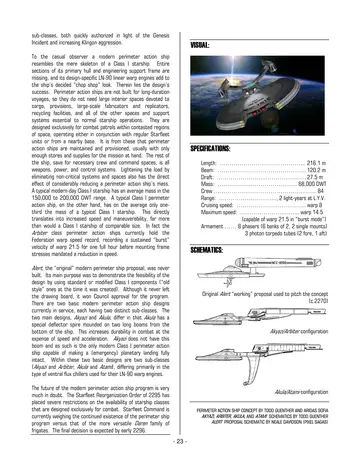
Alert, the “original” modern perimeter ship proposal, was never built. Its main purpose was to demonstrate the feasibility of the design by using standard or modified Class I components (“old style” ones at the time it was created). Although it never left the drawing board, it won Council approval for the program. There are two basic modern perimeter action ship designs currently in service, each having two distinct sub-classes. The two main designs, Akyazi and Akula, differ in that Akula has a special deflector spire mounded on two long booms from the bottom of the ship. This increases durability in combat at the expense of speed and acceleration. Akyazi does not have this boom and as such is the only modern Class I perimeter action ship capable of making a (emergency) planetary landing fully intact. Within these two basic designs are two sub-classes (Akyazi and Arbiter, Akula and Atami), differing primarily in the type of ventral flux chillers used for their LN-90 warp engines.
The future of the modern perimeter action ship program is very much in doubt. The Starfleet Reorganization Order of 2295 has placed severe restrictions on the availability of starship classes that are designed exclusively for combat. Starfleet Command is currently weighing the continued existence of the perimeter ship program versus that of the more versatile Daran family of frigates. The final decision is expected by early 2296. VISUAL:
SPECIFICATIONS:
Length: …………………………………….. 216.1 m Beam: ……………………………………… 120.2 m Draft: …………………….………………… 27.5 m Mass: ………………………………….. 68,000 DWT Crew …………………………………………….. 84 Range: ………………………..., 2 light-years at L.Y.V. Cruising speed: ………………….………….. warp 8 Maximum speed: ………………….……... warp 14.5 (capable of warp 21.5 in “burst mode”) Armament …… 8 phasers (6 banks of 2, 2 single mounts) 3 photon torpedo tubes (2 fore, 1 aft)
SCHEMATICS:
Original Alert “working” proposal used to pitch the concept (c.2270)
Akyazi/Arbiter configuration
Akula/Atami configuration
PERIMETER ACTION SHIP CONCEPT BY TODD GUENTHER AND ARIDAS SOFIA AKYAZI, ARBITER, AKULA, AND ATAMI SCHEMATICS BY TODD GUENTHER ALERT PROPOSAL SCHEMATIC BY NEALE DAVIDSON (PIXEL SAGAS)
- 23 -