4.1 The Earth-Kzin Wars: Overview
2049-2065: The Earth-Kzin Wars In 2048 humanity got their first contact with an intelligent, non-terrestrial, non-human species that certain
2049-2065: The Earth-Kzin Wars
In 2048 humanity got their first contact with an intelligent, non-terrestrial, non-human species that certain of its members had for so long desired. They had hoped, prayed, built their dreams on such an encounter, imagining it to be a benevolent and peaceful exchange with a rational, highly advanced alien race that would accept humanity for the stumbling yet promising species that it was.
What they got instead were the Kzinti.
The Earth-Kzin Wars were a bloody landmark in humanity’s quest for the stars. They were a brutal wake-up call to the fact that not all aliens were going to be the benevolent and peaceful species for who New Age types had for so long yearned. Like every species before them who had run afoul of Kzin, humanity had a simple choice. It could either be conquered or fight to survive. Humanity understandably chose the latter. What made them different from almost other cultures that had made the same choice, though, was that they took it one step further. They took the war to the Kzinti. They fought back with a determination and savagery that rivaled that of their feline foes. At the same time, however, they managed to keep from falling into the well of martial depravity for which the Kzinti were legend. Somehow, despite everything they suffered, humanity never lost its nobility, its compassion, its sense of justice balanced with mercy.
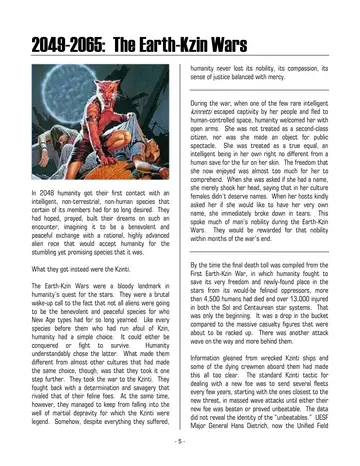
During the war, when one of the few rare intelligent kzinretti escaped captivity by her people and fled to human-controlled space, humanity welcomed her with open arms. She was not treated as a second-class citizen, nor was she made an object for public spectacle. She was treated as a true equal, an intelligent being in her own right no different from a human save for the fur on her skin. The freedom that she now enjoyed was almost too much for her to comprehend. When she was asked if she had a name, she merely shook her head, saying that in her culture females didn’t deserve names. When her hosts kindly asked her if she would like to have her very own name, she immediately broke down in tears. This spoke much of man’s nobility during the Earth-Kzin Wars. They would be rewarded for that nobility within months of the war’s end.
By the time the final death toll was compiled from the First Earth-Kzin War, in which humanity fought to save its very freedom and newly-found place in the stars from its would-be felinoid oppressors, more than 4,500 humans had died and over 13,000 injured in both the Sol and Centaurean star systems. That was only the beginning. It was a drop in the bucket compared to the massive casualty figures that were about to be racked up. There was another attack wave on the way and more behind them.
Information gleaned from wrecked Kzinti ships and some of the dying crewmen aboard them had made this all too clear. The standard Kzinti tactic for dealing with a new foe was to send several fleets every few years, starting with the ones closest to the new threat, in massed wave attacks until either their new foe was beaten or proved unbeatable. The data did not reveal the identity of the “unbeatables.” UESF Major General Hans Dietrich, now the Unified Field
- 5 -
Commander of both Terran and Centaurean forces, wanted to make clear to the Kzinti that humanity were definitely among the “unbeatables.” He therefore began planning a long-term strategy designed to put the Kzinti out of action as soon as possible. In the short term this meant quickly rebuilding the combined fleets and filling them with new ships that had the armament and maneuverability to deal with their foe. In the long term this meant finding a way to strike at the Kzinti so as to break up their staggered massed-wave tactics. The first part was easy, relatively speaking. The second part would be harder, given that Terran ships were still limited to sublight velocities. Zefram Cochrane’s new warp drive wouldn’t become practical for at least another decade, given current estimates, and by then it might be too late. Another way had to be found to short-circuit the Kzin battle plan before their sheer numbers finally took their toll on Dietrich’s available resources.
Perhaps the most important discovery of the war at this time was made while Terran and Centaurean scientists were reverse-engineering captured Kzinti technology. They learned that the Kzin already possessed a form of warp drive. It was crude and incapable of sustained use. Instead, Kzinti ships would “jump” from point to point and then spend a fair amount of time in between recharging their engines for the next jump. This explained why they could travel anywhere they wanted in the Local Group within two years’ time. It was officially dubbed the continuum distortion propulsion (CDP) generator after current Terran experiments along the same lines. It was similar to the CDP generator technology that was being tested at Kashishowa Station prior to its destruction in 2053. Most humans called it the “jump drive” for short. Kzinti energy generation technology was roughly on the same level as humanity’s, though, which meant that the engines of their ships simply weren’t up to the massive power requirements involved for sustained crusing. This was the basic operating princible behind the “jump drive.”
When a captured Kzinti officer was asked how they came up with the CDP engine, he is said to have smiled and then snarled, “We didn’t. The pig-men did. We took it from them. Made them build it for us. But that was long ago. We fight you now. You will meet them soon, when you lie beside their bones on our dinner tables. Softskins like you, but with hair like us and hooves for claws. Very fat. Very tasty.” The full import of his words would not be understood until first contact was made with the Tellarites in 2073.
Much has been made by the historians of Operation Rock Drop, the incredible event that brought an end to the Third Earth-Kzin War. It would have been impossible to achieve, let alone attempt, had it not been for the alien device found at Sidonia on Mars decades earlier. After years of others failing to unlock its mysteries, General Dietrich’s new scientific advisor somehow managed to discern its purpose. It was an artificial wormhole generator, the first (and still only) ever discovered by man, designed to open a tunnel in space from one point to another. No one knew why the Builders had left it behind, nor did General Dietrich frankly care. Dietrich also remembered an asteroid in orbit around the Sol System, that at one time had been a comet and was fitted with fusion engines to keep it from hitting Terra. He had in his hands both the means and method to deal the Kzinti a crushing, possibly fatal blow, provided a way could be found to power and operate the device. Dietrich was not surprised when his new scientific advisor, a man of considerable genius, quickly found a way to make the device operational. Thus was Operation Rock Drop born.
Any future plans Dietrich might have had for his new device were shattered when a Kzinti battle fleet - 6 -
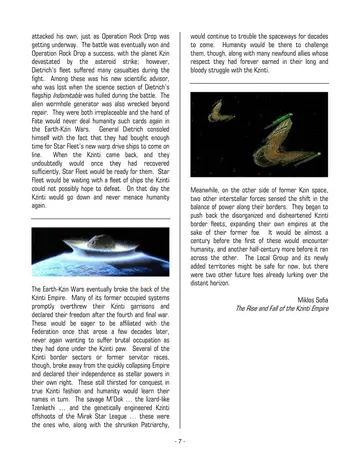
attacked his own, just as Operation Rock Drop was getting underway. The battle was eventually won and Operation Rock Drop a success, with the planet Kzin devastated by the asteroid strike; however, Dietrich’s fleet suffered many casualties during the fight. Among these was his new scientific advisor, who was lost when the science section of Dietrich’s flagship Indomitable was hulled during the battle. The alien wormhole generator was also wrecked beyond repair. They were both irreplaceable and the hand of Fate would never deal humanity such cards again in the Earth-Kzin Wars. General Dietrich consoled himself with the fact that they had bought enough time for Star Fleet’s new warp drive ships to come on line. When the Kzinti came back, and they undoubtedly would once they had recovered sufficiently, Star Fleet would be ready for them. Star Fleet would be waiting with a fleet of ships the Kzinti could not possibly hope to defeat. On that day the Kzinti would go down and never menace humanity again.
The Earth-Kzin Wars eventually broke the back of the Kzinti Empire. Many of its former occupied systems promptly overthrew their Kzinti garrisons and declared their freedom after the fourth and final war. These would be eager to be affiliated with the Federation once that arose a few decades later, never again wanting to suffer brutal occupation as they had done under the Kzinti paw. Several of the Kzinti border sectors or former servitor races, though, broke away from the quickly collapsing Empire and declared their independence as stellar powers in their own right. These still thirsted for conquest in true Kzinti fashion and humanity would learn their names in turn. The savage M’Dok … the lizard-like Tzenkethi … and the genetically engineered Kzinti offshoots of the Mirak Star League … these were the ones who, along with the shrunken Patriarchy, would continue to trouble the spaceways for decades to come. Humanity would be there to challenge them, though, along with many newfound allies whose respect they had forever earned in their long and bloody struggle with the Kzinti.
Meanwhile, on the other side of former Kzin space, two other interstellar forces sensed the shift in the balance of power along their borders. They began to push back the disorganized and disheartened Kzinti border fleets, expanding their own empires at the sake of their former foe. It would be almost a century before the first of these would encounter humanity, and another half-century more before it ran across the other. The Local Group and its newly added territories might be safe for now, but there were two other future foes already lurking over the distant horizon.
Miklos Sofia The Rise and Fall of the Kzinti Empire
- 7 -