3.2 Galileo Class Transport
A profile of the rugged, long-serving Galileo class transport of the First Great Space Rush, presented alongside the ISA’s Ares IV Mars survey probe that was lost to a spatial anomaly in 2032, with specifications for both.
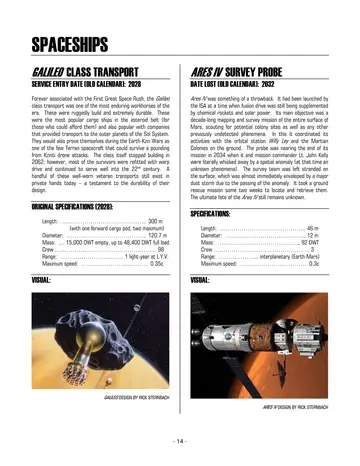
Forever associated with the First Great Space Rush, the Galileo class transport was one of the most enduring workhorses of the era. These were ruggedly build and extremely durable. These were the most popular cargo ships in the asteroid belt (for those who could afford them) and also popular with companies that provided transport to the outer planets of the Sol System. They would also prove themselves during the Earth-Kzin Wars as one of the few Terran spacecraft that could survive a pounding from Kzinti drone attacks. The class itself stopped building in 2062; however, most of the survivors were refitted with warp drive and continued to serve well into the 22nd century. A handful of these well-worn veteran transports still exist in private hands today – a testament to the durability of their design.
Service entry date (old calendar): 2028.
Original Specifications (2028)
- Length: 300 m (with one forward cargo pod, two maximum)
- Diameter: 120.7 m
- Mass: 15,000 DWT empty, up to 48,400 DWT full load
- Crew: 98
- Range: 1 light-year at L.Y.V.
- Maximum speed: 0.35c
Ares IV Survey Probe
Ares IV was something of a throwback. It had been launched by the ISA at a time when fusion drive was still being supplemented by chemical rockets and solar power. Its main objective was a decade-long mapping and survey mission of the entire surface of Mars, scouting for potential colony sites as well as any other previously undetected phenomena. In this it coordinated its activities with the orbital station Willy Ley and the Martian Colonies on the ground. The probe was nearing the end of its mission in 2034 when it and mission commander Lt. John Kelly were literally whisked away by a spatial anomaly (at that time an unknown phenomena). The survey team was left stranded on the surface, which was almost immediately enveloped by a major dust storm due to the passing of the anomaly. It took a ground rescue mission some two weeks to locate and retrieve them. The ultimate fate of the Ares IV still remains unknown.
Date lost (old calendar): 2032.
- Length: 46 m
- Diameter: 12 m
- Mass: 92 DWT
- Crew: 3
- Range: interplanetary (Earth-Mars)
- Maximum speed: 0.3c