9.4 Terran Explorations: Hydra II
A feature on Hydra II, the first of only two pelagic planets ever discovered within Federation space, describes the young waterworld, its origins, its friendly aquatic humanoid natives the Hydrans and their Coral Castles and Water Ballet, the Lonely Isles surface port, and the planet's physical specifications.
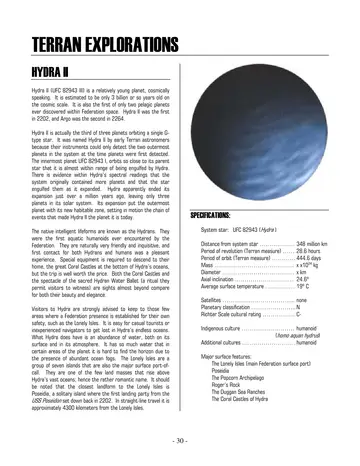
Hydra II (UFC 82943 III) is a relatively young planet, cosmically speaking. It is estimated to be only 3 billion or so years old on the cosmic scale. It is also the first of only two pelagic planets ever discovered within Federation space. Hydra II was the first in 2202, and Argo was the second in 2264.
Hydra II is actually the third of three planets orbiting a single G-type star. It was named Hydra II by early Terran astronomers because their instruments could only detect the two outermost planets in the system at the time planets were first detected. The innermost planet UFC 82943 I, orbits so close to its parent star that it is almost within range of being engulfed by Hydra. There is evidence within Hydra's spectral readings that the system originally contained more planets and that the star engulfed them as it expanded. Hydra apparently ended its expansion just over a million years ago, leaving only three planets in its solar system. Its expansion put the outermost planet in its new habitable zone, setting in motion the chain of events that made Hydra II the planet it is today.
The native intelligent lifeforms are known as the Hydrans. They were the first aquatic humanoids ever encountered by the Federation. They are naturally very friendly and inquisitive, and first contact for both Hydrans and humans was a pleasant experience. Special equipment is required to descend to their home, the great Coral Castles at the bottom of Hydra's oceans, but the trip is well worth the price. Both the Coral Castles and the spectacle of the sacred Hydran Water Ballet (a ritual they permit visitors to witness) are sights almost beyond compare for both their beauty and elegance.
Visitors to Hydra are strongly advised to keep to those few areas where a Federation presence is established for their own safety, such as the Lonely Isles. It is easy for casual tourists or experienced navigators to get lost in Hydra's endless oceans. What Hydra does have is an abundance of water, both on its surface and in its atmosphere. It has so much water that in certain areas of the planet it is hard to find the horizon due to the presence of abundant ocean fogs. The Lonely Isles are a group of seven islands that are also the major surface port-of-call. They are one of the few land masses that rise above Hydra's vast oceans; hence the rather romantic name. It should be noted that the closest landform to the Lonely Isles is Poseidia, a solitary island where the first landing party from the USS Poseidon set down back in 2202. In straight-line travel it is approximately 4300 kilometers from the Lonely Isles.
Specifications:
- System star: UFC 82943 (Hydra)
- Distance from system star: 348 million km
- Period of revolution (Terran measure): 28.6 hours
- Period of orbit (Terran measure): 444.6 days
- Average surface temperature: 19° C
- Satellites: none
- Planetary classification: N
- Richter Scale cultural rating: C
- Indigenous culture: humanoid (homo aquan hydrus)
Major surface features:
- The Lonely Isles (main Federation surface port)
- Poseidia
- The Popcorn Archipelago
- Roger's Rock
- The Duggan Sea Ranches
- The Coral Castles of Hydra