3.10 Historical Articles
A collection of in-universe news articles chronicles the era, from acid rain on terraforming Venus and the first detected alien signals to the loss of Ares IV and the Charybdis, the discovery of geon holes and dilithium, the luxury spaceliner Prince of Wales, the fabricated Khan cover story, first contact at Alpha Centauri, and the UESF’s costly victory over the Kzinti.
Acid Rain Falls on Venus
UNS News Wire – 5 January 2027.
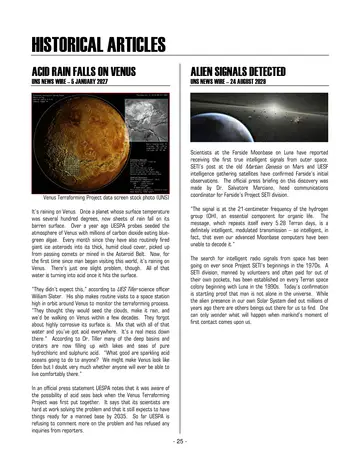
It’s raining on Venus. Once a planet whose surface temperature was several hundred degrees, now sheets of rain fall on its barren surface. Over a year ago UESPA probes seeded the atmosphere of Venus with millions of carbon dioxide eating blue-green algae. Every month since they have also routinely fired giant ice asteroids into its thick, humid cloud cover, picked up from passing comets or mined in the Asteroid Belt. Now, for the first time since man began visiting this world, it’s raining on Venus. There’s just one slight problem, though. All of that water is turning into acid once it hits the surface.
“They didn’t expect this,” according to UES Tiller science officer William Slater. His ship makes routine visits to a space station high in orbit around Venus to monitor the terraforming process. “They thought they would seed the clouds, make it rain, and we’d be walking on Venus within a few decades. They forgot about highly corrosive its surface is. Mix that with all of that water and you’ve got acid everywhere. It’s a real mess down there.” According to Dr. Tiller many of the deep basins and craters are now filling up with lakes and seas of pure hydrochloric and sulphuric acid. “What good are sparkling acid oceans going to do to anyone? We might make Venus look like Eden but I doubt very much whether anyone will ever be able to live comfortably there.”
In an official press statement UESPA notes that it was aware of the possibility of acid seas back when the Venus Terraforming Project was first put together. It says that its scientists are hard at work solving the problem and that it still expects to have things ready for a manned base by 2035. So far UESPA is refusing to comment more on the problem and has refused any inquiries from reporters.
Alien Signals Detected
UNS News Wire – 24 August 2029.
Scientists at the Farside Moonbase on Luna have reported receiving the first true intelligent signals from outer space. SETI’s post at the old Martian Genesis on Mars and UESF intelligence gathering satellites have confirmed Farside’s initial observations. The official press briefing on this discovery was made by Dr. Salvatore Marciano, head communications coordinator for Farside’s Project SETI division.
“The signal is at the 21-centimeter frequency of the hydrogen group (OH), an essential component for organic life. The message, which repeats itself every 5.28 Terran days, is a definitely intelligent, modulated transmission – so intelligent, in fact, that even our advanced Moonbase computers have been unable to decode it.”
The search for intelligent radio signals from space has been going on ever since Project SETI’s beginnings in the 1970s. A SETI division, manned by volunteers and often paid for out of their own pockets, has been established on every Terran space colony beginning with Luna in the 1990s. Today’s confirmation is startling proof that man is not alone in the universe. While the alien presence in our own Solar System died out millions of years ago there are others beings out there for us to find. One can only wonder what will happen when mankind’s moment of first contact comes upon us.
Spatial Anomaly Swallows Ares IV
MBS (Mars Broadcast Service) Newsline – 19 October 2032.
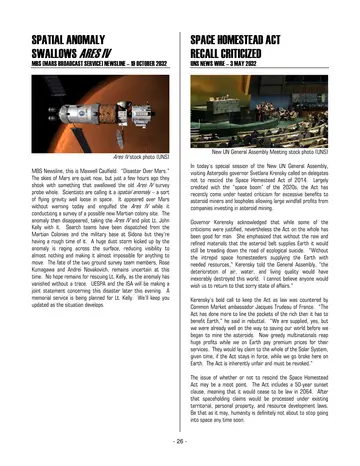
MBS Newsline, this is Maxwell Caulfield. “Disaster Over Mars.” The skies of Mars are quiet now, but just a few hours ago they shook with something that swallowed the old Ares IV survey probe whole. Scientists are calling it a spatial anomaly – a sort of flying gravity well loose in space. It appeared over Mars without warning today and engulfed the Ares IV while it conductiong a survey of a possible new Martian colony site. The anomaly then disappeared, taking the Ares IV and pilot Lt. John Kelly with it. Search teams have been dispatched from the Martian Colonies and the military base at Sidona but they’re having a rough time of it. A huge dust storm kicked up by the anomaly is raging across the surface, reducing visibility to almost nothing and making it almost impossible for anything to move. The fate of the two ground survey team members, Rose Kumagawa and Andrei Novakovich, remains uncertain at this time. No hope remains for rescuing Lt. Kelly, as the anomaly has vanished without a trace. UESPA and the ISA will be making a joint statement concerning this disaster later this evening. A memorial service is being planned for Lt. Kelly. We’ll keep you updated as the situation develops.
Space Homestead Act Recall Criticized
UNS News Wire – 3 May 2032.
In today’s special session of the New UN General Assembly, visiting Asterpolis governor Svetlana Krensky called on delegates not to rescind the Space Homestead Act of 2014. Largely credited with the “space boom” of the 2020s, the Act has recently come under heated criticism for excessive benefits to asteroid miners and loopholes allowing large windfall profits from companies investing in asteroid mining.
Governor Kerensky acknowledged that while some of the criticisms were justified, nevertheless the Act on the whole has been good for man. She emphasized that without the raw and refined materials that the asteroid belt supplies Earth it would still be treading down the road of ecological suicide. “Without the intrepid space homesteaders supplying the Earth with needed resources,” Kerensky told the General Assembly, “the deterioration of air, water, and living quality would have inexorably destroyed this world. I cannot believe anyone would wish us to return to that sorry state of affairs.”
Kerensky’s bold call to keep the Act as law was countered by Common Market ambassador Jacques Trudeau of France. “The Act has done more to line the pockets of the rich than it has to benefit Earth,” he said in rebuttal. “We are supplied, yes, but we were already well on the way to saving our world before we began to mine the asteroids. Now greedy multinationals reap huge profits while we on Earth pay premium prices for their services. They would lay claim to the whole of the Solar System, given time, if the Act stays in force, while we go broke here on Earth. The Act is inherently unfair and must be revoked.”
The issue of whether or not to rescind the Space Homestead Act may be a moot point. The Act includes a 50-year sunset clause, meaning that it would cease to be law in 2064. After that spaceholding claims would be processed under existing territorial, personal property, and resource development laws. Be that as it may, humanity is definitely not about to stop going into space any time soon.
AFP-1 Sabotaged, Pilot Dies
UNS News Wire – 12 February 2035.
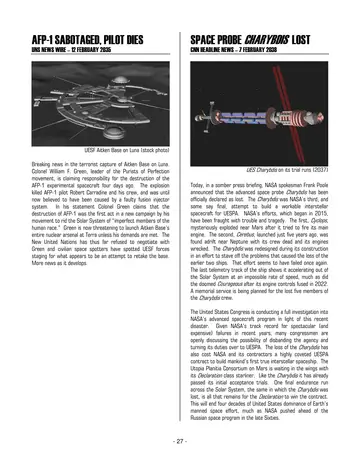
Breaking news in the terrorist capture of Aitken Base on Luna. Colonel William F. Green, leader of the Purists of Perfection movement, is claiming responsibility for the destruction of the AFP-1 experimental spacecraft four days ago. The explosion killed AFP-1 pilot Robert Carradine and his crew, and was until now believed to have been caused by a faulty fusion injector system. In his statement Colonel Green claims that the destruction of AFP-1 was the first act in a new campaign by his movement to rid the Solar System of “imperfect members of the human race.” Green is now threatening to launch Aitken Base’s entire nuclear arsenal at Terra unless his demands are met. The New United Nations has thus far refused to negotiate with Green and civilian space spotters have spotted UESF forces staging for what appears to be an attempt to retake the base. More news as it develops.
Space Probe Charybdis Lost
CNN Headline News – 7 February 2038.
Today, in a somber press briefing, NASA spokesman Frank Poole announced that the advanced space probe Charybdis has been officially declared as lost. The Charybdis was NASA’s third, and some say final, attempt to build a workable interstellar spacecraft for UESPA. NASA’s efforts, which began in 2015, have been fraught with trouble and tragedy. The first, Cyclops, mysteriously exploded near Mars after it tried to fire its main engine. The second, Cerebus, launched just five years ago, was found adrift near Neptune with its crew dead and its engines wrecked. The Charybdis was redesigned during its construction in an effort to stave off the problems that caused the loss of the earlier two ships. That effort seems to have failed once again. The last telemetry track of the ship shows it accelerating out of the Solar System at an impossible rate of speed, much as did the doomed Courageous after its engine controls fused in 2022. A memorial service is being planned for the lost five members of the Charybdis crew.
The United States Congress is conducting a full investigation into NASA’s advanced spacecraft program in light of this recent disaster. Given NASA’s track record for spectacular (and expensive) failures in recent years, many congressmen are openly discussing the possibility of disbanding the agency and turning its duties over to UESPA. The loss of the Charybdis has also cost NASA and its contractors a highly coveted UESPA contract to build mankind’s first true interstellar spaceship. The Utopia Planitia Consortium on Mars is waiting in the wings with its Declaration class starliner. Like the Charybdis it has already passed its initial acceptance trials. One final endurance run across the Solar System, the same in which the Charybdis was lost, is all that remains for the Declaration to win the contract. This will end four decades of United States dominance of Earth’s manned space effort, much as NASA pushed ahead of the Russian space program in the late Sixties.
Geon Holes Allow Communications in Space
UNS News Wire – 19 May 2036.
Geon holes. You can’t drop a rock down them, but you can talk through them. That’s what UESPA scientists are saying today in announcing a discovery that could revolutionize space travel communications.
The biggest problem to date in talking with a ship in space is the time factor. The farther away you get, the long it takes for a regular radio signal to reach the ship. Communication times for ships on the edge of the Solar System are in the order of years. This month’s discovery by the space probe Drake will change all that for the better.
A geon hole is a natural pinpoint void in the fabric of space. Inside a geon hole is a realm contrary to the laws of physics – a wormhole – that allows energy to travel faster than the speed of light. When the Drake probed the geon hole it found with its sensors, its signals were instantly picked up by the UESF base on Titan at the same time that the probe transmitted them. This would also seem to indicate that most likely location of a geon hole is near large masses with high gravity, such as suns and planets.
“You didn’t find them before because you weren’t looking for them,” said quirksome UESPA science advisor Dr. John Smith in a recent interview. “Now that you’ve found them you can talk in space without having to wait years for an answer. All you have to do is find the right geon hole, and presto! Instant space communications.” Dr. Smith remained evasive as to how useful geon holes would eventually prove. “Like I said, you have to find the right hole. Pick the wrong one and you might be talking to a sun on the far side of the galaxy – or worse. It should do, though, once you figure it out, until you come up with a better means of talking in space … and you will, trust me.”
Luxury in the Stars
UNS News Wire – 20 June 2040.
She’s the first in a new type of spaceship some are calling the space liner. She’s the SS Prince of Wales, the first in a new breed of spaceship built and operated by Solar Spaceways for the enjoyment of tourists systemwide.
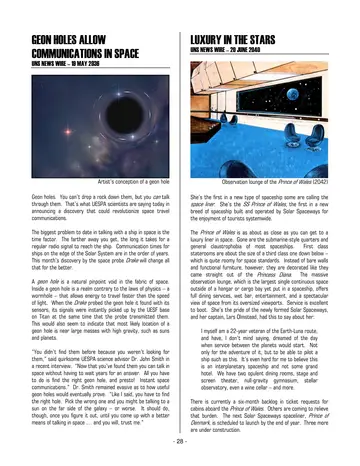
The Prince of Wales is as about as close as you can get to a luxury liner in space. Gone are the submarine-style quarters and general claustrophobia of most spaceships. First class staterooms are about the size of a third class one down below – which is quite roomy for space standards. Instead of bare walls and functional furniture, however, they are decorated like they came straight out of the Princess Diana. The massive observation lounge, which is the largest single continuous space outside of a hangar or cargo bay yet put in a spaceship, offers full dining services, wet bar, entertainment, and a spectacular view of space from its oversized viewports. Service is excellent to boot. She’s the pride of the newly formed Solar Spaceways, and her captain, Lars Olmstead, had this to say about her:
I myself am a 22-year veteran of the Earth-Luna route, and have, I don’t mind saying, dreamed of the day when service between the planets would start. Not only for the adventure of it, but to be able to pilot a ship such as this. It’s even hard for me to believe this is an interplanetary spaceship and not some grand hotel. We have two opulent dining rooms, stage and screen theater, null-gravity gymnasium, stellar observatory, even a wine cellar – and more.
There is currently a six-month backlog in ticket requests for cabins aboard the Prince of Wales. Others are coming to relieve that burden. The next Solar Spaceways spaceliner, Prince of Denmark, is scheduled to launch by the end of year. Three more are under construction.
First Base on Venus
Universe Today Magazine – Week of 11 February 2047. Extract from an article by Thomas Corbett.
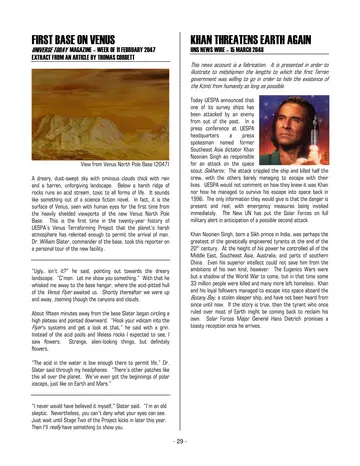
A dreary, dust-swept sky with ominous clouds thick with rain and a barren, unforgiving landscape. Below a harsh ridge of rocks runs an acid stream, toxic to all forms of life. It sounds like something out of a science fiction novel. In fact, it is the surface of Venus, seen with human eyes for the first time from the heavily shielded viewports of the new Venus North Pole Base. This is the first time in the twenty-year history of UESPA’s Venus Terraforming Project that the planet’s harsh atmosphere has relented enough to permit the arrival of man. Dr. William Slater, commander of the base, took this reporter on a personal tour of the new facility.
“Ugly, isn’t it?” he said, pointing out towards the dreary landscape. “C’mon. Let me show you something.” With that he whisked me away to the base hangar, where the acid-pitted hull of the Venus Flyer awaited us. Shortly thereafter we were up and away, zooming though the canyons and clouds.
About fifteen minutes away from the base Slater began circling a high plateau and pointed downward. “Hook your vidicam into the Flyer’s systems and get a look at that,” he said with a grin. Instead of the acid pools and lifeless rocks I expected to see, I saw flowers. Strange, alien-looking things, but definitely flowers.
“The acid in the water is low enough there to permit life,” Dr. Slater said through my headphones. “There’s other patches like this all over the planet. We’ve even got the beginnings of polar icecaps, just like on Earth and Mars.”
“I never would have believed it myself,” Slater said. “I’m an old skeptic. Nevertheless, you can’t deny what your eyes can see. Just wait until Stage Two of the Project kicks in later this year. Then I’ll really have something to show you.”
Khan Threatens Earth Again
UNS News Wire – 15 March 2048. This news account is a fabrication. It is presented in order to illustrate to midshipmen the lengths to which the first Terran government was willing to go in order to hide the existence of the Kzinti from humanity as long as possible.
Today UESPA announced that one of its survey ships has been attacked by an enemy from out of the past. In a press conference at UESPA headquarters a press spokesman named former Southeast Asia dictator Khan Noonien Singh as responsible for an attack on the space scout Sakharov. The attack crippled the ship and killed half the crew, with the others barely managing to escape with their lives. UESPA would not comment on how they knew it was Khan nor how he managed to survive his escape into space back in 1996. The only information they would give is that the danger is present and real, with emergency measures being invoked immediately. The New UN has put the Solar Forces on full military alert in anticipation of a possible second attack.
Khan Noonien Singh, born a Sikh prince in India, was perhaps the greatest of the genetically engineered tyrants at the end of the 20th century. At the height of his power he controlled all of the Middle East, Southeast Asia, Australia, and parts of southern China. Even his superior intellect could not save him from the ambitions of his own kind, however. The Eugenics Wars were but a shadow of the World War to come, but in that time some 33 million people were killed and many more left homeless. Khan and his loyal followers managed to escape into space aboard the Botany Bay, a stolen sleeper ship, and have not been heard from since until now. If the story is true, then the tyrant who once ruled over most of Earth might be coming back to reclaim his own. Solar Forces Major General Hans Dietrich promises a toasty reception once he arrives.
Life Found on Alpha Centauri
MBS Newsline – 2048.
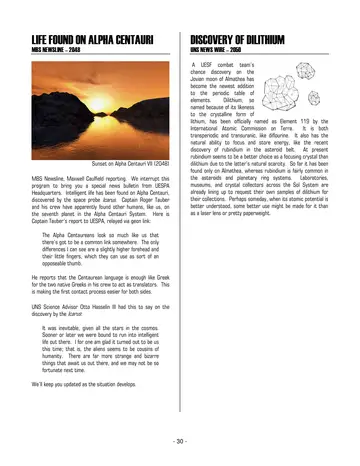
MBS Newsline, Maxwell Caulfield reporting. We interrupt this program to bring you a special news bulletin from UESPA Headquarters. Intelligent life has been found on Alpha Centauri, discovered by the space probe Icarus. Captain Roger Tauber and his crew have apparently found other humans, like us, on the seventh planet in the Alpha Centauri System. Here is Captain Tauber’s report to UESPA, relayed via geon link:
The Alpha Centaureans look so much like us that there’s got to be a common link somewhere. The only differences I can see are a slightly higher forehead and their little fingers, which they can use as sort of an opposeable thumb.
He reports that the Centaurean language is enough like Greek for the two native Greeks in his crew to act as translators. This is making the first contact process easier for both sides.
UNS Science Advisor Otto Hasselin III had this to say on the discovery by the Icarus:
It was inevitable, given all the stars in the cosmos. Sooner or later we were bound to run into intelligent life out there. I for one am glad it turned out to be us this time; that is, the aliens seems to be cousins of humanity. There are far more strange and bizarre things that await us out there, and we may not be so fortunate next time.
We’ll keep you updated as the situation develops.
Discovery of Dilithium
UNS News Wire – 2050.
A UESF combat team’s chance discovery on the Jovian moon of Almathea has become the newest addition to the periodic table of elements. Dilithium, so named because of its likeness to the crystalline form of lithium, has been officially named as Element 119 by the International Atomic Commission on Terra. It is both transperiodic and transuranic, like diflourine. It also has the natural ability to focus and store energy, like the recent discovery of rubindium in the asteroid belt. At present rubindium seems to be a better choice as a focusing crystal than dilithium due to the latter’s natural scarcity. So far it has been found only on Almathea, whereas rubindium is fairly common in the asteroids and planetary ring systems. Laboratories, museums, and crystal collectors across the Sol System are already lining up to request their own samples of dilithium for their collections. Perhaps someday, when its atomic potential is better understood, some better use might be made for it than as a laser lens or pretty paperweight.
UESF Wins War in Space
ABS (American Broadcasting System) Evening News – excerpts from the 11 November 2049 broadcast.
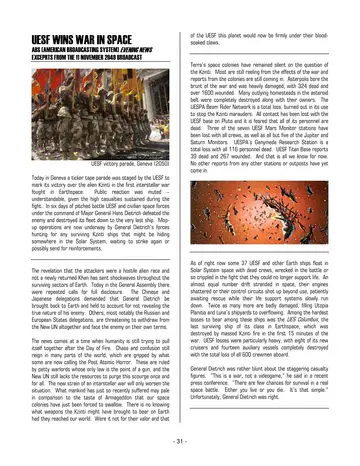
Today in Geneva a ticker tape parade was staged by the UESF to mark its victory over the alien Kzinti in the first interstellar war fought in Earthspace. Public reaction was muted – understandable, given the high casualties sustained during the fight. In six days of pitched battle UESF and civilian space forces under the command of Major General Hans Dietrich defeated the enemy and destroyed its fleet down to the very last ship. Mopup operations are now underway by General Dietrich’s forces hunting for any surviving Kzinti ships that might be hiding somewhere in the Solar System, waiting to strike again or possibly send for reinforcements.
The revelation that the attackers were a hostile alien race and not a newly returned Khan has sent shockwaves throughout the surviving sectors of Earth. Today in the General Assembly there were repeated calls for full disclosure. The Chinese and Japanese delegations demanded that General Dietrich be brought back to Earth and held to account for not revealing the true nature of his enemy. Others, most notably the Russian and European States delegations, are threatening to withdraw from the New UN altogether and face the enemy on their own terms.
The news comes at a time when humanity is still trying to pull itself together after the Day of Fire. Chaos and confusion still reign in many parts of the world, which are gripped by what some are now calling the Post Atomic Horror. These are ruled by petty warlords whose only law is the point of a gun, and the New UN still lacks the resources to purge this scourge once and for all. The new strain of an interstellar war will only worsen the situation. What mankind has just so recently suffered may pale in comparison to the taste of Armageddon that our space colonies have just been forced to swallow. There is no knowing what weapons the Kzinti might have brought to bear on Earth had they reached our world. Were it not for their valor and that of the UESF this planet would now be firmly under their bloodsoaked claws.
Terra’s space colonies have remained silent on the question of the Kzinti. Most are still reeling from the effects of the war and reports from the colonies are still coming in. Asterpolis bore the brunt of the war and was heavily damaged, with 324 dead and over 1600 wounded. Many outlying homesteads in the asteroid belt were completely destroyed along with their owners. The UESPA Beam Rider Network is a total loss, burned out in its use to stop the Kzinti marauders. All contact has been lost with the UESF base on Pluto and it is feared that all of its personnel are dead. Three of the seven UESF Mars Monitor stations have been lost with all crews, as well as all but five of the Jupiter and Saturn Monitors. UESPA’s Ganymede Research Station is a total loss with all 116 personnel dead. UESF Titan Base reports 39 dead and 267 wounded. And that is all we know for now. No other reports from any other stations or outposts have yet come in.
As of right now some 37 UESF and other Earth ships float in Solar System space with dead crews, wrecked in the battle or so crippled in the fight that they could no longer support life. An almost equal number drift stranded in space, their engines shattered or their control circuits shot up beyond use, patiently awaiting rescue while their life support systems slowly run down. Twice as many more are badly damaged, filling Utopia Planitia and Luna’s shipyards to overflowing. Among the hardest losses to bear among these ships was the UES Columbus, the last surviving ship of its class in Earthspace, which was destroyed by massed Kzinti fire in the first 15 minutes of the war. UESF losses were particularly heavy, with eight of its new cruisers and fourteen auxiliary vessels completely destroyed with the total loss of all 600 crewmen aboard.
General Dietrich was rather blunt about the staggering casualty figures. “This is a war, not a videogame,” he said in a recent press conference. “There are few chances for survival in a real space battle. Either you live or you die. It’s that simple.” Unfortunately, General Dietrich was right.