5.3 Conestoga Class Colony Ship
A profile of the Conestoga class, the first warp-capable Terran colony ship designed for a permanent one-way landing on a new world, paired with the homely Merchant class cargo hauler whose lone famous member, the Marco Polo, opened first contact with the Orion colonies at Rigel.
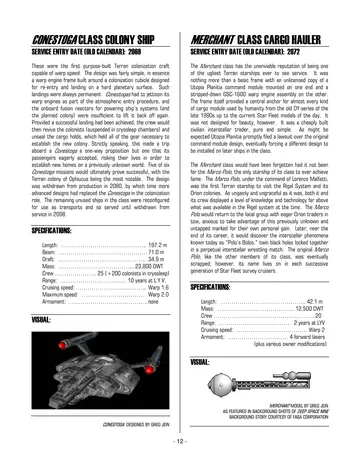
These were the first purpose-built Terran colonization craft capable of warp speed. The design was fairly simple, in essence a warp engine frame built around a colonization cubicle designed for re-entry and landing on a hard planetary surface. Such landings were always permanent. Conestogas had to jettison its warp engines as part of the atmospheric entry procedure, and the onboard fusion reactors for powering ship’s systems (and the planned colony) were insufficient to lift it back off again. Provided a successful landing had been achieved, the crew would then revive the colonists (suspended in cryosleep chambers) and unseal the cargo holds, which held all of the gear necessary to establish the new colony. Strictly speaking, this made a trip aboard a Conestoga a one-way proposition but one that its passengers eagerly accepted, risking their lives in order to establish new homes on a previously unknown world. Five of six Conestoga missions would ultimately prove successful, with the Terran colony of Ophiucus being the most notable. The design was withdrawn from production in 2080, by which time more advanced designs had replaced the Conestoga in the colonization role. The remaining unused ships in the class were reconfigured for use as transports and so served until withdrawn from service in 2098.
Service entry date (old calendar): 2069.
Specifications
- Length: 197.2 m
- Beam: 71.0 m
- Draft: 34.9 m
- Mass: 23,800 DWT
- Crew: 25 (+200 colonists in cryosleep)
- Range: 10 years at L.Y.V.
- Cruising speed: Warp 1.6
- Maximum speed: Warp 2.0
- Armament: none
Merchant Class Cargo Hauler
The Merchant class has the unenviable reputation of being one of the ugliest Terran starships ever to see service. It was nothing more than a basic frame with an unlicensed copy of a Utopia Planitia command module mounted on one end and a stripped-down GSC-1600 warp engine assembly on the other. The frame itself provided a central anchor for almost every kind of cargo module used by humanity from the old DY-series of the late 1990s up to the current Star Fleet models of the day. It was not designed for beauty, however. It was a cheaply built civilian interstellar trader, pure and simple. As might be expected Utopia Planitia promptly filed a lawsuit over the original command module design, eventually forcing a different design to be installed on later ships in the class.
The Merchant class would have been forgotten had it not been for the Marco Polo, the only starship of its class to ever achieve fame. The Marco Polo, under the command of Lorenzo Malfatti, was the first Terran starship to visit the Rigel System and its Orion colonies. As ungainly and ungraceful as it was, both it and its crew displayed a level of knowledge and technology far above what was available in the Rigel system at the time. The Marco Polo would return to the Local Group with eager Orion traders in tow, anxious to take advantage of this previously unknown and untapped market for their own personal gain. Later, near the end of its career, it would discover the interstellar phenomena known today as “Polo’s Bolos,” twin black holes locked together in a perpetual interstellar wrestling match. The original Marco Polo, like the other members of its class, was eventually scrapped; however, its name lives on in each successive generation of Star Fleet survey cruisers.
Service entry date (old calendar): 2072.
Specifications
- Length: 42.1 m
- Mass: 12,500 DWT
- Crew: 20
- Range: 2 years at LYV
- Cruising speed: Warp 2
- Armament: 4 forward lasers (plus various owner modifications)