1.7 Mars Probe One & Heavy-Lift Vehicles
Profiles of the practical DY-100 interplanetary spaceship, the two-ship Mars Probe One expedition to the Red Planet, and the Goliath and competing commercial heavy-lift vehicles, with specifications.
DY-100 Class Spaceship
Service entry date (Old Calendar): 1990
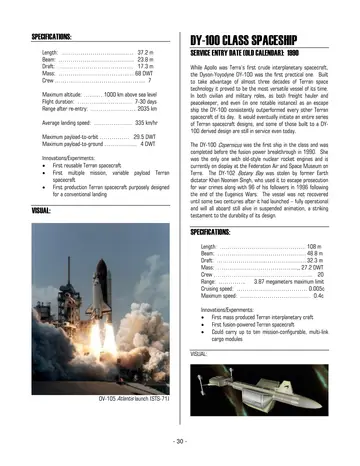
While Apollo was Terra's first crude interplanetary spacecraft, the Dyson-Yoyodyne DY-100 was the first practical one. Built to take advantage of almost three decades of Terran space technology it proved to be the most versatile vessel of its time. In both civilian and military roles, as both freight hauler and peacekeeper, and even (in one notable instance) as an escape ship the DY-100 consistently outperformed every other Terran spacecraft of its day. It would eventually initiate an entire series of Terran spacecraft designs, and some of those built to a DY-100 derived design are still in service even today.
The DY-100 Copernicus was the first ship in the class and was completed before the fusion power breakthrough in 1990. She was the only one with old-style nuclear rocket engines and is currently on display at the Federation Air and Space Museum on Terra. The DY-102 Botany Bay was stolen by former Earth dictator Khan Noonien Singh, who used it to escape prosecution for war crimes along with 96 of his followers in 1996 following the end of the Eugenics Wars. The vessel was not recovered until some two centuries after it had launched – fully operational and with all aboard still alive in suspended animation, a striking testament to the durability of its design.
Specifications: Length 108 m; Beam 48.8 m; Draft 32.3 m; Mass 27.2 DWT; Crew 20; Range 3.87 megameters maximum limit; Cruising speed 0.005c; Maximum speed 0.4c.
Innovations/Experiments:
- First mass produced Terran interplanetary craft
- First fusion-powered Terran spacecraft
- Could carry up to ten mission-configurable, multi-link cargo modules
Mars Probe One
Service entry date (Old Calendar): 1996
Mars Probe One was perhaps the single greatest achievement of America's NASA space agency prior to its absorption into UESPA. It had been known for years that Mars had the greatest potential of any nearby Sol System planet for a Terran colony; however, getting there was the problem. The answer was found in Project Orion, a modernized version of the early NERVA nuclear rocket program. The fact that it would be using a fission powered rocket plus the need to carry stores and equipment for a round trip of three to four years, plus time spent on the surface of Mars, dictated the sheer size of Mars Probe One. This was the main reason why Mars Probe One was built at the Goddard Moonbase instead of on Terra, where Luna's lower gravity would help in such a massive undertaking.
Mars Probe One was actually two ships in one. The Willy Ley served as orbital parent ship while the smaller John Carter made the actual surface landings. The Willy Ley was built a section at a time (as was the Carter), each carried up into space aboard a space shuttle and then ferried to the then-building Goddard Moonbase. A total of 71 such trips were required before Mars Probe One completed construction. The actual pilot module for the Ley only required the first trip; the rest was for the ship's massive superstructure and the ferrying of components for the John Carter lander. An early form of artificial gravity was provided via centrifugal motion generators attached to a single rotating section of the ship. This was the first and last time such a system was ever used in a Terran spacecraft, as more advanced systems became available shortly thereafter. The craft was designed for a 540-day round trip from Terra to Mars and back again. Once construction was approved on a second ship (the Kennedy) this feature became a redundant safety fallback. Its Carter lander carried two one-man rovers, a base camp module, a portable interplanetary transmitter, and enough materials and supplies to build and maintain a surface expedition for six months. These would be left behind on the surface for future missions once the initial survey was done. The resultant empty storage space aboard the Carter was to be filled with rock and soil samples for the trip home to Earth (or so the official report reads; one wonders why they needed so much room for rocks and dirt). The initial flight to Mars took 342 days 11 hours, just over two days longer than initially planned, with Mars orbital insertion achieved on 24 April 1987. A mid-course correction had to be made in order to avoid a previously undetected meteorite, resulting in the delay. The crew of the Carter spent a total of 48 days on the Martian surface. Only 45 had been planned; an extra three were authorized due to problems encountered near the end of the surface expedition. According to official reports the Carter burned too much fuel during its landing approach and several non-critical systems had to be stripped out of the ship in order to lighten the load for takeoff.
Mars Probe One had been originally designed for a Terra-Mars round trip; however, this was changed in mid-mission. A follow-up NASA ship, the John F. Kennedy, arrived in orbit just as Mars Probe One was receiving the last of its survey teams for the trip back to Earth. Both crews returned to Earth aboard the Kennedy. A thoroughly reprovisioned Willy Ley was left in orbit as both waypoint and impromptu space station for the next Terran space mission. It remains there to this day as both museum and monument to this remarkable mission.
The Willy Ley was named for the co-author of the 1956 book The Exploration of Mars, written with the technical input of rocketry pioneer Werhner von Braun. The John Carter was named for a popular fictional character created by Terran author Edgar Rice Burroughs who had a series of adventures on the Red Planet. The John F. Kennedy was named for the famous United States president who started his country up the path towards space.
Specifications: Length 140 m; Beam 22 m; Draft 7.3 m; Mass 19 DWT; Crew 6; Apogee 16,000 km above median surface level; Perigee 3,200 km above median surface level; Flight duration to Mars 342 days 11 hrs.
Innovations/Experiments:
- First Terran spacecraft to reach Mars (Sol IV)
- First Terran expedition to visit Cydonia
Heavy-Lift Vehicles
Service entry date (Old Calendar): c.1996
The Goliath HLV was an idea that had been kicking around NASA ever since the 1960s, when famed German scientist Werhner von Braun first proposed the idea. At the time he had suggested that the massive Saturn rocket designed to carry man to the moon had other uses, such as putting space station components into orbit. The idea would eventually become a reality with Skylab, which was built on a Saturn second stage frame and used a modified Saturn IB rocket to achieve orbit. The space shuttle program was supposed to replace such rockets; however, NASA had little use for such old-fashioned technologies once fusion-powered spacecraft became a reality. The buck was passed to private industry, which already had several ideas of its own on reusable industrial launch vehicles.
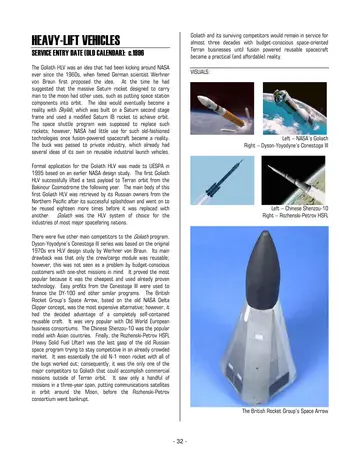
Formal application for the Goliath HLV was made to UESPA in 1995 based on an earlier NASA design study. The first Goliath HLV successfully lifted a test payload to Terran orbit from the Baikonur Cosmodrome the following year. The main body of this first Goliath HLV was retrieved by its Russian owners from the Northern Pacific after its successful splashdown and went on to be reused eighteen more times before it was replaced with another. Goliath was the HLV system of choice for the industries of most major spacefaring nations.
There were five other main competitors to the Goliath program. Dyson-Yoyodyne's Conestoga III series was based on the original 1970s era HLV design study by Werhner von Braun. Its main drawback was that only the crew/cargo module was reusable; however, this was not seen as a problem by budget-conscious customers with one-shot missions in mind. It proved the most popular because it was the cheapest and used already proven technology. Easy profits from the Conestoga III were used to finance the DY-100 and other similar programs. The British Rocket Group's Space Arrow, based on the old NASA Delta Clipper concept, was the most expensive alternative; however, it had the decided advantage of a completely self-contained reusable craft. It was very popular with Old World European business consortiums. The Chinese Shenzhou-10 was the popular model with Asian countries. Finally, the Rozhenski-Petrov HSFL (Heavy Solid Fuel Lifter) was the last gasp of the old Russian space program trying to stay competitive in an already crowded market. It was essentially the old N-1 moon rocket with all of the bugs worked out; consequently, it was the only one of the major competitors to Goliath that could accomplish commercial missions outside of Terran orbit. It saw only a handful of missions in a three-year span, putting communications satellites in orbit around the Moon, before the Rozhenski-Petrov consortium went bankrupt. Goliath and its surviving competitors would remain in service for almost three decades with budget-conscious space-oriented Terran businesses until fusion powered reusable spacecraft became a practical (and affordable) reality.