3.12 Acknowledgements: Volume 3
Author Richard E. Mandel’s closing notes explain his sources and creative choices for the volume—covering Alpha Centauri’s geography, the Charybdis and Columbus designs, the Companion class, and the Kzinti first-contact story—followed by lists of special thanks, Kzinti material credits, visual sources, and contact information.
Author’s Comments
It appears that for the first time in the recorded history of TREK techdom I’ve managed to come up with a somewhat complete set of statistics on the major inhabited planet of Alpha Centauri. Many thanks to the Goldsteins and Rick Sternbach for the initial data presented in the original SFC. This I have supplemented with additional data from the Exploration Society’s ArcBuilder site. Their data is a fairly close match to the limited information given in the SFC, although their geography is different and they make the third planet (not the seventh) to be the Earthlike one. I have substituted Greek names in place of theirs for all major geographical features save one: the Redlands. That didn’t need any change for TREK conformity. Newer TREK sources list the fourth planet as the major one. I defer to the older sources (such as the original SFC and Shane Johnson’s Worlds of the Federation) that list the seventh as being the main planet. The native names for the fourth and seventh planets are from Memory Beta. The name of the fifth is my invention; it is the Greek word for “barren rock.” The name of Athens, the major city on Alpha Centauri VII, comes from David Schmidt’s Starfleet Dynamics. Other non-TREK sources also list the city of Parthenos as one of the planet’s major population centers. As for that interesting cultural footnote about the summer season? That comes from Asimov’s Foundation series. (grin)
The UESF logo is adapted from an original design is by Aridas Sofia (Federation Reference Series Online), which is derived from the original UFP logo by Franz Joseph Schnaubelt (Star Fleet Technical Manual).
Planet of the Apes fans might recognize the mission patch for the Charybdis. It’s a slightly modified version of ANSA’s Icarus patch from the first Apes feature film.
I’m quite aware that my take on the Charybdis isn’t the same as most of you. The most popular take seems to be the fraudulent Ares IV like image that was posted up a while back as an elaborate hoax. It’s also too elaborate and antique a design given the time frame involved. I’ve borrowed the Almucantar from ArcBuilder due to its resemblance to the old Boeing Interplanetary CEV study of the 1970s. It also happens to dovetail nicely with the TAU Project design heritage I’ve tried to establish. Timo’s notes helped a lot with this, although as you might guess I had some major disagreements with them. I guess everybody will have their own opinion on this subject until an “official” design comes out someday.
Former UESPA science advisor Dr. John Smith has not been seen since his involvement with the discovery of geon holes. When last spotted, the graying, curly-haired man was in the company of a young, dark-haired woman. Both were stepping into an old-fashioned police box outside of UESPA’s London office. All efforts to locate the Doctor and his companion have been fruitless. Supposedly he was off to “reverse the polarity of the neutron flow” of something or other. ;)
While I don’t agree with all of Timo’s conjectures on the history of Federation spaceflight I would like to mention some of his data regarding the Columbus class explorer. According to him there were only five ships in the class. An explosion during a fueling accident kept the UES Columbus from ever leaving the Sol System. The UES Nautilus ran into a meteor show while trying to make the passage of the Kuiper Belt and was lost with all hands on 21 January 2046. It was apparently the last one launched. The prior three -- Icarus, Adam & Eve (Timo names this the Hector instead) and Promethus were more lucky and sustained only minor micrometeorid damage making the same passage a few years earlier. Columbus was eventually appropriated for military use and armed with 4 lasers and a rack for 25 fusion missiles. Apparently it was destroyed before it could ever fire a shot in its new career. Timo’s account is based on Prime Two; he has it whacked by an ECON missile in 2053. In the Prime One timeline I have it being destroyed by the Kzinti during the Battle of the Solar System in 2050.
I made the Companion class the UESF’s first known major warship class for two reasons. First, it is described as playing the escort role in the original SFC. This would automatically make it a military vessel. Second, I couldn’t be help but be struck by its likeness to the Agammemnon and other Earth Alliance cruisers from Babylon 5. It’s smaller by far, yes; nevertheless it somewhat evokes the image of a small-scale Omega class destroyer. IMHO there would have been about 12-15 of these available for the First Earth-Kzin War. They got clobbered because they were too slow and not very maneuverable. Only a handful would be left after the end of the last war in 2065. The DY series of ships proved more effective in combat; hence the accelerated development of what would eventually become the DY-X. The DY-X, as well as the successor to the Companion class, will figure prominently in the Second and Third Earth-Kzin Wars.
The story of humanity’s first encounter with the Kzinti is loosely based on Larry Niven’s original account from “The Warriors” and the expansion of additional writers as told in the Man-Kzin War series of anthologies. Geoffery Mandel deserves credit for setting the guidelines for adapting the Kzinti into the TREK canon in his old Star Fleet Handbook fanzine. All I did in this case was rename the ship and change some other minor details in Niven’s story in order to make it better conform to the TREK universe. TREK’s “first contact” ship is named for pioneering Russian physicist Andrei Sakharov, who won worldwide fame for his dissident views with the former Soviet government back in the 1980s. I deliberately made the ship’s crew Russian as a bit of a take on Pavel Chekov’s overzealous pride in his heritage. It’s my way of showing that he had something to be proud about. Russians fight like mad whenever the odds are against them, as World War II showed. They seemed, in my opinion, to be a fitting “first human foe” for the Kzinti to encounter.
The image of UESF Major General Hans Dietrich is that of actor Eric Braden from the feature film Colossus: The Forbin Project. He played the character of the German WWII officer Dietrich (under the name Hans Gudegast) in the old Rat Patrol television series. I always wanted to see him do a STAR TREK episode – or better yet, Captain Harlock. Too old for both now, I fear, but this is as good a way to slip him in here as any.
The image of the “Kzinti warrior” inside the Sakharov is actually that of a Kilrathi trooper from the Wing Commander feature film.
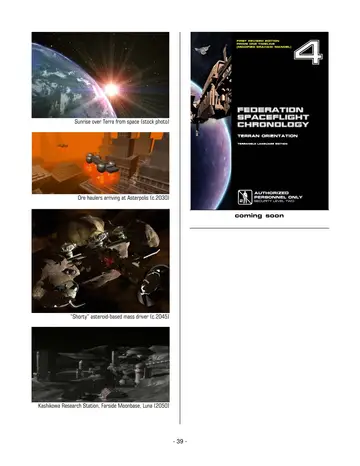
The image of the mass driver in action is borrowed from Babylon 5. It’s actually a picture of a Centaurean cruiser bombarding the Narn homeworld in violation of interstellar treaty against such weapons. Likewise the image of the Kzinti sphere ship in flames is a “photoshopped” picture taken from an old Italian scifi mag with a DY-series added to the picture for the sake of reference.
You’re going to be hearing a lot more from Centaurian author “Miklos Sofia” in the next issue. That’s going to deal almost exclusively with the Earth-Kzin Wars, a treatment for which TREK fans have prayed for years. Also be sure to check out the special “sneak peak” I’ve included for Volume 4 at the end of this document.
By the way … remember that 1-ton device that the John Carter survey team found at Sidonia? I haven’t forgotten about it and neither should you. It’s going to have a major impact on a certain event during the Earth-Kzin Wars. Stay tuned.
Until next time,
- Richard E. Mandel
Special Thanks To
Apple Computer, Inc.; HP/Compaq Computer, Inc.; Jason Boguess; Eric Christansen; James Dixon; Ex Astris Scienta; Stan and Fred Goldstein; Greg Jein; Memory Alpha; Memory Beta; Lawrence Miller; Timo Saloniemi; David Schmidt; Aridas Sofia; Starship Schematic Database; Rick Sternbach; Wikipedia.
Kzinti Materials Special Regards
Larry Niven (award winning novelist and Kzinti creator); Baen Books (image of the spacesuited Kzinti); Court Jones (Kzinti concept sketches); Paul Lloyd (Searcher 3D model, Kzinti patrol cruiser model); Aridas Sofia and Franz J. Schnaubelt (UESF logo).
Visual Sources
ArcBuilder; Reimund Bertrams; Celestia Motherlode; Desktop Starships; Fox Entertainment; Andrew J. Hodges; Erik Holman; Greg Jein; MGM/UA Entertainment; The NASA Archives; The National Air and Space Museum; The National Archives; Michael Newlyn; Paramount Pictures; John Sennett; The SpaceArt Archives; Rick Sternbach; TrekBBS.
Contact Info
Want to contribute to the Federation Spaceflight Chronology? You can find me on the FRS Online or Star Fleet Network forums. If you prefer direct contact then you can reach me at rtrodude@yahoo.com