1.3 Timeline of Events
A year-by-year timeline of 20th-century Terran spaceflight from the births of the rocketry pioneers in the 1850s through the Moon's declaration of independence in 2000, interleaved with Star Trek timeline notes.
1857 • Birth of Konstantin Tsiolkovsky.
1882 • Birth of Robert Goddard.
1894 • Birth of Hermann Oberth.
1903 • In his native Russia, academician Konstantin Tsiolkovsky publishes the first of what will be many papers espousing the possibilities of manned flight into space via rocket technology. Among the concepts he envisions are the multi-stage rocket, the orbital space station, the space elevator, spacecraft airlocks, and closed-cycle spacecraft life support systems. All of these are generations ahead of their time. • Orville and Wilbur Wright make the first successful flight of a heavier-than-air powered vehicle, the airplane, on the beaches of Kitty Hawk, North Carolina (United States).
1912 • Birth of Werhner von Braun.
1919 • Robert Goddard publishes A Method of Reaching Extreme Altitudes. It describes Goddard's theories about building working solid and liquid fuel rockets, as well as their applications for manned flight. Both the press and his peers will roundly criticize Goddard at the time. Even so, his work will influence the later efforts of Oberth and von Braun.
1929 • Hermann Oberth is the scientific consultant for the Fritz Lang movie Frau im Mond (The Woman in the Moon). It is the first movie with an off-world setting and helps promote rocket science to the German public. One of Oberth's contributions is to build and launch a working scale rocket as a publicity stunt. • Part of the team that helps Oberth launch this rocket is Werhner von Braun, one of Oberth's students at the Technical University of Berlin.
c.1930 According to Section 31, the Graham/Mandel Star Trek timeline is created when a Depression era bum accidentally kills himself. He does so with a phaser dropped by Dr. Leonard McCoy, a temporally displaced Star Fleet officer suffering from an accidental overdose of cordrazine.
NOTE: This is Prime One, the original Star Trek fandom timeline and the one that serves as the basis for this work.
1934 • Werhner von Braun builds and successfully launches two small-scale rockets as a demonstration for the German Army (Wehrmacht) working under a grant for the Army's ordinance division. He will later be put in charge of Nazi Germany's ballistic missile development program.
1944 • Nazi Germany initiates the V-2 program, Terra's first successful ballistic missile. • V-1 and V-2 rockets are used against England in Terra's first ballistic missile program. The technology required for this effort will pave the way for the various Terran manned rocket programs of the later 20th century.
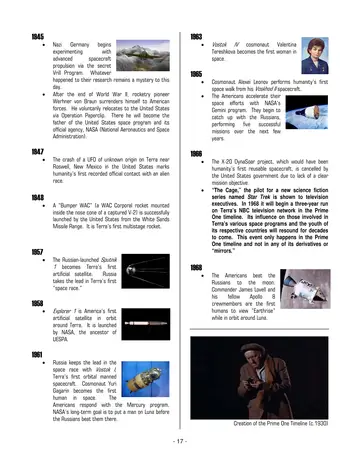
1945 • Nazi Germany begins experimenting with advanced spacecraft propulsion via the secret Vrill Program. Whatever happened to their research remains a mystery to this day. • After the end of World War II, rocketry pioneer Werhner von Braun surrenders himself to American forces. He voluntarily relocates to the United States via Operation Paperclip. There he will become the father of the United States space program and its official agency, NASA (National Aeronautics and Space Administration).
1947 • The crash of a UFO of unknown origin on Terra near Roswell, New Mexico in the United States marks humanity's first recorded official contact with an alien race.
1948 • A “Bumper WAC” (a WAC Corporal rocket mounted inside the nose cone of a captured V-2) is successfully launched by the United States from the White Sands Missile Range. It is Terra's first multistage rocket.
1957 • The Russian-launched Sputnik 1 becomes Terra's first artificial satellite. Russia takes the lead in Terra's first “space race.”
1958 • Explorer 1 is America's first artificial satellite in orbit around Terra. It is launched by NASA, the ancestor of UESPA.
1961 • Russia keeps the lead in the space race with Vostok I, Terra's first orbital manned spacecraft. Cosmonaut Yuri Gagarin becomes the first human in space. The Americans respond with the Mercury program. NASA's long-term goal is to put a man on Luna before the Russians beat them there.
1963 • Vostok IV cosmonaut Valentina Tereshkova becomes the first woman in space.
1965 • Cosmonaut Alexei Leonov performs humanity's first space walk from his Voskhod II spacecraft. • The Americans accelerate their space efforts with NASA's Gemini program. They begin to catch up with the Russians, performing five successful missions over the next few years.
1966 • The X-20 DynaSoar project, which would have been humanity's first reusable spacecraft, is cancelled by the United States government due to lack of a clear mission objective. • “The Cage,” the pilot for a new science fiction series named Star Trek is shown to television executives. In 1968 it will begin a three-year run on Terra's NBC television network in the Prime One timeline. Its influence on those involved in Terra's various space programs and the youth of its respective countries will resound for decades to come. This event only happens in the Prime One timeline and not in any of its derivatives or “mirrors.”
1968 • The Americans beat the Russians to the moon. Commander James Lovell and his fellow Apollo 8 crewmembers are the first humans to view “Earthrise” while in orbit around Luna.
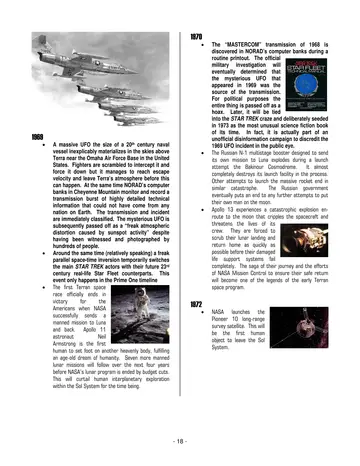
1969 • A massive UFO the size of a 20th century naval vessel inexplicably materializes in the skies above Terra near the Omaha Air Force Base in the United States. Fighters are scrambled to intercept it and force it down but it manages to reach escape velocity and leave Terra's atmosphere before this can happen. At the same time NORAD's computer banks in Cheyenne Mountain monitor and record a transmission burst of highly detailed technical information that could not have come from any nation on Earth. The transmission and incident are immediately classified. The mysterious UFO is subsequently passed off as a “freak atmospheric distortion caused by sunspot activity” despite having been witnessed and photographed by hundreds of people. • Around the same time (relatively speaking) a freak parallel space-time inversion temporarily switches the main STAR TREK actors with their future 23rd century real-life Star Fleet counterparts. This event only happens in the Prime One timeline. • The first Terran space race officially ends in victory for the Americans when NASA successfully sends a manned mission to Luna and back. Apollo 11 astronaut Neil Armstrong is the first human to set foot on another heavenly body, fulfilling an age-old dream of humanity. Seven more manned lunar missions will follow over the next four years before NASA's lunar program is ended by budget cuts. This will curtail human interplanetary exploration within the Sol System for the time being.
1970 • The “MASTERCOM” transmission of 1968 is discovered in NORAD's computer banks during a routine printout. The official military investigation will eventually determine that the mysterious UFO that appeared in 1969 was the source of the transmission. For political purposes the entire thing is passed off as a hoax. Later, it will be tied into the STAR TREK craze and deliberately seeded in 1973 as the most unusual science fiction book of its time. In fact, it is actually part of an unofficial disinformation campaign to discredit the 1969 UFO incident in the public eye. • The Russian N-1 multistage booster designed to send its own mission to Luna explodes during a launch attempt at the Baikonur Cosmodrome. It almost completely destroys its launch facility in the process. Other attempts to launch the massive rocket end in similar catastrophe. The Russian government eventually puts an end to any further attempts to put their own man on the moon. • Apollo 13 experiences a catastrophic explosion enroute to the moon that cripples the spacecraft and threatens the lives of its crew. They are forced to scrub their lunar landing and return home as quickly as possible before their damaged life support systems fail completely. The saga of their journey and the efforts of NASA Mission Control to ensure their safe return will become one of the legends of the early Terran space program.
1972 • NASA launches the Pioneer 10 long-range survey satellite. This will be the first human object to leave the Sol System.
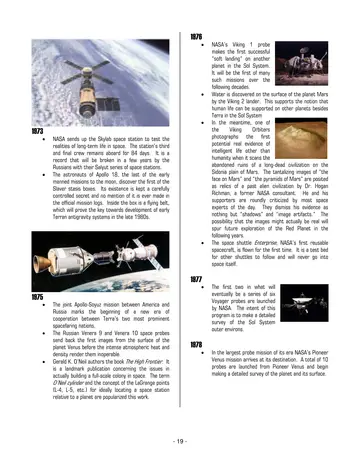
1973 • NASA sends up the Skylab space station to test the realities of long-term life in space. The station's third and final crew remains aboard for 84 days. It is a record that will be broken in a few years by the Russians with their Salyut series of space stations. • The astronauts of Apollo 18, the last of the early manned missions to the moon, discover the first of the Slaver stasis boxes. Its existence is kept a carefully controlled secret and no mention of it is ever made in the official mission logs. Inside the box is a flying belt, which will prove the key towards development of early Terran antigravity systems in the late 1980s.
1975 • The joint Apollo-Soyuz mission between America and Russia marks the beginning of a new era of cooperation between Terra's two most prominent spacefaring nations. • The Russian Venera 9 and Venera 10 space probes send back the first images from the surface of the planet Venus before the intense atmospheric heat and density render them inoperable. • Gerald K. O'Neill authors the book The High Frontier. It is a landmark publication concerning the issues in actually building a full-scale colony in space. The term O'Neill cylinder and the concept of the LaGrange points (L-4, L-5, etc.) for ideally locating a space station relative to a planet are popularized by this work.
1976 • NASA's Viking 1 probe makes the first successful “soft landing” on another planet in the Sol System. It will be the first of many such missions over the following decades. • Water is discovered on the surface of the planet Mars by the Viking 2 lander. This supports the notion that human life can be supported on other planets besides Terra in the Sol System. • In the meantime, one of the Viking Orbiters photographs the first potential real evidence of intelligent life other than humanity when it scans the abandoned ruins of a long-dead civilization on the Cydonia plain of Mars. The tantalizing images of “the face on Mars” and “the pyramids of Mars” are posited as relics of a past alien civilization by Dr. Hogan Richman, a former NASA consultant. He and his supporters are roundly criticized by most space experts of the day. They dismiss his evidence as nothing but “shadows” and “image artifacts.” The possibility that the images might actually be real will spur future exploration of the Red Planet in the following years. • The space shuttle Enterprise, NASA's first reusable spacecraft, is flown for the first time. It is a test bed for other shuttles to follow and will never go into space itself.
1977 • The first two in what will eventually be a series of six Voyager probes are launched by NASA. The intent of this program is to make a detailed survey of the Sol System outer environs.
1978 • In the largest probe mission of its era NASA's Pioneer Venus mission arrives at its destination. A total of 10 probes are launched from Pioneer Venus and begin making a detailed survey of the planet and its surface.
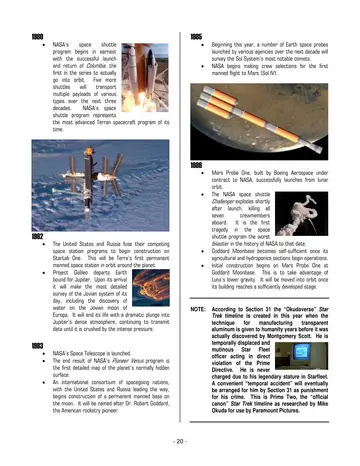
1980 • NASA's space shuttle program begins in earnest with the successful launch and return of Columbia, the first in the series to actually go into orbit. Five more shuttles will transport multiple payloads of various types over the next three decades. NASA's space shuttle program represents the most advanced Terran spacecraft program of its time.
1982 • The United States and Russia fuse their competing space station programs to begin construction on StarLab One. This will be Terra's first permanent manned space station in orbit around the planet. • Project Galileo departs Earth bound for Jupiter. Upon its arrival it will make the most detailed survey of the Jovian system of its day, including the discovery of water on the Jovian moon of Europa. It will end its life with a dramatic plunge into Jupiter's dense atmosphere, continuing to transmit data until it is crushed by the intense pressure.
1983 • NASA's Space Telescope is launched. • The end result of NASA's Pioneer Venus program is the first detailed map of the planet's normally hidden surface. • An international consortium of spacegoing nations, with the United States and Russia leading the way, begins construction of a permanent manned base on the moon. It will be named after Dr. Robert Goddard, the American rocketry pioneer.
1985 • Beginning this year, a number of Earth space probes launched by various agencies over the next decade will survey the Sol System's most notable comets. • NASA begins making crew selections for the first manned flight to Mars (Sol IV).
1986 • Mars Probe One, built by Boeing Aerospace under contract to NASA, successfully launches from lunar orbit. • The NASA space shuttle Challenger explodes shortly after launch, killing all seven crewmembers aboard. It is the first tragedy in the space shuttle program, the worst disaster in the history of NASA to that date. • Goddard Moonbase becomes self-sufficient once its agricultural and hydroponics sections begin operations. • Initial construction begins on Mars Probe One at Goddard Moonbase. This is to take advantage of Luna's lower gravity. It will be moved into orbit once its building reaches a sufficiently developed stage.
NOTE: According to Section 31 the “Okudaverse” Star Trek timeline is created in this year when the technique for manufacturing transparent aluminum is given to humanity years before it was actually discovered by Montgomery Scott. He is a temporally displaced and mutinous Star Fleet officer acting in direct violation of the Prime Directive. He is never charged due to his legendary stature in Starfleet. A convenient “temporal accident” will eventually be arranged for him by Section 31 as punishment for his crime. This is Prime Two, the “official canon” Star Trek timeline as researched by Mike Okuda for use by Paramount Pictures.
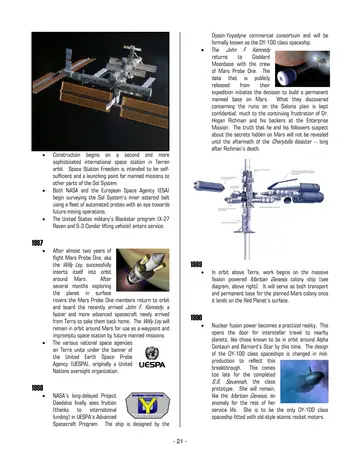
• Construction begins on a second and more sophisticated international space station in Terran orbit. Space Station Freedom is intended to be self-sufficient and a launching point for manned missions to other parts of the Sol System. • Both NASA and the European Space Agency (ESA) begin surveying the Sol System's inner asteroid belt using a fleet of automated probes with an eye towards future mining operations. • The United States military's Blackstar program (X-27 Raven and S-3 Condor lifting vehicle) enters service.
1987 • After almost two years of flight Mars Probe One, aka the Willy Ley, successfully inserts itself into orbit around Mars. After several months exploring the planet in surface rovers the Mars Probe One members return to orbit and board the recently arrived John F. Kennedy, a faster and more advanced spacecraft newly arrived from Terra to take them back home. The Willy Ley will remain in orbit around Mars for use as a waypoint and impromptu space station by future manned missions. • The various national space agencies on Terra unite under the banner of the United Earth Space Probe Agency (UESPA), originally a United Nations oversight organization.
1988 • NASA's long-delayed Project Daedalus finally sees fruition (thanks to international funding) in UESPA's Advanced Spacecraft Program. The ship is designed by the Dyson-Yoyodyne commercial consortium and will be formally known as the DY-100 class spaceship. • The John F. Kennedy returns to Goddard Moonbase with the crew of Mars Probe One. The data that is publicly released from their expedition initiates the decision to build a permanent manned base on Mars. What they discovered concerning the ruins on the Cydonia plain is kept confidential, much to the continuing frustration of Dr. Hogan Richman and his backers at the Enterprise Mission. The truth that he and his followers suspect about the secrets hidden on Mars will not be revealed until the aftermath of the Charybdis disaster – long after Richman's death.
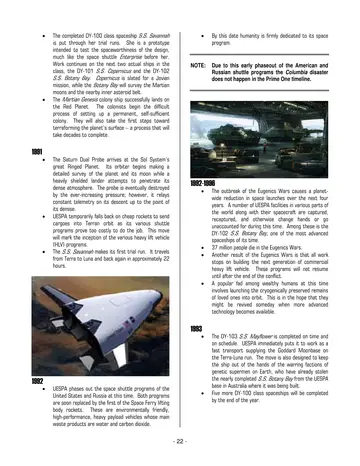
1989 • In orbit above Terra, work begins on the massive fission powered Martian Genesis colony ship (see diagram). It will serve as both transport and permanent base for the planned Mars colony once it lands on the Red Planet's surface.
1990 • Nuclear fusion power becomes a practical reality. This opens the door for interstellar travel to nearby planets, like those known to be in orbit around Alpha Centauri and Barnard's Star by this time. The design of the DY-100 class spaceships is changed in mid-production to reflect this breakthrough. This comes too late for the completed S.S. Savannah, the class prototype. She will remain, like the Martian Genesis, an anomaly for the rest of her service life. She is to be the only DY-100 class spaceship fitted with old-style atomic rocket motors. • The completed DY-100 class spaceship S.S. Savannah is put through her trial runs. She is a prototype intended to test the spaceworthiness of the design, much like the space shuttle Enterprise before her. Work continues on the next two actual ships in the class, the DY-101 S.S. Copernicus and the DY-102 S.S. Botany Bay. Copernicus is slated for a Jovian mission, while the Botany Bay will survey the Martian moons and the nearby inner asteroid belt. • The Martian Genesis colony ship successfully lands on the Red Planet. The colonists begin the difficult process of setting up a permanent, self-sufficient colony. They will also take the first steps toward terraforming the planet's surface – a process that will take decades to complete.
1991 • The Saturn Dual Probe arrives at the Sol System's great Ringed Planet. Its orbiter begins making a detailed survey of the planet and its moon while a heavily shielded lander attempts to penetrate its dense atmosphere. The probe is eventually destroyed by the ever-increasing pressure; however, it relays constant telemetry on its descent up to the point of its demise. • UESPA temporarily falls back on cheap rockets to send cargoes into Terran orbit as its various shuttle programs prove too costly to do the job. This move will mark the inception of the various heavy lift vehicle (HLV) programs. • The S.S. Savannah makes its first trial run. It travels from Terra to Luna and back again in approximately 22 hours.
1992 • UESPA phases out the space shuttle programs of the United States and Russia at this time. Both programs are soon replaced by the first of the Space Ferry lifting body rockets. These are environmentally friendly, high-performance, heavy payload vehicles whose main waste products are water and carbon dioxide. • By this date humanity is firmly dedicated to its space program.
NOTE: Due to this early phaseout of the American and Russian shuttle programs the Columbia disaster does not happen in the Prime One timeline.
1992-1996 • The outbreak of the Eugenics Wars causes a planetwide reduction in space launches over the next four years. A number of UESPA facilities in various parts of the world along with their spacecraft are captured, recaptured, and otherwise change hands or go unaccounted for during this time. Among these is the DY-102 S.S. Botany Bay, one of the most advanced spaceships of its time. • 37 million people die in the Eugenics Wars. • Another result of the Eugenics Wars is that all work stops on building the next generation of commercial heavy lift vehicle. These programs will not resume until after the end of the conflict. • A popular fad among wealthy humans at this time involves launching the cryogenically preserved remains of loved ones into orbit. This is in the hope that they might be revived someday when more advanced technology becomes available.
1993 • The DY-103 S.S. Mayflower is completed on time and on schedule. UESPA immediately puts it to work as a fast transport supplying the Goddard Moonbase on the Terra-Luna run. The move is also designed to keep the ship out of the hands of the warring factions of genetic supermen on Earth, who have already stolen the nearly completed S.S. Botany Bay from the UESPA base in Australia where it was being built. • Five more DY-100 class spaceships will be completed by the end of the year.
1994 • ERMS-2, the first working global climate control satellite, is successfully launched. • The published research of Miguel Alcubierre proves that faster-than-light travel is possible even given the physical laws of our space-time continuum. His paper, “The Warp Drive: Hyper-fast Travel Within General Relativity,” is published by the University of Wales. It causes a sensation among the leading Terran space scientists of the day. Practical applications of Alcubierre's theories are decades in the future, however, given Terra's current technology and the Eugenics War currently raging on the planet. • A stray ballistic missile from one of the warring factions on Earth hits an orbital cryostorage facility. Dozens of modules are destroyed, while others are blown away into interstellar space to drift forever with no hope of retrieval. • The last two DY-100 class spaceships are built. Work is already underway to develop and build their successors, the DY-200 class.
1996 • The S.S. Copernicus is sent on a mission to Mars to resupply the Martian Colonies. In fact all DY-100 class spaceships still in UESPA hands are sent away from Terra at this time to prevent any more from falling into the hands of the “supermen.” The Eugenics Wars are finally winding down and UESPA fears what might happen if one of the factions gains a fleet of advanced spacecraft. • As UN Coalition forces prepare for their final offensive against the armies of Khan Noonien Singh they are surprised by the sight of the captured S.S. Botany Bay blasting off into space. Attempts to intercept it before it can reach space are futile. The Botany Bay rapidly accelerates out of the Sol System with Khan and 94 other genetically engineered “supermen” aboard in suspended animation. No UESPA vessel is within range to intercept it. Its last recorded telemetry shows it headed towards Tau Ceti before it disappears from Terran tracking stations. • Voyager 6, the last of the Voyager series of deep space probes, is launched by the United States.
1997 • Antimatter is generated for the first time under carefully controlled laboratory conditions. Alcubierre's Warp Drive Theory postulates that a controlled matter-antimatter reaction is the best means for powering a warp drive starship. The practical use of antimatter in such an engine is still decades, perhaps centuries in the future.
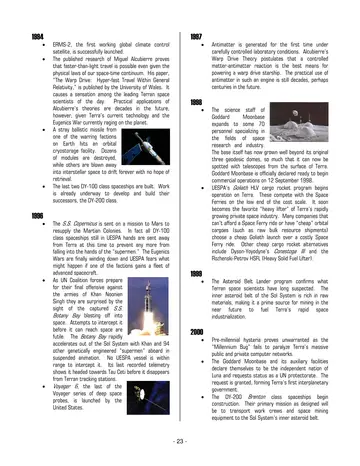
1998 • The science staff of Goddard Moonbase expands to some 70 personnel specializing in the fields of space research and industry. The base itself has now grown well beyond its original three geodesic domes, so much that it can now be spotted with telescopes from the surface of Terra. Goddard Moonbase is officially declared ready to begin commercial operations on 12 September 1998. • UESPA's Goliath HLV cargo rocket program begins operation on Terra. These compete with the Space Ferries on the low end of the cost scale. It soon becomes the favorite “heavy lifter” of Terra's rapidly growing private space industry. Many companies that can't afford a Space Ferry ride or have “cheap” orbital cargoes (such as raw bulk resource shipments) choose a cheap Goliath launch over a costly Space Ferry ride. Other cheap cargo rocket alternatives include Dyson-Yoyodyne's Conestoga III and the Rozhenski-Petrov HSFL (Heavy Solid Fuel Lifter).
1999 • The Asteroid Belt Lander program confirms what Terran space scientists have long suspected. The inner asteroid belt of the Sol System is rich in raw materials, making it a prime source for mining in the near future to fuel Terra's rapid space industrialization.
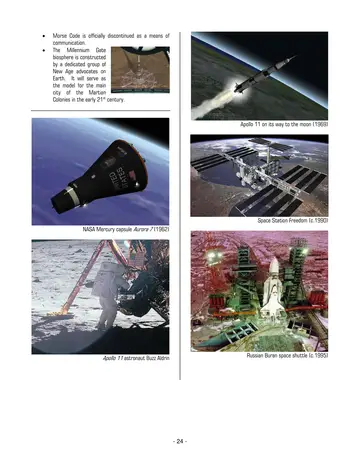
2000 • Pre-millennial hysteria proves unwarranted as the “Millennium Bug” fails to paralyze Terra's massive public and private computer networks. • The Goddard Moonbase and its auxiliary facilities declare themselves to be the independent nation of Luna and request status as a UN protectorate. The request is granted, forming Terra's first interplanetary government. • The DY-200 Brenton class spaceships begin construction. Their primary mission as designed will be to transport work crews and space mining equipment to the Sol System's inner asteroid belt. • Morse Code is officially discontinued as a means of communication. • The Millennium Gate biosphere is constructed by a dedicated group of New Age advocates on Earth. It will serve as the model for the main city of the Martian Colonies in the early 21st century.