5.8 Alien Encounters: Vulcans, Kaferians, Tellarites & Andorians
Detailed physiological and cultural profiles of the four major Local Group species humanity met during this era: the long-lived, telepathic Vulcans; the insectoid hive-minded Kaferians; the porcine, argumentative, brilliantly engineering Tellarites; and the blue-skinned, antennaed warrior Andorians.
Vulcans
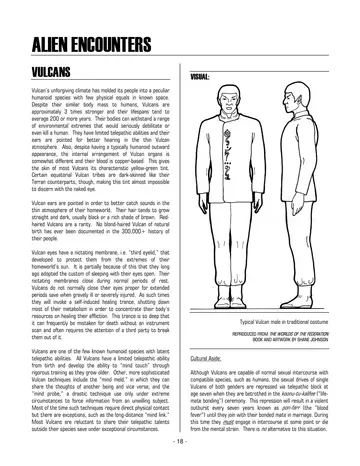
Vulcan’s unforgiving climate has molded its people into a peculiar humanoid species with few physical equals in known space. Despite their similar body mass to humans, Vulcans are approximately 3 times stronger and their lifespans tend to average 200 or more years. Their bodies can withstand a range of environmental extremes that would seriously debilitate or even kill a human. They have limited telepathic abilities and their ears are pointed for better hearing in the thin Vulcan atmosphere. Also, despite having a typically humanoid outward appearance, the internal arrangement of Vulcan organs is somewhat different and their blood is copper-based. This gives the skin of most Vulcans its characteristic yellow-green tint. Certain equatorial Vulcan tribes are dark-skinned like their Terran counterparts, though, making this tint almost impossible to discern with the naked eye.
Vulcan ears are pointed in order to better catch sounds in the thin atmosphere of their homeworld. Their hair tends to grow straight and dark, usually black or a rich shade of brown. Red-haired Vulcans are a rarity. No blond-haired Vulcan of natural birth has ever been documented in the 300,000+ history of their people.
Vulcan eyes have a nictating membrane, i.e. “third eyelid,” that developed to protect them from the extremes of their homeworld’s sun. It is partially because of this that they long ago adopted the custom of sleeping with their eyes open. Their nictating membranes close during normal periods of rest. Vulcans do not normally close their eyes proper for extended periods save when gravely ill or severely injured. At such times they will invoke a self-induced healing trance, shutting down most of their metabolism in order to concentrate their body’s resources on healing their affliction. This trance is so deep that it can frequently be mistaken for death without an instrument scan and often requires the attention of a third party to break them out of it.
Vulcans are one of the few known humanoid species with latent telepathic abilities. All Vulcans have a limited telepathic ability from birth and develop the ability to “mind touch” through rigorous training as they grow older. Other, more sophisticated Vulcan techniques include the “mind meld,” in which they can share the thoughts of another being and vice versa; and the “mind probe,” a drastic technique used only under extreme circumstances to force information from an unwilling subject. Most of the time such techniques require direct physical contact but there are exceptions, such as the long-distance “mind link.” Most Vulcans are reluctant to share their telepathic talents outside their species save under exceptional circumstances.
Cultural Aside: Although Vulcans are capable of normal sexual intercourse with compatible species, such as humans, the sexual drives of single Vulcans of both genders are repressed via telepathic block at age seven when they are betrothed in the koon-ut-kalifee (“lifemate bonding”) ceremony. This repression will result in a violent outburst every seven years known as pon-farr (the “blood fever”) until they join with their bonded mate in marriage. During this time they must engage in intercourse at some point or die from the mental strain. There is no alternative to this situation.
Kaferians
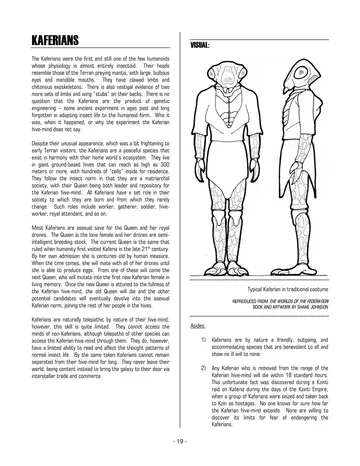
The Kaferians were the first and still one of the few humanoids whose physiology is almost entirely insectoid. Their heads resemble those of the Terran preying mantis, with large, bulbous eyes and mandible mouths. They have clawed limbs and chitinous exoskeletons. There is also vestigial evidence of two more sets of limbs and wing “stubs” on their backs. There is no question that the Kaferians are the product of genetic engineering – some ancient experiment in ages past and long forgotten in adapting insect life to the humanoid form. Who it was, when it happened, or why the experiment occurred the Kaferian hive-mind does not say.
Despite their unusual appearance, which was a bit frightening to early Terran visitors, the Kaferians are a peaceful species that exist in harmony with their home world’s ecosystem. They live in giant ground-based hives that can reach as high as 300 meters or more, with hundreds of “cells” inside for residence. They follow the insect norm in that they are a matriarchal society, with their Queen being both leader and repository for the Kaferian hive-mind. All Kaferians have a set role in their society to which they are born and from which they rarely change. Such roles include worker, gatherer, soldier, hiveworker, royal attendant, and so on.
Most Kaferians are asexual save for the Queen and her royal drones. The Queen is the lone female and her drones are semi-intelligent breeding stock. The current Queen is the same that ruled when humanity first visited Kaferia in the late 21st century. By her own admission she is centuries old by human measure. When the time comes, she will mate with all of her drones until she is able to produce eggs. From one of these will come the next Queen, who will mutate into the first new Kaferian female in living memory. Once the new Queen is attuned to the fullness of the Kaferian hive-mind, the old Queen will die and the other potential candidates will eventually devolve into the asexual Kaferian norm, joining the rest of her people in the hives.
Kaferians are naturally telepathic by nature of their hive-mind; however, this skill is quite limited. They cannot access the minds of non-Kaferians, although telepaths of other species can access the Kaferian hive-mind through them. They do, however, have a limited ability to read and affect the thought patterns of normal insect life. By the same token Kaferians cannot remain separated from their hive-mind for long. They never leave their world, being content instead to bring the galaxy to their door via interstellar trade and commerce.
Asides:
- Kaferians are by nature a friendly, outgoing, and accommodating species that are benevolent to all and show no ill will to none.
- Any Kaferian who is removed from the range of the Kaferian hive-mind will die within 18 standard hours. This unfortunate fact was discovered during a Kzinti raid on Kaferia during the days of the Kzinti Empire, when a group of Kaferians were seized and taken back to Kzin as hostages. No one knows for sure how far the Kaferian hive-mind extends. None are willing to discover its limits for fear of endangering the Kaferians.
Tellarites
Tellarites are the only known porcine humanoid species in the universe. They are almost certainly the result of genetic engineering in their past. Their history starts abruptly some 15,000 years ago with a fully formed civilization. Their own legends speak of their ancestors being the willing servants of an advanced race who were placed on Tellar Prime for their own safety once their mentors faced extinction from another ancient power. The industrious Tellarites quickly learned to fend for themselves in their new home, forgetting everything about their past lives save for what pieces were preserved in their mythlore.
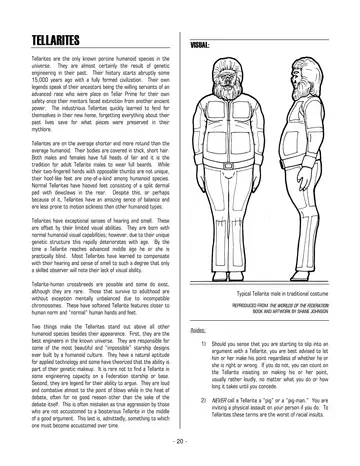
Tellarites are on the average shorter and more rotund than the average humanoid. Their bodies are covered in thick, short hair. Both males and females have full heads of hair and it is the tradition for adult Tellarite males to wear full beards. While their two-fingered hands with opposable thumbs are not unique, their hoof-like feet are one-of-a-kind among humanoid species. Normal Tellarites have hooved feet consisting of a split dermal pad with dewclaws in the rear. Despite this, or perhaps because of it, Tellarites have an amazing sense of balance and are less prone to motion sickness than other humanoid types.
Tellarites have exceptional senses of hearing and smell. These are offset by their limited visual abilities. They are born with normal humanoid visual capabilities; however, due to their unique genetic structure this rapidly deteriorates with age. By the time a Tellarite reaches advanced middle age he or she is practically blind. Most Tellarites have learned to compensate with their hearing and sense of smell to such a degree that only a skilled observer will note their lack of visual ability.
Tellarite-human crossbreeds are possible and some do exist, although they are rare. Those that survive to adulthood are without exception mentally unbalanced due to incompatible chromosomes. These have softened Tellarite features closer to human norm and “normal” human hands and feet.
Two things make the Tellarites stand out above all other humanoid species besides their appearance. First, they are the best engineers in the known universe. They are responsible for some of the most beautiful and “impossible” starship designs ever built by a humanoid culture. They have a natural aptitude for applied technology and some have theorized that the ability is part of their genetic makeup. It is rare not to find a Tellarite in some engineering capacity on a Federation starship or base. Second, they are legend for their ability to argue. They are loud and combative almost to the point of blows while in the heat of debate, often for no good reason other than the sake of the debate itself. This is often mistaken as true aggression by those who are not accustomed to a boisterous Tellarite in the middle of a good argument. This last is, admittedly, something to which one must become accustomed over time.
Asides:
- Should you sense that you are starting to slip into an argument with a Tellarite, you are best advised to let him or her make his point regardless of whether he or she is right or wrong. If you do not, you can count on the Tellarite insisting on making his or her point, usually rather loudly, no matter what you do or how long it takes until you concede.
- NEVER call a Tellarite a “pig” or a “pig-man.” You are inviting a physical assault on your person if you do. To Tellarites these terms are the worst of racial insults.
Andorians
Andorians are unique among humanoid species. Certain aspects of their physiology suggest an insectoid origin or infusion at some point in their evolutionary development. Genetic mutation or alteration in their distant past has been suggested as the most likely cause.
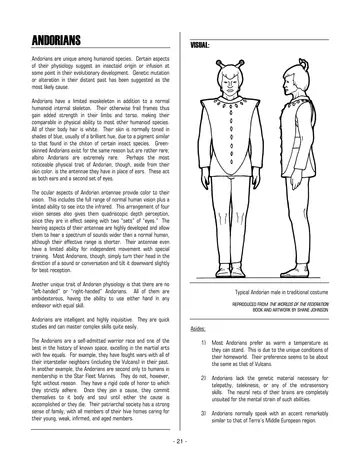
Andorians have a limited exoskeleton in addition to a normal humanoid internal skeleton. Their otherwise frail frames thus gain added strength in their limbs and torso, making them comparable in physical ability to most other humanoid species. All of their body hair is white. Their skin is normally toned in shades of blue, usually of a brilliant hue, due to a pigment similar to that found in the chiton of certain insect species. Green-skinned Andorians exist for the same reason but are rather rare; albino Andorians are extremely rare. Perhaps the most noticeable physical trait of Andorians, though, aside from their skin color, is the antennae they have in place of ears. These act as both ears and a second set of eyes.
The ocular aspects of Andorian antennae provide color to their vision. This includes the full range of normal human vision plus a limited ability to see into the infrared. This arrangement of four vision senses also gives them quadriscopic depth perception, since they are in effect seeing with two “sets” of “eyes.” The hearing aspects of their antennae are highly developed and allow them to hear a spectrum of sounds wider than a normal human, although their effective range is shorter. Their antennae even have a limited ability for independent movement with special training. Most Andorians, though, simply turn their head in the direction of a sound or conversation and tilt it downward slightly for best reception.
Another unique trait of Andorian physiology is that there are no “left-handed” or “right-handed” Andorians. All of them are ambidextrous, having the ability to use either hand in any endeavor with equal skill.
Andorians are intelligent and highly inquisitive. They are quick studies and can master complex skills quite easily.
The Andorians are a self-admitted warrior race and one of the best in the history of known space, excelling in the martial arts with few equals. For example, they have fought wars with all of their interstellar neighbors (including the Vulcans) in their past. In another example, the Andorians are second only to humans in membership in the Star Fleet Marines. They do not, however, fight without reason. They have a rigid code of honor to which they strictly adhere. Once they join a cause, they commit themselves to it body and soul until either the cause is accomplished or they die. Their patriarchal society has a strong sense of family, with all members of their hive homes caring for their young, weak, infirmed, and aged members.
Asides:
- Most Andorians prefer as warm a temperature as they can stand. This is due to the unique conditions of their homeworld. Their preference seems to be about the same as that of Vulcans.
- Andorians lack the genetic material necessary for telepathy, telekinesis, or any of the extrasensory skills. The neural nets of their brains are completely unsuited for the mental strain of such abilities.
- Andorians normally speak with an accent remarkably similar to that of Terra’s Middle European region.