2.10 Acknowledgements: Volume 2
The author's commentary on the sources, in-jokes and timeline reasoning behind Volume 2, followed by credits, image and artwork sources, and contact information.
Author’s Comments
The story of the Yueliang 1 was inspired in part by Arthur C. Clarke’s similar tale of a doomed Chinese expedition to Jupiter in the original novelization of 2010: Odyssey Two. In that tale the Chinese were also in the race to get to Discovery first and were actually ahead of the Leonov. They stopped on Europa to refuel their engines and were destroyed by the lifeforms there. This incident was the real reason behind the Leonov sending a survey probe to Europa per the novel.
The United News Service comes into being as the major news service sometime around the turn of the millennia (2002-2003). It was a joint effort launched by Terra’s major news organizations (AP, UPI, Reuters, BBC, CNN, FNS, etc.) at providing news from Luna and Venus, and eventually all of Terra’s space colonization efforts. With World War III and the Post Atomic Horror that followed it became the major news network for the Sol System. Think of it as CNN or FNS (Fox News Service) in space.
Anyone who wants to know about the L-4 and L-5 series of space platforms should read The High Frontier by Gerald K. O’Neill, first published in the early 1970s. He rightly deserves all the credit for laying the groundwork for such an ambitious space colonization program. I read it when I was a child and I never forgot it. Many of the L-5 images reproduced here come directly from that work. They should also look familiar to Gundam fans, since the creators of that classic anime series were fans of O’Neill as well.
The Lindbergh class Space Ferries were all named for Terran aviation pioneers (Lindbergh, Rutan, Wright, Langley, Mitchell, etc.). The Rutan is the only one still in existence by the time of TOS/TAS. Like the space shuttle OV-099 Pathfinder it was a stress test body that was never meant to go into orbit. It is preserved in a static display at the Federation Air and Space Museum on Terra. It’s hard to tell from Sternbach’s drawing but they resembled a DC-X (Delta Clipper II) lifting body with large, fin-like stabilizer struts that also doubled as the landing gear. We know this from the tech specs; it has the same beam and draught measurements, indicating a DC-X type body.
I deliberately implied that the British Rocket Group launched the last HLV as an homage of sorts to the largely unsung British efforts at furthering space explorations. The name itself is taken directly from the Quartermass serials of the 1950s and is also a bit of a wink at the Doctor Who franchise. At one point I considered including the data on the Guenivere One space probe but thought that might be a bit too obvious. The entry for the Bussard ramjet colonization ship program of the 2010s is meant to resolve the mention of such efforts in a number of later TREK canon and non-canon references. Four of the five known ships are the Forty Families, Marilee, Tamahome, and Alamo. No two designs were exactly alike. I used NASA’s study for the Marilee because that seemed to best fit the diagrams as I recall them from reading the TREK TOS novel Perry’s Planet in my youth.
The “SAL” computer in the first DY-300 prototype program is another reference to 2010: Odyssey Two by Arthur C. Clarke.
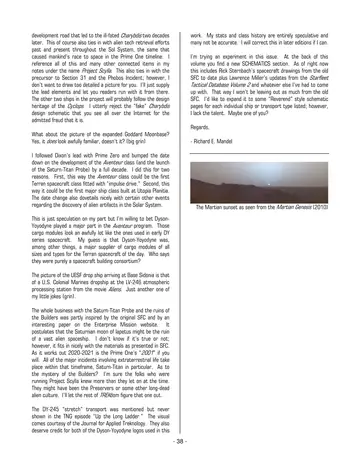
Does the “late Lunar scientist Thomas Morrison” look familiar? He should. That’s a still of actor Adam West from the highly acclaimed feature film Robinson Crusoe on Mars. I mean, why not? He died in the movie, too (grin). Be sure to look for the other more obvious RCoM reference I’ve slipped into this issue.
I can already hear some of you getting ready to flame me over the data in this volume for my data concerning the launch of the Aries IV mission to Mars. “That’s not what they said in Voyager,” you’ll say. Remember, that show takes place in the Prime Two (Okuda) timeline, not this one. In the Prime Two timeline ISA (2018) was in existence before UESPA (2067); also, Aries IV was scouting locations for the first colony on Mars. Both UESPA and the Martian Colonies were already fixed features by that point in time in this – the Prime One timeline. As a result I had to come up with an alternate reason for the mission that didn’t depart too much from what was shown on screen. Thus ISA comes into being as a satellite agency of UESPA and Aries IV is actually on a ten-year survey mission scouting additional potential colony sites. It will take the Martian Colonies two weeks to find the stranded Aries IV survey team because Mars is a big planet when you have only four bases to work from and the people you’re looking for are practically on the other side of that world. UESPA no doubt through everything they had on Mars into the effort and they probably had to use the Willy Ley for orbital sweeps to aid in the search. The supposition that the Aries IV was on an extended survey mission, resupplying from the Martian Colonies as needed, would also help explain how the ground survey team managed to survive for two weeks before they were rescued. They had a fully stocked ground base that was never shown on screen.
The tale of the Cyclops came about as the result of a lone entry in Dixon’s timeline (Prime Zero) concerning an early attempt at Alpha Centauri. One might be tempted to dismiss it out-of-hand as spurious. Instead, I see it as the beginning of the development road that led to the ill-fated Charybdis two decades later. This of course also ties in with alien tech retrieval efforts past and present throughout the Sol System, the same that caused mankind’s race to space in the Prime One timeline. I reference all of this and many other connected items in my notes under the name Project Scylla. This also ties in with the precursor to Section 31 and the Phobos Incident; however, I don’t want to draw too detailed a picture for you. I’ll just supply the lead elements and let you readers run with it from there. The other two ships in the project will probably follow the design heritage of the Cyclops. I utterly reject the “fake” Charybdis design schematic that you see all over the Internet for the admitted fraud that it is.
What about the picture of the expanded Goddard Moonbase? Yes, it does look awfully familiar, doesn’t it? (big grin)
I followed Dixon’s lead with Prime Zero and bumped the date down on the development of the Aventeur class (and the launch of the Saturn-Titan Probe) by a full decade. I did this for two reasons. First, this way the Aventeur class could be the first Terran spacecraft class fitted with “impulse drive.” Second, this way it could be the first major ship class built at Utopia Planitia. The date change also dovetails nicely with certain other events regarding the discovery of alien artifacts in the Solar System.
This is just speculation on my part but I’m willing to bet Dyson-Yoyodyne played a major part in the Aventeur program. Those cargo modules look an awfully lot like the ones used in early DY series spacecraft. My guess is that Dyson-Yoyodyne was, among other things, a major supplier of cargo modules of all sizes and types for the Terran spacecraft of the day. Who says they were purely a spacecraft building consortium?
The picture of the UESF drop ship arriving at Base Sidonia is that of a U.S. Colonial Marines dropship at the LV-246 atmospheric processing station from the movie Aliens. Just another one of my little jokes (grin).
The whole business with the Saturn-Titan Probe and the ruins of the Builders was partly inspired by the original SFC and by an interesting paper on the Enterprise Mission website. It postulates that the Saturnian moon of Iapetus might be the ruin of a vast alien spaceship. I don’t know if it’s true or not; however, it fits in nicely with the materials as presented in SFC. As it works out 2020-2021 is the Prime One’s “2001” if you will. All of the major incidents involving extraterrestrial life take place within that timeframe, Saturn-Titan in particular. As to the mystery of the Builders? I’m sure the folks who were running Project Scylla knew more than they let on at the time. They might have been the Preservers or some other long-dead alien culture. I’ll let the rest of TREKdom figure that one out.
The DY-245 “stretch” transport was mentioned but never shown in the TNG episode “Up the Long Ladder.” The visual comes courtesy of the Journal for Applied Treknology. They also deserve credit for both of the Dyson-Yoyodyne logos used in this work. My stats and class history are entirely speculative and many not be accurate. I will correct this in later editions if I can.
I’m trying an experiment in this issue. At the back of this volume you find a new SCHEMATICS section. As of right now this includes Rick Sternbach’s spacecraft drawings from the old SFC to date plus Lawrence Miller’s updates from the Starfleet Tactical Database Volume 2 and whatever else I’ve had to come up with. That way I won’t be leaving out as much from the old SFC. I’d like to expand it to some “Reverend” style schematic pages for each individual ship or transport type listed; however, I lack the talent. Maybe one of you?
Regards,
– Richard E. Mandel
Special Thanks To:
- Apple Computer, Inc.
- HP/Compaq Computer, Inc.
- Eric Kristiansen
- James Dixon
- Encyclopedia Astronautica
- Ex Astris Scienta
- Stan and Fred Goldstein
- Walter Irwin and G.B. Love
- Timo Saloniemi
- Aridas Sofia
- Rick Sternbach
- The United States Air Force
- The United States Army
- Wikipedia
Image Sources:
- Defense Tech: Space Archives
- Fox Entertainment
- The Enterprise Mission
- ITC Entertainment
- The Marshall Space Flight Center
- The National Aeronautics and Space Administration
- The National Archives
- Paramount Pictures
- Universal Pictures
Conceptual Artwork and Schematic Sources:
- Jeff Bateman
- Joe Bergeron
- Journal for Applied Treknology
- Chris Butler
- Michael Carrell
- Defense Tech: Space Archives
- Don Davis
- Encyclopedia Astronautica
- Lawrence Miller
- The Enterprise Mission
- M. J. Graham
- Tom Newsom
- Rick Sternbach
- The United States Air Force Art Collection
Contact Info:
Want to contribute to the Federation Spaceflight Chronology? You can find me on the FRS Online or Star Fleet Network forums. If you prefer direct contact then you can reach me at rtrodude@yahoo.com