Fed Chronology · Chapter 2 · Volume 2 — 2001–2025: Breaking the Bonds of Sol
2.1 Major Events
A year-by-year timeline of events from 2001 to 2025, covering the founding of the New United Nations and UESF, the Martian Colonies, the discoveries of antimatter and subspace, the Saturn-Titan and Phobos incidents, and the slide toward World War III.
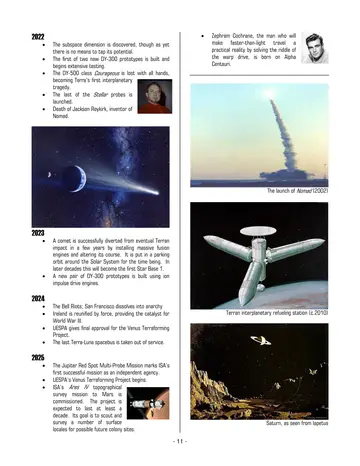
The launch of Nomad (2002)
Terran interplanetary refueling station (c.2010)
Saturn, as seen from Iapetus
2001
- The New United Nations is established as Terra’s first one-world government.
- The Mercury Rover successfully surveys a portion of the hottest planet in the Sol System.
- Terran astronomers detect planets orbiting Alpha Centauri. At least one is believed to be habitable.
- ESA launches its own space station with UESPA approval in order to better service the unique needs of the Common Market.
2002
- The Nomad space probe is launched.
- The wreck of the Yueliang 1 is discovered on the dark side of the moon. It is found by a survey crew scouting locations for the planned Farside Moonbase.
2003
- The first L-5 space colony begins construction.
- The Advanced Comet Probe is launched.
- The United Space Initiative is issued by the New United Nations.
- The United Earth Solar Fleet becomes the formal title of UESPA’s space fleet. It is organized along semi-military lines. It is the direct ancestor of Star Fleet.
- UESF’s dismal post-war spacecraft inventory, due to losses incurred by the Eugenics Wars, results in a new crash building program.
2004
- The first DY-200 Breton class ship enters service.
- Goddard Moonbase begins another major period of expansion.
- Farside Moonbase is completed and begins operations.
- The first Terran mass driver begins operations at the Clavius Mines on Luna. This early mass driver is built into the lunar surface. Later versions are more portable and will be common in asteroid mining within three decades.
2005
- Jules Ashworth is the first Terran born off-world. He is born to a scientist working at Luna’s Farside Moonbase.
- UESPA initiates its Mars Base colonization program, much to the relief of the early Martian Genesis colonists.
2006
- Thomas Morrison is the first Terran civilian to die off-world. He is buried in a simple grave on Luna.
2007
- Tsiolkovskygrad, the first L-5 “space city,” is completed and the first 250 residents move in. It is informally nicknamed “New Russia” since the majority of its population consists of Russians and Slavs.
2008
- The tenth and last of the DY-200 Breton class spaceships enters service.
- The Fusion Torch, first proposed in the early 1970s, becomes a working reality. It can cut through practically anything, its beam reducing materials to their base atoms. It helps fuel the space industry boom of this era. It also finds immediate applications within the military industrial complex, where it will bring about the development of the Terran particle beam cannon.
- The first Terra-Luna “spacebus” enters service.
- UESPA launches a new series of comet probes.
2009
- New Constantinople, the second L-5 “space city,” is completed and opens its doors. It will become a haven for disaffected Middle Eastern cultures. Five more will be completed every two years, to varying designs, for a grand total of seven parked at the L-4 and L-5 LaGrange points in orbit around Terra.
- Mars Base One is completed on time and on schedule. It is the first of the official Martian Colonies. Many of the former Martian Genesis colonists gladly take up residence, leaving their old colony mostly deserted.
2010
- Five early multigenerational colony ships are launched from earth by private concerns around this time. Among these are the Forty Families, the Marilee, and the Alamo. These projects are not sanctioned by UESPA, although they are given launch and intersystem clearance. This effort will help inspire the later Space Ark program.
- The first New United Nations space census is conducted.
2011
- “Martian fever” ravages the Martian Colonies. It is a previously unknown viral strain awakened from hibernation by the terraforming effort on Mars.
- The DY-200 Breton class receive their first major in-service overhaul and life upgrade.
2012
- Both Goddard and Farside Moonbase set up their own Project SETI divisions by the end of the year.
- Another Project SETI complex is set up on Mars inside the largely abandoned Martian Genesis. The only neighbors of the science team are a few “old timers” and a commune of local “space hippies” who have rejected the new, more urban colony lifestyle in favor for the relative isolation of the old colony site.
- Terra’s Orbital Power Satellite Network begins full scale operations.
2013
- The prototype for the new DY-300 class fails its acceptance tests and is promptly abandoned. The planned decommissioning of the DY-100s is put on hold as a result.
- The last of the HLV-type rockets is launched this year. Rocket technology as a whole is largely abandoned as outdated and obsolete, though the basic theory will live on in school science projects and spacecraft steering thruster systems.
2014
- The Space Homestead Act opens the Sol System’s inner asteroid belt for colonization by anyone with the means to get there. This marks the beginning of the first great Space Land Rush.
- An expedition to Jupiter by the DY-100 class spaceship Savannah marks the farthest that a manned expedition has yet traveled in the Sol System.
- The Asteroid Rover unmanned surveying probe enters service.
2015
- Mars Base Two is completed.
- The Stellar series of interstellar probes enters service.
- The last of the Lindbergh class Space Ferry IIs are withdrawn from service.
2016
- The DY-100 class King Charles and the newly returned Savannah are decommissioned. They will serve as testbeds for the new DY-500 program.
2017
- Discovery of natural antimatter by the UESPA space probe U Thant.
- Mars Base Three, the third and final part of UESPA’s Martian Colonies project, is completed. With this the Martian Colonies are now in theory self-sufficient, although they still gladly welcome visiting supply ships from Terra and other space colonies. The Martian Colonies will become a major hub of trade and commerce among Terra’s rapidly growing interplanetary space colonies.
- Dyson-Yoyodyne and several other Terran astronautical engineering firms are granted permission by UESPA to set up factories and shipyards at the Lunar and Martian Colonies. Most large spacecraft construction projects will move to these new facilities over the next two decades once they are completed.
2018
- UESPA tries and fails to launch a manned expedition to Alpha Centauri this year. There will not be another one until a new generation of long-range manned explorer craft is developed.
- The last DY-100 ship in service, the Werhner von Braun, is decommissioned.
- Development of the “impulse engine,” so named for its fusion-powered, internally metered ion impulse drive. Its main advantage is that it can use practically anything (“even rocks”) for fuel. Once perfected, it will become the drive system of choice for future Terran vessels. Even after the invention of warp drive it will remain the most practical means of sublight propulsion for centuries to come.
- The “spinner drive” is successfully tested for the first time on the converted DY-200 Exeter. It marks the first Terran spaceship engine design to employ a controlled singularity. The loss of the Charybdis in 2038 will be blamed on the failure of such an engine and the program subsequently abandoned.
- “Sleeper ship” technology becomes a thing of the past thanks to the dual developments of impulse and spinner drive.
- The Aventeur class spaceships enter service. It is the first manned Terran spacecraft fitted with ion impulse drive.
- UESPA organizes the International Space Agency (ISA) as a means for the various Terran national space agencies to coordinate their own space science missions. This allows it to concentrate more on its off-world efforts, such as its new project on Mars.
- The first Terran homesteaders depart for the asteroid belt.
2019
- The DY-500 Wheeler class enters service.
- On the 50th anniversary of Apollo 11 the New United Nations declares all seven Apollo landing sites and the crash site of Yueliang 1 as historic monuments.
- UESPA approves the construction of what will eventually become the Utopia Planitia Shipyards at Mars. It is built and financed by all of Terra’s leading space industries, as opposed to a sole corporation.
- The Saturn-Titan Probe is launched under the command of USAF Colonel Shaun Geoffery Christopher.
2020
- The Saturn-Titan Probe arrives at Saturn. Its first real discovery is of alien mining activity in its ring system. Its second is that the moon of Iapetus is the hulk of a giant spaceship.
2021
- The first true non-Terran lifeforms are discovered on Mars. They are the fossilized remains of insects uncovered during a fierce planetary sandstorm.
- The submersible Nautilus is crushed by a giant squid while exploring Europa.
- The Phobos Incident. A Martian Colonies mining expedition is lost with all hands on the Martian moon. For the first time in Terran history the security clause of the New United Nations charter (Article III, Section 31) is invoked. UESF forces lock down the Martian moon and refuse to answer any inquiries other than returning the bodies to their next-of-kin.
2022
- The subspace dimension is discovered, though as yet there is no means to tap its potential.
- The first of two new DY-300 prototypes is built and begins extensive testing.
- The DY-500 class Courageous is lost with all hands, becoming Terra’s first interplanetary tragedy.
- The last of the Stellar probes is launched.
- Death of Jackson Roykirk, inventor of Nomad.
2023
- A comet is successfully diverted from eventual Terran impact in a few years by installing massive fusion engines and altering its course. It is put in a parking orbit around the Solar System for the time being. In later decades this will become the first Star Base 1.
- A new pair of DY-300 prototypes is built using ion impulse drive engines.
2024
- The Bell Riots; San Francisco dissolves into anarchy.
- Ireland is reunified by force, providing the catalyst for World War III.
- UESPA gives final approval for the Venus Terraforming Project.
- The last Terra-Luna spacebus is taken out of service.
2025
- The Jupiter Red Spot Multi-Probe Mission marks ISA’s first successful mission as an independent agency.
- UESPA’s Venus Terraforming Project begins.
- ISA’s Ares IV topographical survey mission to Mars is commissioned. The project is expected to last at least a decade. Its goal is to scout and survey a number of surface locales for possible future colony sites.
- Zephram Cochrane, the man who will make faster-than-light travel a practical reality by solving the riddle of the warp drive, is born on Alpha Centauri.