12.15 Constellation Class Star Cruiser (Explorer)
RANGER CLASS LIGHT CRUISER SERVICE ENTRY DATE (OLD CALENDAR): 2290 Not to be confused with the Class II scout of the late 2260s, the Class I
RANGER CLASS LIGHT CRUISER SERVICE ENTRY DATE (OLD CALENDAR): 2290
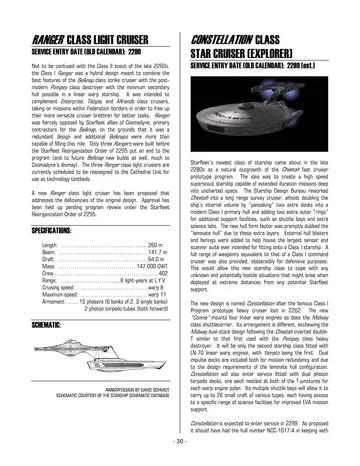
Not to be confused with the Class II scout of the late 2260s, the Class I Ranger was a hybrid design meant to combine the best features of the Belknap class strike cruiser with the postmodern Pompey class destroyer with the minimum secondary hull possible in a linear warp starship. It was intended to complement Enterprise, Tikopai, and Miranda class cruisers, taking on missions within Federation borders in order to free up their more versatile cruiser brethren for better tasks. Ranger was fiercely opposed by Starfleet allies of Cosmadyne, primary contractors for the Belknap, on the grounds that it was a redundant design and additional Belknaps were more than capable of filling this role. Only three Rangers were built before the Starfleet Reorganization Order of 2295 put an end to the program (and to future Belknap new builds as well, much to Cosmadyne’s dismay). The three Ranger class light cruisers are currently scheduled to be reassigned to the Cathedral Unit for use as technology testbeds.
A new Ranger class light cruiser has been proposed that addresses the deficiencies of the original design. Approval has been held up pending program review under the Starfleet Reorganization Order of 2295.
SPECIFICATIONS:
Length: …………………………………….. 260 m Beam: ……………………………………… 141.7 m Draft: …………………….………………… 64.0 m Mass: ………………………………… 147,000 DWT Crew …………………………………………….. 402 Range: ………………………..., 8 light-years at L.Y.V. Cruising speed: ………………….………….. warp 8 Maximum speed: ………………….………… warp 11 Armament: .….. 15 phasers (6 banks of 2, 3 single banks) 2 photon torpedo tubes (both forward)
SCHEMATIC:
RANGER DESIGN BY DAVID SCHMIDT SCHEMATIC COURTESY OF THE STARSHIP SCHEMATIC DATABASE CONSTELLATION CLASS STAR CRUISER (EXPLORER) SERVICE ENTRY DATE (OLD CALENDAR): 2299 (est.)
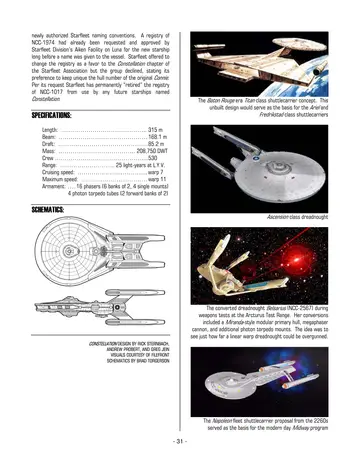
Starfleet’s newest class of starship came about in the late 2280s as a natural outgrowth of the Cheetah fast cruiser prototype program. The idea was to create a high speed superscout starship capable of extended duration missions deep into uncharted space. The Starship Design Bureau reworked Cheetah into a long range survey cruiser, almost doubling the ship’s internal volume by “pancaking” two extra decks into a modern Class I primary hull and adding two extra outer “rings” for additional support facilities, such as shuttle bays and extra science labs. The new hull form factor was promptly dubbed the “laminate hull” due to these extra layers. External hull blisters and fairings were added to help house the largest sensor and scanner suite ever intended for fitting onto a Class I starship. A full range of weaponry equivalent to that of a Class I command cruiser was also provided, obstensibly for defensive purposes. This would allow this new starship class to cope with any unknown and potentially hostile situations that might arise when deployed at extreme distances from any potential Starfleet support.
The new design is named Constellation after the famous Class I Program prototype heavy cruiser lost in 2262. The new “Connie” mounts four linear warp engines as does the Midway class shuttlecarrier. Its arrangement is different, eschewing the Midway dual-stack design following the Cheetah inverted doubleT similar to that first used with the Pompey class heavy destroyer. It will be only the second starship class fitted with LN-70 linear warp engines, with Yamato being the first. Dual impulse decks are included both for mission redundancy and due to the design requirements of the laminate hull configuration. Constellation will also enter service fitted with dual photon torpedo decks, one each nestled at both of the T-junctures for each warp engine pylon. Its multiple shuttle bays will allow it to carry up to 26 small craft of various types, each having access to a specific range of science facilities for improved EVA mission support.
Constellation is expected to enter service in 2299. As proposed it should have had the hull number NCC-1017-A in keeping with - 30 -
newly authorized Starfleet naming conventions. A registry of NCC-1974 had already been requested and approved by Starfleet Division’s Aiken Facility on Luna for the new starship long before a name was given to the vessel. Starfleet offered to change the registry as a favor to the Constellation chapter of the Starfleet Association but the group declined, stating its preference to keep unique the hull number of the original Connie. Per its request Starfleet has permanently “retired” the registry of NCC-1017 from use by any future starships named Constellation.
SPECIFICATIONS:
Length: …………………………………….. 315 m Beam: ……………………………………… 168.1 m Draft: …………………….………………… 85.2 m Mass: ………………………………… 208,750 DWT Crew ………………………………………... 530 Range: ………………………. 25 light-years at L.Y.V. Cruising speed: ………………….………….. warp 7 Maximum speed: ………………….………… warp 11 Armament: …. 16 phasers (6 banks of 2, 4 single mounts) 4 photon torpedo tubes (2 forward banks of 2)
SCHEMATICS:
CONSTELLATION DESIGN BY RICK STERNBACH, ANDREW PROBERT, AND GREG JEIN VISUALS COURTESY OF FILEFRONT SCHEMATICS BY BRAD TORGERSON The Baton Rouge era Titan class shuttlecarrier concept. This unbuilt design would serve as the basis for the Ariel and Fredrikstad class shuttlecarriers
Ascension class dreadnought
The converted dreadnought Belsarius (NCC-2567) during weapons tests at the Arcturus Test Range. Her conversions included a Miranda-style modular primary hull, megaphaser cannon, and additional photon torpedo mounts. The idea was to see just how far a linear warp dreadnought could be overgunned.
The Napoleon fleet shuttlecarrier proposal from the 2260s served as the basis for the modern day Midway program
- 31 -