11.6 Enterprise and Tikopai Class Heavy Cruisers
ENTERPRISE AND TIKOPAI CLASS HEAVY CRUISERS SERVICE ENTRY DATES (OLD CALENDAR): 2267, 2275 On 7 March 2265 the Starfleet heavy cruiser Enter
ENTERPRISE AND TIKOPAI CLASS HEAVY CRUISERS SERVICE ENTRY DATES (OLD CALENDAR): 2267, 2275
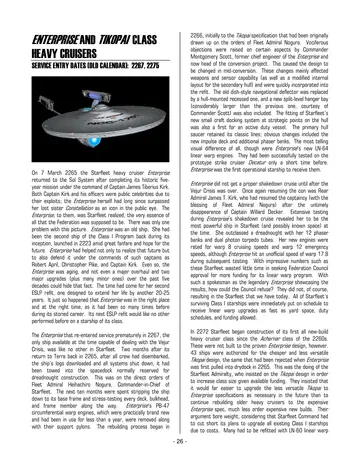
On 7 March 2265 the Starfleet heavy cruiser Enterprise returned to the Sol System after completing its historic fiveyear mission under the command of Captain James Tiberius Kirk. oth Captain Kirk and his officers were public celebrities due to B t heir exploits; the Enterprise herself had long since surpassed her lost sister Constellation as an icon in the public eye. The Enterprise, to them, was Starfleet realized, the very essence of all that the Federation was supposed to be. There was only one problem with this picture. Enterprise was an old ship. She had been the second ship of the Class I Program back during its inception, launched in 2223 amid great fanfare and hope for the but future. Enterprise had helped not only to realize that future also defend it under the commands of such captains as to Robert April, Christopher Pike, and Captain Kirk. Even so, the Enterprise was aging, and not even a major overhaul and two major upgrades (plus many minor ones) over the past five decades could hide that fact. The time had come for her second ESLP refit, one designed to extend her life by another 20-25 years. It just so happened that Enterprise was in the right place a nd at the right time, as it had been so many times before during its storied career. Its next ESLP refit would like no other performed before on a starship of its class.
The Enterprise that re-entered service prematurely in 2267, the hip available at the time capable of dealing with the Vejur only s risis, was like no other in Starfleet. Two months after its C return to Terra back in 2265, after all crew had disembarked, the ship’s logs downloaded and all systems shut down, it had been towed into the spacedock normally reserved for dreadnought construction. This was on the direct orders of Fleet Admiral Heihachiro Nogura, Commander-in-Chief of Starfleet. The next ten months were spent stripping the ship down to its base frame and stress-testing every deck, bulkhead, and frame member along the way. Enterprise’s PB-47 circumferential warp engines, which were practically brand new and had been in use for less than a year, were removed along with their support pylons. The rebuilding process began in 2266, initially to the Tikopai specification that had been originally drawn up on the orders of Fleet Admiral Nogura. Vociferous objections were raised on certain aspects by Commander Montgomery Scott, former chief engineer of the Enterprise and now head of the conversion project. This caused the design to be changed in mid-conversion. These changes mainly affected weapons and sensor capability (as well as a modified internal quickly incorporated into layout for the secondary hull) and were e refit. The old dish-style navigational deflector was replaced th by a hull-mounted recessed one, and a new split-level hanger bay (considerably larger than the previous one, courtesy of Commander Scott) was also included. The fitting of Starfleet’s new small craft docking system at strategic points on the hull was also a first for an active duty vessel. The primary hull saucer retained its classic lines; obvious changes included the new impulse deck and additional phaser banks. The most telling visual difference of all, though were Enterprise’s new LN-64 linear warp engines. They had been successfully tested on the strike cruiser Decatur only a short time before. prototype nterprise was the first operational starship to receive them. E
et a proper shakedown cruise until after the Enterprise did not g Vejur Crisis was over. Once again resuming the con was Rear Adm iral James T. Kirk, who had resumed the captaincy (with the bles y sing of Fleet Admiral Nogura) after the untimel disa ppearance of Captain Willard Decker. Extensive testing durin e g Enterprise’s shakedown cruise revealed her to be th mos t powerful ship in Starfleet (and possibly known space) at the time. She outclassed a dreadnought with her 12 phaser bank s and dual photon torpedo tubes. Her new engines were rate d for warp 8 cruising speeds and warp 12 emergency speed s, although Enterprise hit an unofficial speed of warp 17.8 during subsequent testing. With impres sive numbers such as these Starfleet wasted little time in seeking Federation Council appr ova for more funding for its linear warp program. With l such s a pokesman as the legendary Enterprise showcasing the results, h ow could the Council refuse? They did not, of course, resu g ll of Starfleet’s ltin in the Starfleet that we have today. A rvi g n schedule to vin Class I starships were immediately put o su warp upgrades as fast as yard space, duty receive linear funding allowed. schedules, and
In 2272 Starfleet began construction of its first all new-build heavy cruiser class since the Achernar class of the 2260s. These were not built to the proven Enterprise design, however. 43 ships were authorized for the cheaper and less versatile Tikopai design, the same that had been rejected when Enterprise was first pulled into drydock in 2265. This was the doing of the Tikopai design in orde Starfleet Admiralty, who insisted on the r o increase c t lass size given available funding. They insisted that it would far easier to upgrade the less versatile Tikopai to Enterprise specifi cations as necessary in the future than to ntinue rebuilding older heavy cruisers to the expensive co Enterprise spec, much less order expensive new builds. Their argument bore weight, considering that Starfleet Command had to cut short its plans to upgrade all existing Class I starships due to costs. Many had to be refitted with LN-60 linear warp - 26 -
te chnology (instead of LN-64 as preferred) in order to meet p e the roduction timetables. By th end of the 2270s all of on with version had to be fitted remaining starships awaiting c ompletely self-contained LN-52. the cheaper, less versatile, but c eet Both the Starship Design Bureau and experienced Starfl the eterans argued against the proposal but in the end v y got its way; however, the number of the ships in the Admiralt class was reduced to 33 for fiscal reasons. Tikopai, the class ship, was launched on 11 October 2275. She and her sister ships are scheduled to be uprated to full Enterprise specifications during their first ESLP refits, which are scheduled to take place just after the turn of the century.
Tikopai might have been remembered as little more than a cheaper Enterprise variant save for one thing. As the first newbuild starship class of the linear warp generation,* Tikopai was able to take advantage of the latest advances in starship construction techniques. The original Class I heavy cruisers Constitution, Bonhomme Richard, Achernar) had 75-year ( expected service durations, with a potential service lifetime of 100 years given proper care and maintenance. The Tikopai class were the first Class I starships with planned service durations of 100 years (150 potential, including post-duty fleet reserve storage). It was an almost Klingon approach to starship construction, giving them such long service lives; however, Starfleet was already looking ahead to its own future. It did not want to be caught again with an aging and inadequate fleet as it had been in the decades following the Romulan War. The Tikopai, along with its new-build cousins in other classes, would ensure that Starfleet would be able to both defend the Federation and expand its borders in the decades to come.
(*) Technically this was the U.S.S. Truxtun (NCC-1728), a new-build Endeavour class uprated heavy cruiser. The Endeavour class is widely c onsidered to be the last of the original Class I generation of starships due to its use of the original style primary and secondary hulls.
SPECIFICATIONS:
Length: …………………………………….. 304.8 m Beam: ……………………………………… 141.7 m Draft: …………………….………………… 71.3 m Mass: ………………….……………... 210,000 DWT Crew …………………………………………….. 500 Range: ……………………….……. 22 years at L.Y.V. Cruising speed: ………………….………….. warp 8 Maximum speed: ………………….………… warp 12 Armament: …. 18 phasers (7 banks of 2, 6 single mounts) 2 photon torpedo tubes
Innovations: • First official starship class in Starfleet’s new Class I linear warp program • First fitted with Starfleet’s docking port system • Tikopai was the first class of all new-build Class I starships since the start of the linear warp program VISUALS:
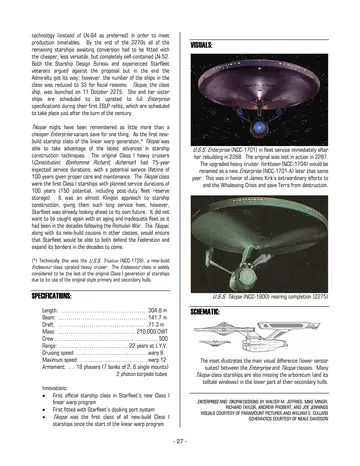
U.S.S. Enterprise (NCC-1701) in fleet service immediately after her rebuilding in 2268. The original was lost in action in 2287. The upgraded heavy cruiser Yorktown (NCC-1704) would be renamed as a new Enterprise (NCC-1701-A) later that same year. This was in honor of James Kirk’s extraordinary efforts to end the Whalesong Crisis and save Terra from destruction.
U.S.S. Tikopai (NCC-1800) nearing completion (2275)
SCHEMATIC:
The inset illustrates the main visual difference (lower sensor suites) between the Enterprise and Tikopai classes. Many Tikopai class starships are also missing the arboretum (and its telltale windows) in the lower part of their secondary hulls.
ENTERPRISE AND TIKOPAI DESIGNS BY WALTER M. JEFFRIES, MIKE MINOR, RICHARD TAYLOR, ANDREW PROBERT, AND JOE JENNINGS VISUALS COURTESY OF PARAMOUNT PICTURES AND WILLIAM S. CULLARS SCHEMATICS COURTESY OF NEALE DAVIDSON
- 27 -